Zhou Yi, Tan Zhi, Huang Hao, Zeng Yonglian, Chen Shilian, Wei Jie, Huang Guozhen, Qian Chaosi, Yuan Guandou, He Songqing
Division of Hepatobiliary Surgery, The First Affiliated Hospital of Guangxi Medical University, Nanning, Guangxi 530021, P.R. China.
Key Laboratory of Early Prevention and Treatment for Regional High Frequency Tumor (Guangxi Medical University), Ministry of Education, Nanning, Guangxi 530021, P.R. China.
Exp Ther Med. 2021 Dec;22(6):1380. doi: 10.3892/etm.2021.10816. Epub 2021 Sep 28.
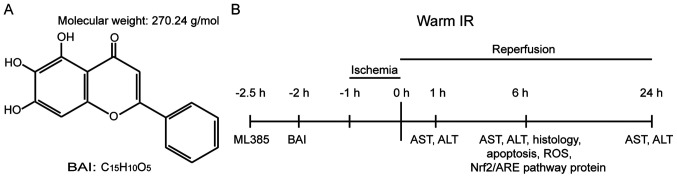
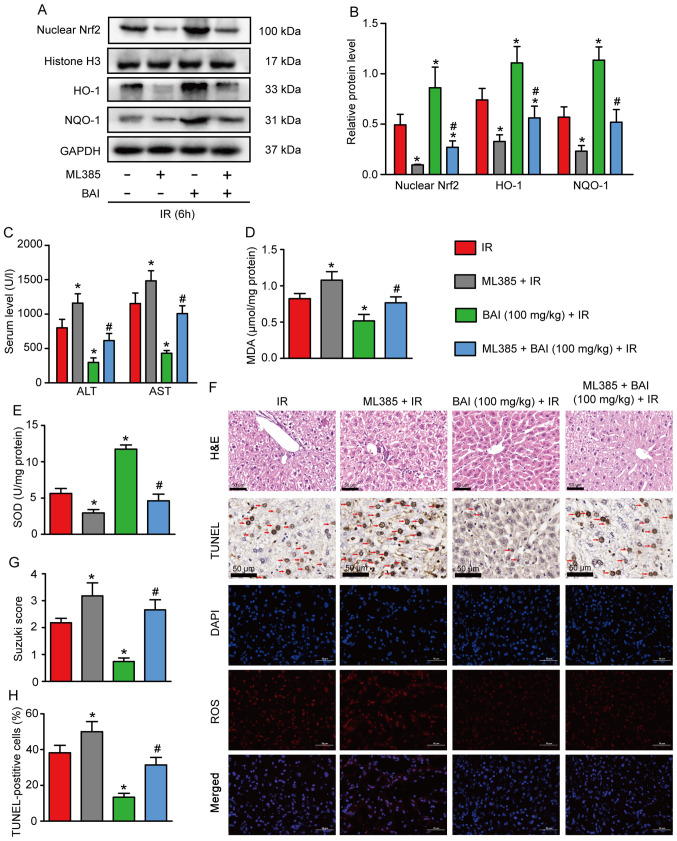
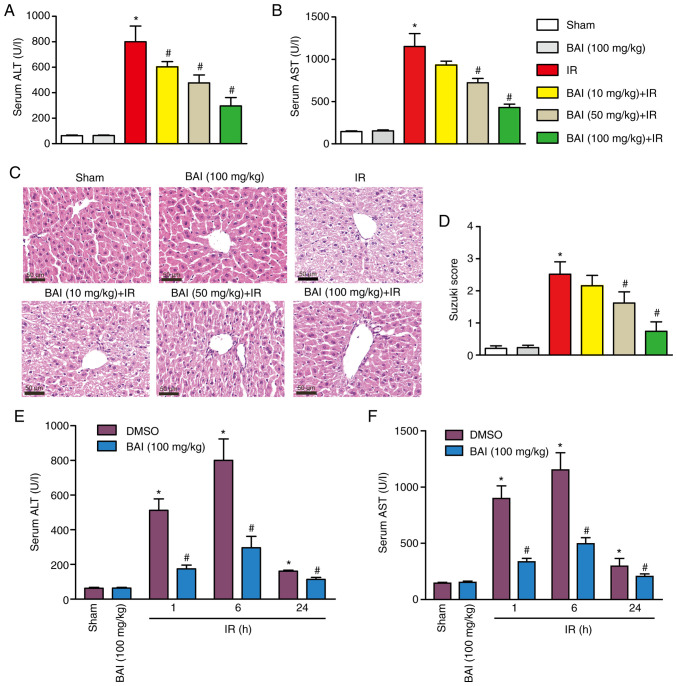
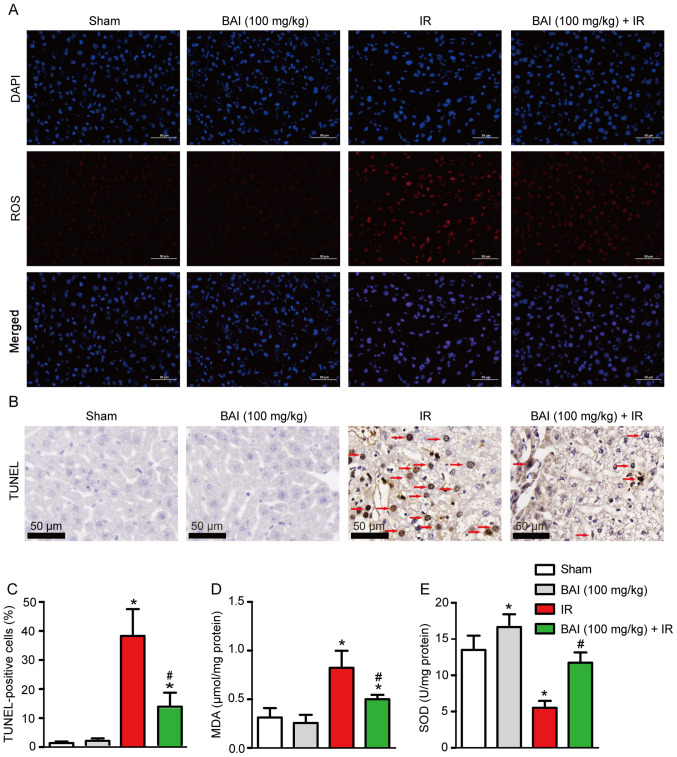
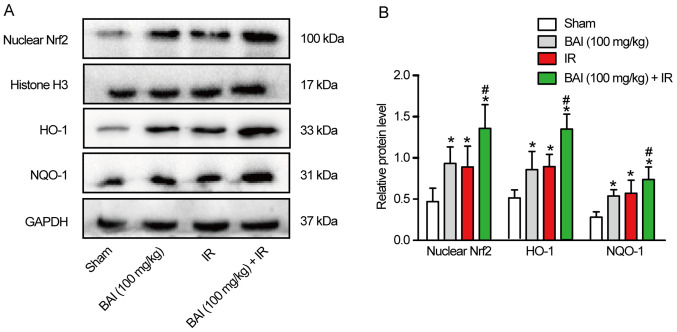
Hepatic ischemia-reperfusion injury (HIRI) is caused by blood flow recovery following ischemia. Baicalein (BAI), a natural antioxidant used in traditional Chinese medicine, eliminates excessive free radicals and protects the structure of the cell membrane. However, its protective mechanism against HIRI is still unclear. The present study investigated underlying mechanism using a mouse HIRI model. Liver injury was evaluated using serum levels of alanine aminotransferase and aspartate aminotransferase, and hematoxylin-eosin staining was performed to evaluate the pathological changes in liver tissue. Apoptosis of hepatocytes was detected by TUNEL staining. The expression levels of reactive oxygen species (ROS), malondialdehyde (MDA) and superoxide dismutase (SOD) in the liver were detected to evaluate oxidative stress. Western blotting was performed to assess expression levels of nuclear factor E2-related factor 2 (Nrf2)/antioxidant response elements (ARE) pathway proteins in liver tissue. BAI pre-treatment significantly decreased elevation of serum aminotransferase levels induced by IR and alleviated histological damage to the liver. BAI decreased production of ROS and MDA in liver tissue induced by IR and increased the activity of SOD. At the same time, BAI inhibited apoptosis of liver cells induced by oxidative stress. Furthermore, BAI promoted the translocation of Nrf2 into the nucleus and increased the expression of total heme oxygenase-1 and NAD(P)H dehydrogenase quinone-1. The Nrf2 inhibitor ML385 reversed the protective effect of BAI on HIRI. These results indicated that BAI served a protective effect in HIRI by regulating the Nrf2/ARE pathway.
肝缺血再灌注损伤(HIRI)是由缺血后血流恢复引起的。黄芩素(BAI)是一种用于传统中药的天然抗氧化剂,可清除过量自由基并保护细胞膜结构。然而,其对HIRI的保护机制仍不清楚。本研究使用小鼠HIRI模型研究潜在机制。通过丙氨酸氨基转移酶和天冬氨酸氨基转移酶的血清水平评估肝损伤,并进行苏木精-伊红染色以评估肝组织的病理变化。通过TUNEL染色检测肝细胞凋亡。检测肝脏中活性氧(ROS)、丙二醛(MDA)和超氧化物歧化酶(SOD)的表达水平以评估氧化应激。进行蛋白质免疫印迹法以评估肝组织中核因子E2相关因子2(Nrf2)/抗氧化反应元件(ARE)通路蛋白的表达水平。BAI预处理显著降低了IR诱导的血清氨基转移酶水平升高,并减轻了肝脏的组织学损伤。BAI减少了IR诱导的肝组织中ROS和MDA的产生,并增加了SOD的活性。同时,BAI抑制了氧化应激诱导的肝细胞凋亡。此外,BAI促进Nrf2向细胞核的转位,并增加了总血红素加氧酶-1和NAD(P)H脱氢酶醌-1的表达。Nrf2抑制剂ML385逆转了BAI对HIRI的保护作用。这些结果表明,BAI通过调节Nrf2/ARE通路对HIRI起到保护作用。