Raj Kavin, Chandna Sanya, Doukas Sotirios G, Watts Abi, Jyotheeswara Pillai Keerthana, Anandam Anil, Singh Dhruv, Nagarakanti Randy, Sankaramangalam Kesavan
Internal Medicine, Saint Peter's University Hospital, New Brunswick, USA.
Endocrinology and Diabetes, Saint Peter's University Hospital, New Brunswick, USA.
Cureus. 2021 Sep 3;13(9):e17687. doi: 10.7759/cureus.17687. eCollection 2021 Sep.
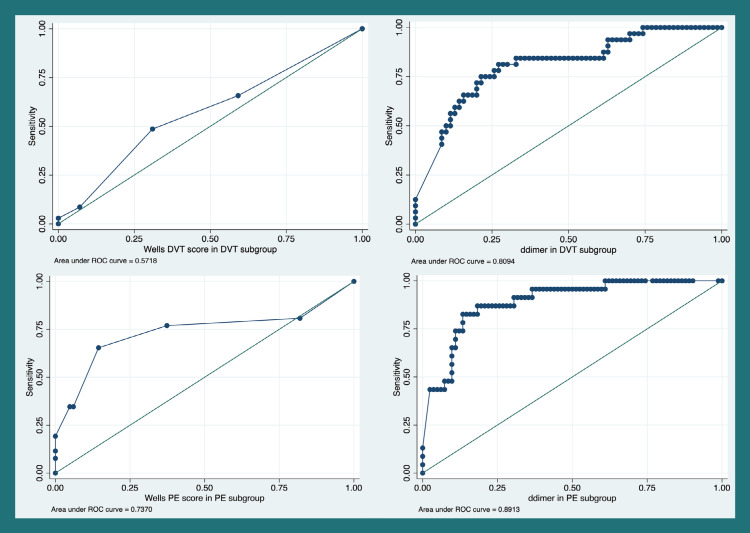
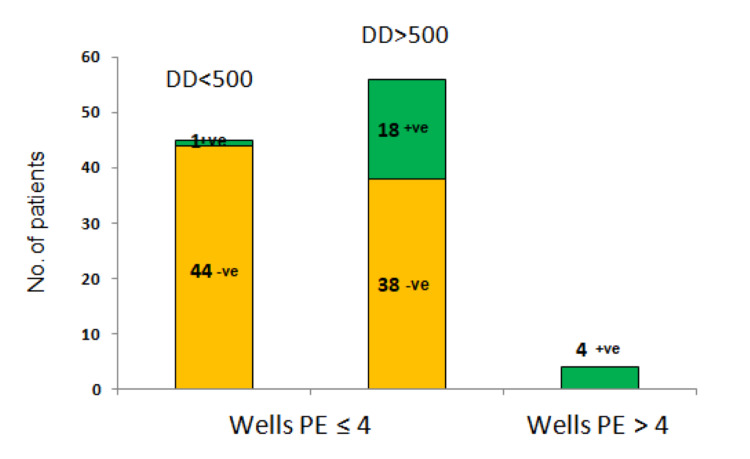
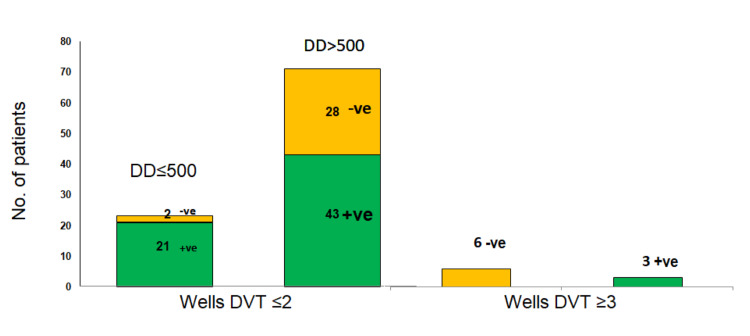
Introduction Deep vein thrombosis (DVT) and pulmonary embolism (PE) are key complications of coronavirus disease 2019 (COVID-19). The study's primary outcome was assessing the utility of Wells DVT, Wells PE scores, and D-dimers in diagnosing DVT and PE. Secondary outcomes were the risk factors for the development of PE and DVT in COVID-19 patients. Materials and methods We compared COVID-19 patients with a positive and negative lower extremity (LE) duplex. A similar approach was made for patients who underwent imaging for PE. Results The prevalence of PE was 23.8% (26 out of 109 patients), and the prevalence of DVT was 33% (35 out of 106). A D-dimer of 500 ng/mL had a sensitivity of 95.6% and 93.7% for the diagnosis of PE and DVT, respectively. A Wells DVT score of 3 points had a specificity of 92.9% and sensitivity of 8.8% for DVT diagnosis in COVID-19. A Wells PE score of 4 had a specificity of 100% and a sensitivity of 20% for the diagnosis of PE. The combined approach of using a Wells DVT score of 3 in suspected DVT and a Wells PE score of 4 in suspected PE and D-dimers of 500 ng/ml has a sensitivity of 94.2% and 96.1%, respectively. In the suspected DVT group, male gender (OR 3.88, 95% CI 1.55-9.7, P=0.004), lower body mass index (BMI) (OR 0.92, 95% CI 0.86-0.99, P=0.037), antiplatelet use (OR 0.19, 95% CI 0.04-0.88, P=0.035), systolic blood pressure 100 mmhg (OR 4.96, 95% CI 1.37-17.86, P=0.014), absolute lymphocytes 1 (OR 2.57, 95% CI 1.07-6.12, P=0.033), D-dimer 500 ng/ml (OR 6.42, 95% CI 1.40-29.38, P=0.016), blood urea nitrogen (BUN) 20 mg/dl (OR 2.33, 95% CI 1.00-5.41, P=0.048), and intubation (OR 3.32, 95% CI 1.26-8.78, P=0.015) were found to be statistically significant for DVT. In the suspected PE group, history of cancer (OR 10.69, 95% CI 1.06-107.74, P=0.044), total WBC count (OR 1.07, 95% CI 0.95-1.21, P=0.032), platelets 400,000 (OR 5.13, 95% CI 1.79-14.68, P=0.002), D-dimer levels 500 ng/ml (OR 25.47, 95% CI 3.27-197.97, P=0.002), Wells PE score (OR 2.46, 95% CI 1.50-4.06, P<0.001), pulmonary embolism rule-out criteria (PERC) score (OR 1.79, 95% CI 1.05-3.05, P=0.054), and Sequential Organ Failure Assessment (SOFA) score (OR 1.91, 95% CI 1.16-3.12, P=0.002) were statistically significant. Conclusions The combined approach of using a Wells DVT score of 3 in suspected DVT and Wells PE score of 4 in suspected PE and D-dimers of 500 ng/ml may be used to diagnose PE and DVT in COVID-19. Venous thromboembolism (VTE) occurrence in COVID-19 is associated with non-traditional risk factors such as intubation and higher severity of systemic inflammation, and these patients may benefit from more aggressive testing for VTE.
引言 深静脉血栓形成(DVT)和肺栓塞(PE)是2019冠状病毒病(COVID-19)的关键并发症。该研究的主要结果是评估Wells DVT、Wells PE评分和D-二聚体在诊断DVT和PE中的效用。次要结果是COVID-19患者发生PE和DVT的危险因素。
材料与方法 我们比较了下肢(LE)双功超声检查结果为阳性和阴性的COVID-19患者。对接受PE影像学检查的患者采用了类似的方法。
结果 PE的患病率为23.8%(109例患者中的26例),DVT的患病率为33%(106例患者中的35例)。D-二聚体500 ng/mL对PE和DVT诊断的敏感性分别为95.6%和93.7%。Wells DVT评分为3分对COVID-19患者DVT诊断的特异性为92.9%,敏感性为8.8%。Wells PE评分为4分对PE诊断的特异性为100%,敏感性为20%。在疑似DVT中使用Wells DVT评分为3分、疑似PE中使用Wells PE评分为4分以及D-二聚体500 ng/ml的联合方法,其敏感性分别为94.2%和96.1%。在疑似DVT组中,男性(OR 3.88,95%CI 1.55 - 9.7,P = 0.004)、较低的体重指数(BMI)(OR 0.92,95%CI 0.86 - 0.99,P = 0.037)、使用抗血小板药物(OR 0.19,95%CI 0.04 - 0.88,P = 0.035)、收缩压<100 mmHg(OR 4.96,95%CI 1.37 - 17.86,P = 0.014)、绝对淋巴细胞计数<1(OR 2.57,95%CI 1.07 - 6.12,P = 0.033)、D-二聚体>500 ng/ml(OR 6.42,95%CI 1.40 - 29.38,P = 0.016)、血尿素氮(BUN)>20 mg/dl(OR 2,33,95%CI 1.00 - 5.41,P = 0.048)和插管(OR 3.32,95%CI 1.26 - 8.78,P = 0.015)被发现对DVT具有统计学意义。在疑似PE组中,癌症病史(OR 10.69,95%CI 1.06 - 107.74,P = 0.044)、白细胞总数(OR 1.07,95%CI 0.95 - 1.21,P = 0.032)、血小板>400,000(OR 5.13,95%CI 1.79 - 14.68, P = 0.002)、D-二聚体水平>500 ng/ml(OR 25.47,95%CI 3.27 - 197.97,P = 0.002)、Wells PE评分(OR 2.46,95%CI 1.50 - 4.06,P<0.001)、肺栓塞排除标准(PERC)评分(OR 1.79,95%CI 1.05 - 3.05,P = 0.054)和序贯器官衰竭评估(SOFA)评分(OR 1.91,95%CI 1.16 - 3.12,P = 0.002)具有统计学意义。
结论 在疑似DVT中使用Wells DVT评分为3分、疑似PE中使用Wells PE评分为4分以及D-二聚体500 ng/ml的联合方法可用于诊断COVID-19患者的PE和DVT。COVID-19患者静脉血栓栓塞(VTE)的发生与插管和全身炎症更严重等非传统危险因素相关,这些患者可能从更积极的VTE检测中获益。