Kleiner Reinhold, Zhou Xianjing, Dorsch Eric, Zhang Xufeng, Koelle Dieter, Jin Dafei
Physikalisches Institut, Center for Quantum Science (CQ) and LISA+, Universität Tübingen, Tübingen, Germany.
Center for Nanoscale Materials, Argonne National Laboratory, Argonne, IL, USA.
Nat Commun. 2021 Oct 15;12(1):6038. doi: 10.1038/s41467-021-26132-y.
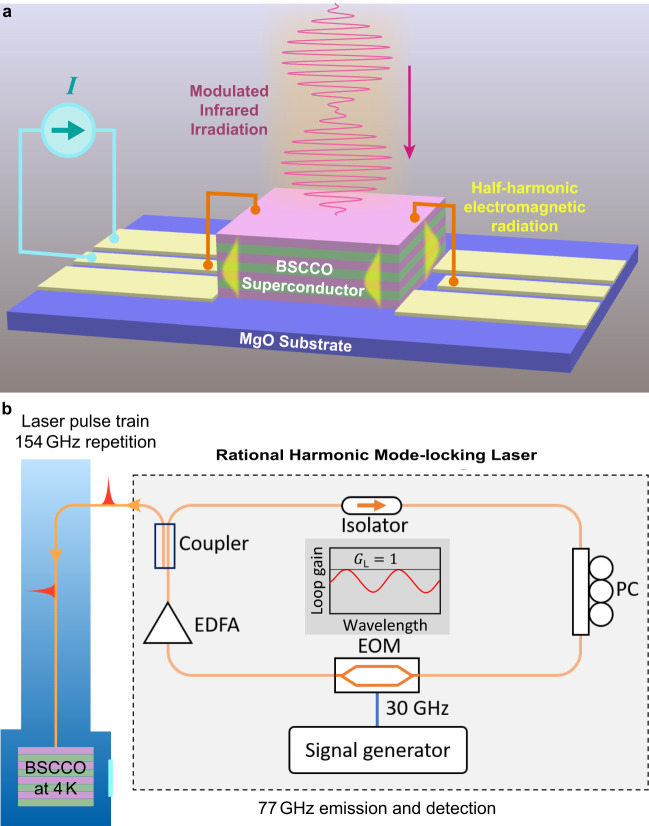
We theoretically demonstrate that the high-critical-temperature (high-T) superconductor BiSrCaCuO (BSCCO) is a natural candidate for the recently envisioned classical space-time crystal. BSCCO intrinsically forms a stack of Josephson junctions. Under a periodic parametric modulation of the Josephson critical current density, the Josephson currents develop coupled space-time crystalline order, breaking the continuous translational symmetry in both space and time. The modulation frequency and amplitude span a (nonequilibrium) phase diagram for a so-defined spatiotemporal order parameter, which displays rigid pattern formation within a particular region of the phase diagram. Based on our calculations using representative material properties, we propose a laser-modulation experiment to realize the predicted space-time crystalline behavior. Our findings bring new insight into the nature of space-time crystals and, more generally, into nonequilibrium driven condensed matter systems.
我们从理论上证明,高临界温度(高温)超导体BiSrCaCuO(BSCCO)是最近设想的经典时空晶体的天然候选者。BSCCO本质上形成了约瑟夫森结的堆叠。在约瑟夫森临界电流密度的周期性参数调制下,约瑟夫森电流发展出耦合的时空晶体序,打破了空间和时间上的连续平移对称性。调制频率和幅度跨越了一个针对如此定义的时空序参量的(非平衡)相图,该相图在相图的特定区域内显示出刚性图案形成。基于我们使用代表性材料特性进行的计算,我们提出了一个激光调制实验来实现预测的时空晶体行为。我们的发现为时空晶体的本质,更一般地说,为非平衡驱动的凝聚态系统带来了新的见解。