Lv Yang, Jiang Yujia, Lu Jiasheng, Gao Hao, Dong Weiliang, Zhou Jie, Zhang Wenming, Xin Fengxue, Jiang Min
State Key Laboratory of Materials-Oriented Chemical Engineering, College of Biotechnology and Pharmaceutical Engineering, Nanjing Tech University, Puzhu South Road 30#, Nanjing, 211800, People's Republic of China.
Jiangsu National Synergetic Innovation Center for Advanced Materials, Nanjing Tech University, Nanjing, 211800, People's Republic of China.
Biotechnol Biofuels. 2021 Oct 16;14(1):203. doi: 10.1186/s13068-021-02053-2.
Butyl acetate has shown wide applications in food, cosmetics, medicine, and biofuel sectors. These short-chain fatty acid esters can be produced by either chemical or biological synthetic process with corresponding alcohols and acids. Currently, biosynthesis of short chain fatty acid esters, such as butyl butyrate, through microbial fermentation systems has been achieved; however, few studies regarding biosynthesis of butyl acetate were reported.
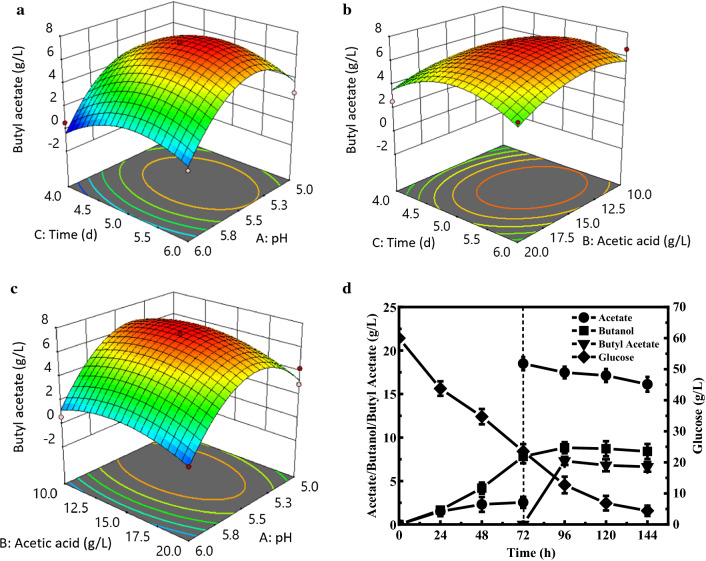
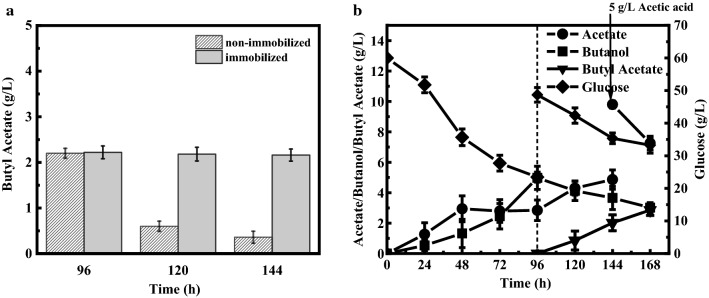
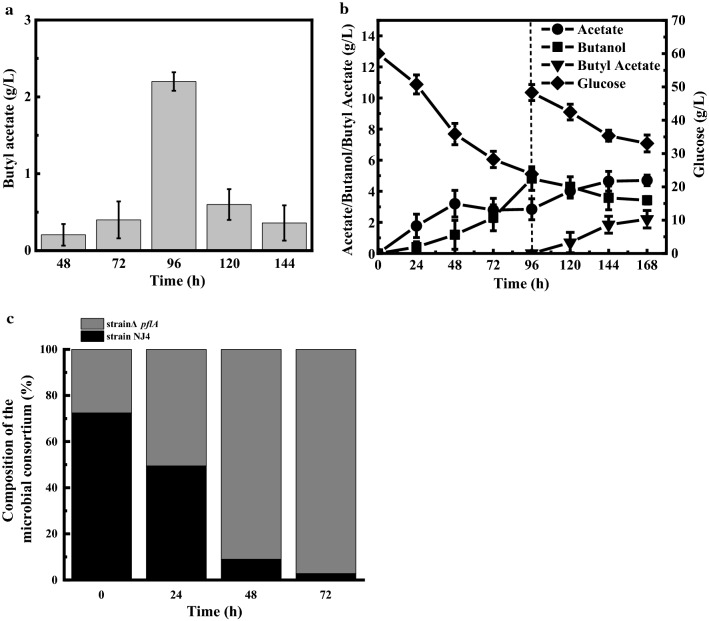
In this study, three proof-of-principle strategies for the one-pot butyl acetate production from glucose through microbial fermentation were designed and evaluated. (1) 7.3 g/L of butyl acetate was synthesized by butanol-producing Clostridium acetobutylicum NJ4 with the supplementation of exogenous acetic acid; (2) With the addition of butanol, 5.76 g/L of butyl acetate can be synthesized by acetate-producing Actinobacillus succinogenes130z (ΔpflA); (3) Microbial co-culture of C. acetobutylicum NJ4 and A. succinogenes130z (ΔpflA) can directly produce 2.2 g/L of butyl acetate from glucose by using microbial co-culture system with the elimination of precursors. Through the further immobilization of A. succinogenes130z (ΔpflA), butyl acetate production was improved to 2.86 g/L.
Different microbial mono- and co-culture systems for butyl acetate biosynthesis were successfully constructed. These strategies may be extended to the biosynthesis of a wide range of esters, especially to some longer chain ones.
乙酸丁酯在食品、化妆品、医药和生物燃料领域有着广泛应用。这些短链脂肪酸酯可通过相应的醇和酸经化学或生物合成工艺制备。目前,通过微生物发酵系统已实现了短链脂肪酸酯如丁酸丁酯的生物合成;然而,关于乙酸丁酯生物合成的研究报道较少。
本研究设计并评估了三种通过微生物发酵从葡萄糖一锅法生产乙酸丁酯的原理验证策略。(1)产丁醇的丙酮丁醇梭菌NJ4在添加外源乙酸的情况下合成了7.3 g/L的乙酸丁酯;(2)添加丁醇后,产乙酸的琥珀酸放线杆菌130z(ΔpflA)可合成5.76 g/L的乙酸丁酯;(3)丙酮丁醇梭菌NJ4和琥珀酸放线杆菌130z(ΔpflA)的微生物共培养通过使用消除前体的微生物共培养系统可直接从葡萄糖生产2.2 g/L的乙酸丁酯。通过进一步固定琥珀酸放线杆菌130z(ΔpflA),乙酸丁酯产量提高到2.86 g/L。
成功构建了用于乙酸丁酯生物合成的不同微生物单培养和共培养系统。这些策略可能扩展到多种酯类的生物合成,特别是一些长链酯类。