Department of Health Sciences, University of York, Seebohm Rowntree Building, Heslington, YO10 5DD, York, UK.
Department of Pharmacy, University of Reading, Reading, UK.
Addict Sci Clin Pract. 2021 Oct 16;16(1):63. doi: 10.1186/s13722-021-00271-5.
Alcohol is challenging to discuss, and patients may be reluctant to disclose drinking partly because of concern about being judged. This report presents an overview of the development of a medications review intervention co-produced with the pharmacy profession and with patients, which breaks new ground by seeking to give appropriate attention to alcohol within these consultations.
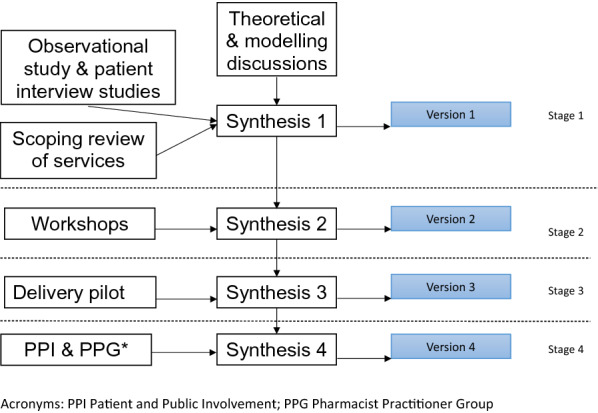
This intervention was developed in a series of stages and refined through conceptual discussion, literature review, observational and interview studies, and consultations with advisory groups. In this study we reflect on this process, paying particular attention to the methods used, where lessons may inform innovations in other complex clinical consultations.
Early work with patients and pharmacists infused the entire process with a heightened sense of the complexity of consultations in everyday practice, prompting careful deliberation on the implications for intervention development. This required the research team to be highly responsive to both co-production inputs and data gathered in formally conducted studies, and to be committed to working through the implications for intervention design. The intervention thus evolved significantly over time, with the greatest transformations resulting from patient and pharmacist co-design workshops in the second stage of the process, where pharmacists elaborated on the nature of the need for training in particular. The original research plans provided a helpful structure, and unanticipated issues for investigation emerged throughout the process. This underscored the need to engage dynamically with changing contexts and contents and to avoid rigid adherence to any early prescribed plan.
Alcohol interventions are complex and require careful developmental research. This can be a messy enterprise, which can nonetheless shed new insights into the challenges involved in optimising interventions, and how to meet them, if embraced with an attitude of openness to learning. We found that exposing our own research plans to scrutiny resulted in changes to the intervention design that gained the confidence of different stakeholders. Our understanding of the methods used, and their consequences, may be bounded by the person-centred nature of this particular intervention.
酒精是一个难以讨论的话题,患者可能不愿意透露自己的饮酒情况,部分原因是担心被评判。本报告概述了一项与药剂师专业共同开发的药物审查干预措施,该措施旨在为这些咨询提供适当关注酒精的机会,这是一个新的突破。
该干预措施分几个阶段开发,并通过概念讨论、文献综述、观察和访谈研究以及咨询顾问小组进行了改进。在这项研究中,我们特别关注所使用的方法,反思这一过程,这些方法在其他复杂的临床咨询中可能会为创新提供借鉴。
与患者和药剂师的早期合作使整个过程更加深入地了解了日常实践中咨询的复杂性,促使研究小组对干预措施发展的影响进行了仔细的考虑。这要求研究小组对共同生产的投入和正式进行的研究中收集的数据高度敏感,并致力于研究干预设计的影响。因此,该干预措施随着时间的推移发生了重大变化,第二阶段的患者和药剂师共同设计研讨会对干预措施的设计产生了最大的影响,药剂师在会上详细阐述了培训需求的性质。最初的研究计划提供了一个有用的结构,整个过程中出现了许多意想不到的需要调查的问题。这强调了需要动态地处理不断变化的背景和内容,避免对任何早期规定的计划进行僵化的坚持。
酒精干预措施很复杂,需要仔细的发展研究。这可能是一个混乱的过程,但它可以为优化干预措施所涉及的挑战以及如何应对这些挑战提供新的见解,如果以开放的心态接受学习的话。我们发现,对我们自己的研究计划进行审查,导致干预设计发生了变化,从而获得了不同利益相关者的信任。我们对所使用的方法及其后果的理解可能受到这一特定干预措施以人为中心性质的限制。