Department of Pulmonary Rehabilitation, Philipps-University of Marburg, Marburg, Hessen, Germany
Institute for Pulmonary Rehabilitation Research, Schoen Klinik Berchtesgadener Land, Schoenau am Koenigssee, Germany.
Thorax. 2023 Apr;78(4):326-334. doi: 10.1136/thoraxjnl-2020-216509. Epub 2021 Oct 16.
In patients with COPD, oxygen (O)-supplementation via a constant flow oxygen system (CFOS) can result in insufficient oxygen saturation (SpO <90%) during exercise. An automatically titrating O-system (ATOS) has been shown to be beneficial compared with an untitrated CFOS, however, it is unknown if ATOS is superior to CFOS, titrated during exercise as stipulated by guidelines. The aim was to investigate the effects of ATOS compared with titrated CFOS on walking capacity in people with hypoxaemic COPD.
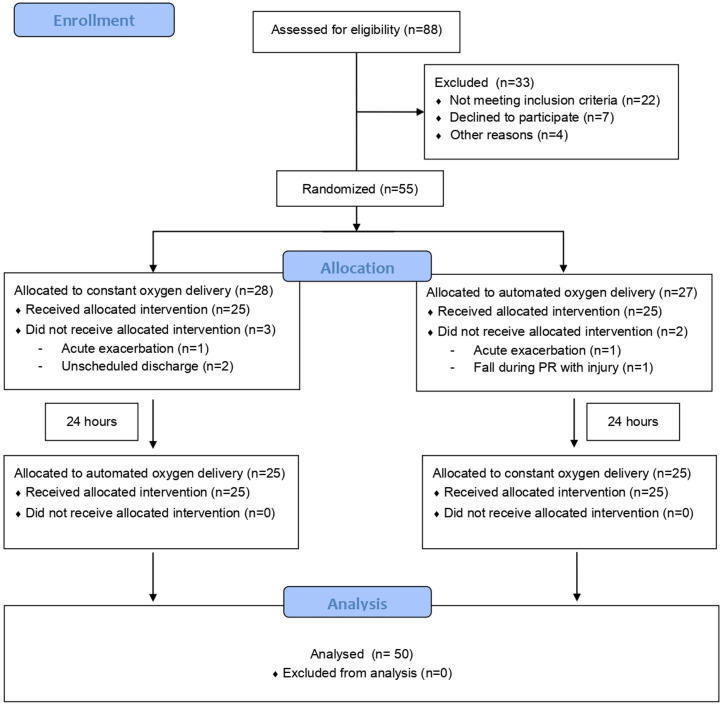
Fifty participants completed this prospective randomised controlled, double-blind, crossover trial. Participants performed two endurance shuttle walk tests (ESWTs) with: (1) exercise titrated CFOS (ESWT) and (2) ATOS targeting an SpO of 92% (ESWT). Primary outcome measure was walking time. Secondary measures were SpO, transcutaneous-PCO (TcPCO), respiratory rate (RR), heart rate (HR) at isotime (end of shortest ESWT) with blood gases and dyspnoea at rest and end exercise.
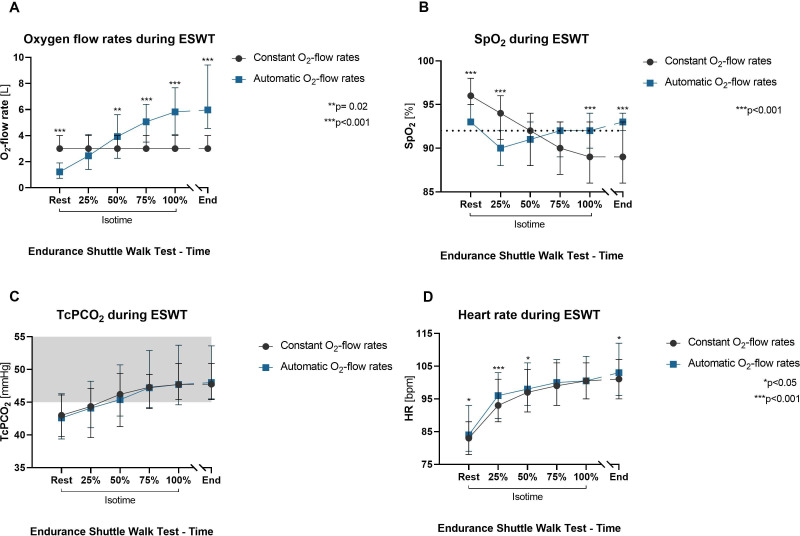
Participants (median (IQR): age 66 (59, 70) years, FEV 28.8 (24.8, 35.1) % predicted, PO 54.7 (51.0, 57.7) mm Hg, PCO 44.2 (38.2, 47.8) mm Hg) walked significantly longer with ESWT in comparison to ESWT (median effect (95% CI) +144.5 (54 to 241.5) s, p<0.001). At isotime, SpO was significantly higher (+3 (95% CI 1 to 4) %, p<0.001) with ATOS while TcPCO, RR and HR were comparable. End exercise, PO (+8.85 (95% CI 6.35 to 11.9) mm Hg) and dyspnoea (-0.5 (95% CI -1.0 to -0.5) points) differed significantly in favour of ATOS (each p<0.001) while PCO was comparable.
In patients with hypoxaemia with severe COPD the use of ATOS leads to significant, clinically relevant improvements in walking endurance time, SpO, PO and dyspnoea with no impact on PCO.
NCT03803384.
在 COPD 患者中,通过恒流氧气系统(CFOS)进行氧气(O)补充可能导致运动时氧饱和度(SpO <90%)不足。已证明自动滴定氧气系统(ATOS)比未滴定 CFOS 更有益,然而,尚不清楚 ATOS 是否优于在指南规定的运动时滴定的 CFOS。目的是研究 ATOS 与滴定 CFOS 对低氧性 COPD 患者步行能力的影响。
50 名参与者完成了这项前瞻性随机对照、双盲、交叉试验。参与者进行了两次耐力穿梭步行测试(ESWT):(1)运动滴定 CFOS(ESWT)和(2)ATOS 目标 SpO 为 92%(ESWT)。主要观察指标为步行时间。次要观察指标为 SpO、经皮 PCO(TcPCO)、呼吸频率(RR)、最短 ESWT 结束时的心率(HR)和静息及运动结束时的血气及呼吸困难。
参与者(中位数(IQR):年龄 66(59,70)岁,FEV 28.8(24.8,35.1)%预计值,PO 54.7(51.0,57.7)mmHg,PCO 44.2(38.2,47.8)mmHg)在 ESWT 中步行时间明显长于 ESWT(中位数效应(95%置信区间)+144.5(54 至 241.5)s,p<0.001)。在等时,ATOS 时 SpO 显著升高(+3(95%CI 1 至 4)%,p<0.001),而 TcPCO、RR 和 HR 则相似。运动结束时,PO(+8.85(95%CI 6.35 至 11.9)mmHg)和呼吸困难(-0.5(95%CI -1.0 至 -0.5)点)显著有利于 ATOS(均 p<0.001),而 PCO 则相似。
在低氧血症合并严重 COPD 的患者中,使用 ATOS 可显著改善运动耐力时间、SpO、PO 和呼吸困难,且对 PCO 无影响。
NCT03803384。