Meyer Jacob D, O'Connor John, McDowell Cillian P, Lansing Jeni E, Brower Cassandra S, Herring Matthew P
Department of Kinesiology, Iowa State University, Ames, IA, United States.
The Irish Longitudinal Study of Ageing (TILDA), Trinity College Dublin, The University of Dublin, Dublin, Ireland.
Front Psychiatry. 2021 Oct 1;12:741433. doi: 10.3389/fpsyt.2021.741433. eCollection 2021.
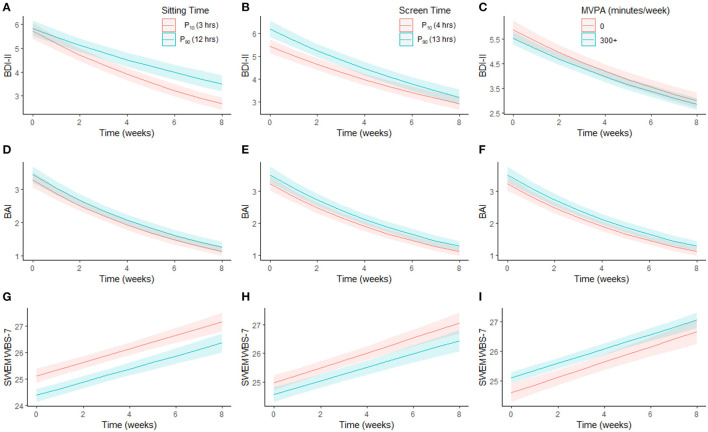
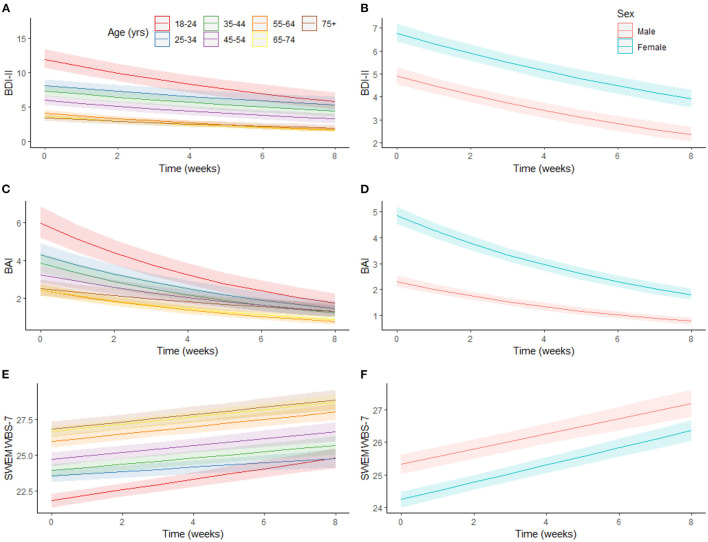
The COVID-19 pandemic has elicited increased sedentary behaviors, decreased moderate-to-vigorous physical activity (MVPA), and worsened mental health, yet the longitudinal impact of these changes and their inter-relations remains unknown. Our purpose was to examine associations between changes in self-reported activity behaviors and mental health over an 8-week period following the COVID-19 outbreak. Participants from all 50 states and the District of Colombia were recruited through convenience and snowball sampling at baseline April 3-10, 2020. Prospective data from 2,327 US adults with ≥2 responses (63.8% female; 74.3% response rate) were collected weekly via online survey for eight consecutive weeks (April 3-June 3, 2020). Primary exposures were self-reported time spent sitting, viewing screens and in MVPA, with primary outcomes being depressive symptoms, anxiety symptoms, and positive mental health (PMH). A significant sitting-by-time interaction ( < 0.05) showed slightly higher marginal effects for depressive symptoms for the 90th-percentile of sitting time than the 10th-percentile at baseline (5.8 [95% confidence interval = 5.5-6.2] vs. 5.7 [5.4-6.1]), with the difference magnifying over time (week 8: 3.5 [3.2-3.9] vs. 2.7 [2.4-2.9]). No other interactions over time were significant. Screen time was negatively associated with PMH and positively associated with depressive and anxiety symptoms ( < 0.05). Sitting time was negatively associated with PMH ( < 0.05). Rapid changes in sitting patterns (e.g., due to a pandemic) may have lasting effects on depressive symptoms. Strategies targeting those most affected (i.e., young adults, females) and/or focused on reducing sitting time may be critical for preventing long-term mental health effects resulting from COVID-19 or other large-scale behavior changes in the general population.
新冠疫情引发了久坐行为增加、中等到剧烈身体活动(MVPA)减少以及心理健康恶化的情况,然而这些变化的纵向影响及其相互关系仍不明确。我们的目的是研究新冠疫情爆发后8周内自我报告的活动行为变化与心理健康之间的关联。2020年4月3日至10日基线期,通过便利抽样和滚雪球抽样从美国50个州和哥伦比亚特区招募了参与者。对2327名美国成年人进行前瞻性数据收集,这些成年人至少有2次回复(63.8%为女性;回复率74.3%),在连续八周(2020年4月3日至6月3日)每周通过在线调查收集数据。主要暴露因素为自我报告的久坐时间、看屏幕时间和进行MVPA的时间,主要结局为抑郁症状、焦虑症状和积极心理健康(PMH)。显著存在的久坐时间交互作用(<0.05)表明,在基线期,久坐时间第90百分位数的抑郁症状边际效应略高于第10百分位数(5.8[95%置信区间=5.5 - 6.2]对5.7[5.4 - 6.1]),且随着时间推移差异扩大(第8周:3.5[3.2 - 3.9]对2.7[2.4 - 2.9])。随时间推移的其他交互作用均不显著。看屏幕时间与PMH呈负相关,与抑郁和焦虑症状呈正相关(<0.05)。久坐时间与PMH呈负相关(<0.05)。久坐模式的快速变化(如因疫情导致)可能对抑郁症状产生持久影响。针对受影响最严重的人群(即年轻人、女性)的策略和/或专注于减少久坐时间的策略,对于预防新冠疫情或普通人群其他大规模行为变化导致的长期心理健康影响可能至关重要。