Department of Neurology, Medical University of Vienna, Vienna, Austria.
Division of Neuropathology and Neurochemistry, Department of Neurology, Medical University of Vienna, Vienna, Austria.
Front Immunol. 2021 Sep 30;12:753856. doi: 10.3389/fimmu.2021.753856. eCollection 2021.
Anti-IgLON5 disease forms an interface between neuroinflammation and neurodegeneration and includes clinical phenotypes that are often similar to those of neurodegenerative diseases. An early diagnosis of patients with anti-IgLON5 disease and differentiation from neurodegenerative diseases is necessary and may have therapeutic implications.
In our small sample size study we investigated oculomotor function as a differentiating factor between anti-IgLON5 disease and neurodegenerative disorders. We examined ocular motor and vestibular function in four patients suffering from anti-IgLON5 disease using video-oculography (VOG) and a computer-controlled rotational chair system (sampling rate 60 Hz) and compared the data with those from ten age-matched patients suffering from progressive supranuclear palsy (PSP) and healthy controls (CON).
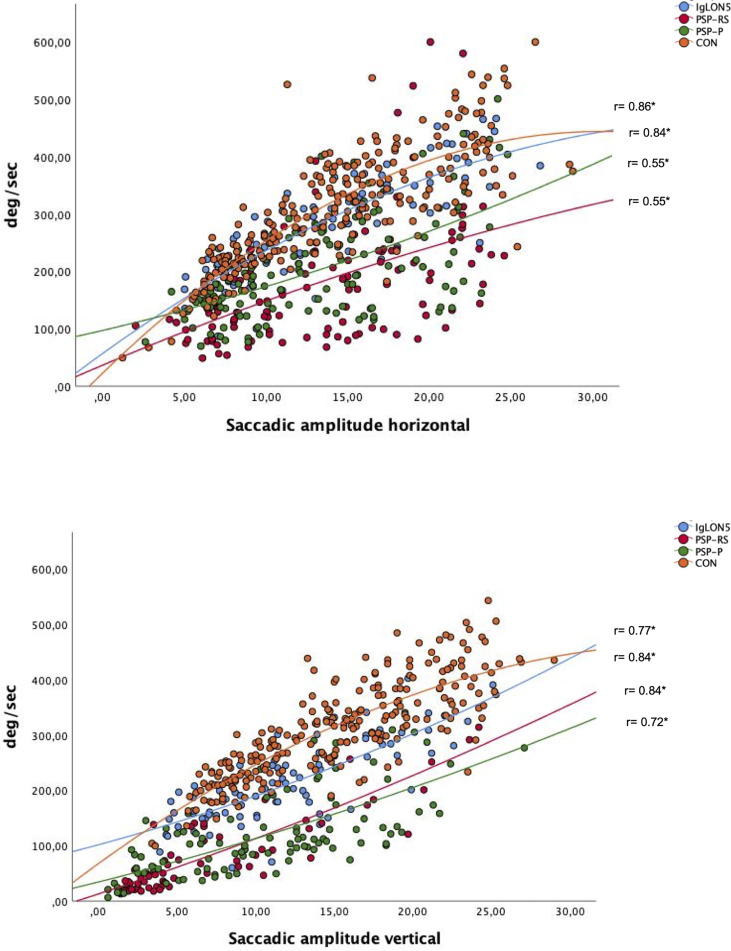
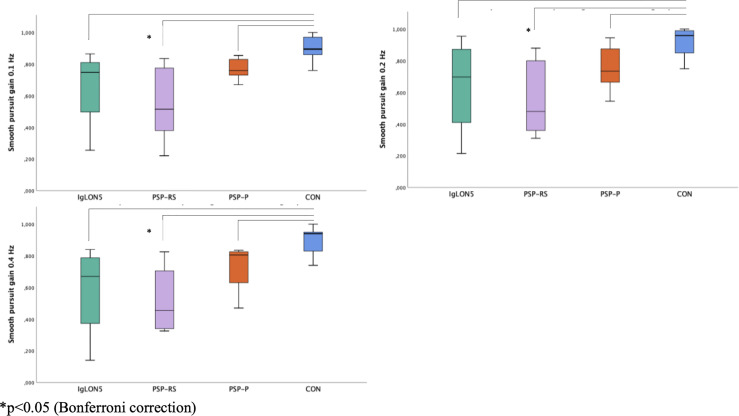
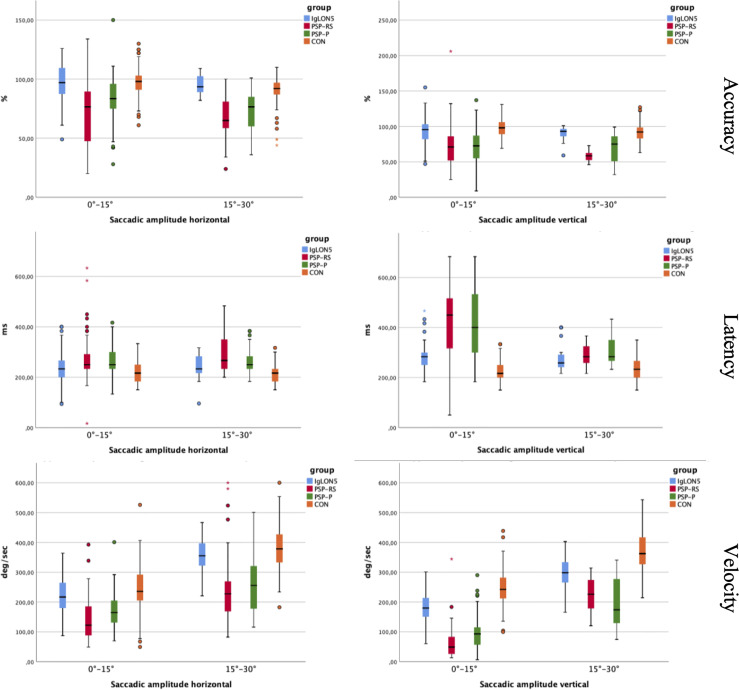
Patients suffering from anti-IgLON5 disease differed from PSP most strikingly in terms of saccade velocity and accuracy, the presence of square wave jerks (SWJ) (anti-IgLON5 0/4 . PSP 9/10) and the clinical finding of supranuclear gaze palsy (anti-IgLON5 1/4). The presence of nystagmus, analysis of smooth pursuit eye movements, VOR and VOR suppression was reliable to differentiate between the two disease entities. Clear differences in all parameters, although not always significant, were found between all patients and CON.
We conclude that the use of VOG as a tool for clinical neurophysiological assessment can be helpful in differentiating between patients with PSP and patients with anti-IgLON5 disease. VOG could have particular value in patients with suspected PSP and lack of typical Parkinson's characteristics. future trials are indispensable to assess the potential of oculomotor function as a biomarker in anti-IgLON5 disease.
抗 IgLON5 病形成了神经炎症和神经退行性变之间的界面,包括与神经退行性疾病经常相似的临床表型。对抗 IgLON5 病患者进行早期诊断并与神经退行性疾病区分开来是必要的,并且可能具有治疗意义。
在我们的小样本量研究中,我们研究了眼球运动功能作为区分抗 IgLON5 病和神经退行性疾病的因素。我们使用视频眼动描记法(VOG)和计算机控制的转椅系统(采样率 60 Hz)检查了四名患有抗 IgLON5 病的患者的眼动和前庭功能,并将数据与十名患有进行性核上性麻痹(PSP)和健康对照组(CON)的年龄匹配患者进行了比较。
与 PSP 相比,患有抗 IgLON5 病的患者在扫视速度和准确性、方波急跳(SWJ)的存在(抗 IgLON5 0/4. PSP 9/10)以及核上性凝视麻痹的临床发现(抗 IgLON5 1/4)方面差异最为明显。眼球震颤、平滑追踪眼动分析、VOR 和 VOR 抑制的存在是区分这两种疾病实体的可靠方法。虽然并非总是显著,但所有患者与 CON 之间在所有参数上均存在明显差异。
我们得出结论,使用 VOG 作为临床神经生理学评估的工具可以帮助区分 PSP 患者和抗 IgLON5 病患者。VOG 在疑似 PSP 患者且缺乏典型帕金森特征的患者中可能具有特殊价值。未来的试验对于评估眼动功能作为抗 IgLON5 病生物标志物的潜力是不可或缺的。