Katyal Deepika, Subramanian Aravind Kumar, Venugopal Adith, Marya Anand
Department of Orthodontics, Saveetha Dental College, Saveetha Institute of Medical and Technical Sciences, Chennai 600077, India.
Department of Orthodontics, Faculty of Dentistry, University of Puthisastra, Phnom Penh 12211, Cambodia.
Int J Dent. 2021 Oct 8;2021:9457553. doi: 10.1155/2021/9457553. eCollection 2021.
The quantity and quality of the etching pattern produced by acids play a significant role in the wettability and contact angle of the adhesive with the enamel surface in orthodontics. The better the etch pattern, the more the surface energy of the enamel, better the penetration of the adhesive, which ultimately results in better bond strength. The present study aimed to evaluate the contact angle of the bonding agent with the enamel surface etched by five commercially available etchants and check if any difference existed between the five.
Twenty-five human maxillary and mandibular central incisors and premolars extracted for orthodontic or dental purposes were used in this study as samples. The teeth were allocated into five groups based upon the etchant used to etch the enamel surface. After the samples were etched, a hard tissue microtome was used to create thin slices of the enamel surface. The samples were then exposed to bonding agent Ormco Enlight. The bonding agent was released in the form of droplets onto the enamel slices mounted on a contact angle goniometer. The contact angle values were tabulated, and statistical analysis using the one-way ANOVA test was carried out.
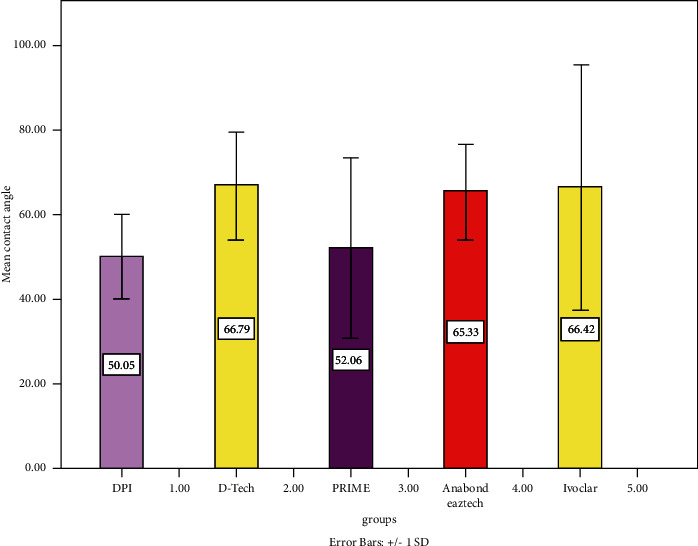
The contact angle measurements of the etchant group, DPI, were the lowest, while D-tech has the highest contact angle values. However, statistical analysis revealed no statistically significant difference between the contact angle measurements of the five groups included in the study.
No statistically significant difference existed between the five etchant groups included in the study. However, commercially available etchant DPI showed lesser contact angle and thus better wettability in comparison to other groups. Further elemental analysis and surface analysis are required to validate these results.
正畸治疗中,酸蚀产生的蚀刻图案的数量和质量对黏合剂与牙釉质表面的润湿性和接触角起着重要作用。蚀刻图案越好,牙釉质的表面能越高,黏合剂的渗透效果越好,最终导致更好的黏结强度。本研究旨在评估一种黏合剂与五种市售蚀刻剂蚀刻后的牙釉质表面的接触角,并检查这五种蚀刻剂之间是否存在差异。
本研究使用25颗因正畸或牙科治疗目的而拔除的人类上颌和下颌中切牙及前磨牙作为样本。根据用于蚀刻牙釉质表面的蚀刻剂将牙齿分为五组。样本蚀刻后,使用硬组织切片机制作牙釉质表面的薄片。然后将样本暴露于黏合剂奥美科Enlight。将黏合剂以液滴形式释放到安装在接触角测量仪上的牙釉质薄片上。将接触角值制成表格,并使用单因素方差分析进行统计分析。
蚀刻剂组DPI的接触角测量值最低,而D-tech的接触角值最高。然而,统计分析显示,本研究中五组的接触角测量值之间没有统计学上的显著差异。
本研究中的五个蚀刻剂组之间没有统计学上的显著差异。然而,与其他组相比,市售蚀刻剂DPI的接触角较小,因此润湿性更好。需要进一步的元素分析和表面分析来验证这些结果。