Universidad de Cantabria - IDIVAL, Santander, Spain.
CIBER Epidemiología y Salud Pública (CIBERESP), Madrid, Spain.
Int Breastfeed J. 2021 Oct 18;16(1):82. doi: 10.1186/s13006-021-00422-z.
Breastfeeding is associated with lower incidence and severity of lower respiratory tract disease. However, little is known about the relationship between feeding type and breastfeeding duration with bronchiolitis in a child's first year.
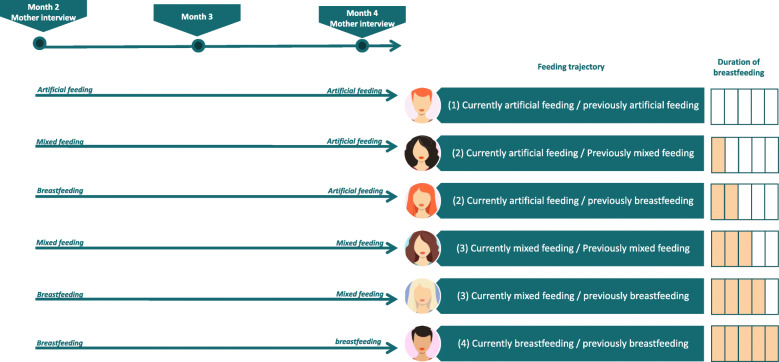
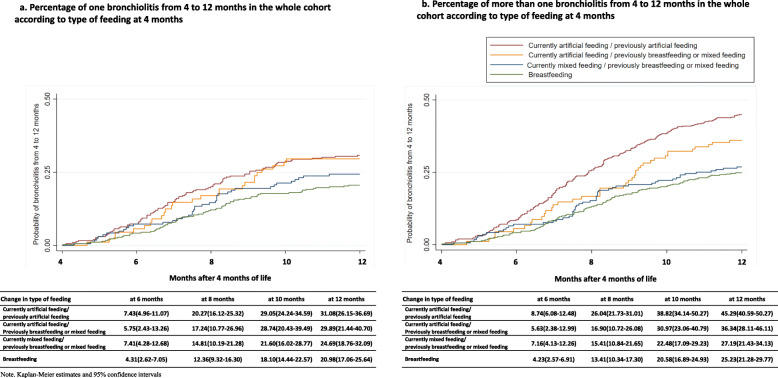
A prospective cohort study of 969 newborn babies were followed-up for 12 months to determine breastfeeding duration, feeding type, feeding trajectory, and bronchiolitis episodes at Marqués de Valdecilla University Hospital, Spain in 2018. Type of feeding was recorded by interviewing mothers at the time of hospital discharge and at 2, 4, 6, 9 and 12 months of life, in three categories: breastfeeding, mixed feeding and infant formula. Type of feeding at hospital discharge refers to feeding from birth to discharge. In any other times studied, it refers to feeding in the last 24 h. The association between the feeding type and bronchiolitis was analysed using logistic regression. Poisson regression was used to evaluate the association between feeding type and the number of bronchiolitis episodes with Kaplan-Meier estimators presenting the cumulative probability of suffering bronchiolitis. The results were adjusted for mother and child characteristics.
Our data shows exclusive breastfeeding and mixed breastfeeding reduce the number of episodes of bronchiolitis. Regarding feeding at 4 months, exclusive breastfeeding reduced by 41% the number of episodes of bronchiolitis (adjusted incidence Ratio (aIR) 0.59, 95% CI 0.46, 0.76) and mixed feeding by 37% (aIR 0.63, 95% CI 0.47, 0.86). Moreover, changing from exclusive breastfeeding to mixed feeding increased the incidence of bronchiolitis compared with continuing exclusive breastfeeding. An early swap to mixed breastfeeding before months 2 or 4, was associated with a reduced the number of episodes of bronchiolitis, (aIR 0.53, 95% CI 0.39, 0.73 if introduction of mixed breastfeeding before month 2, and aIR 0.61, 95% CI 0.45, 0.83 if introduction of mixed breastfeeding before month 4), when compared with infant formula alone.
Any breastfeeding was associated with lower incidence of bronchiolitis and number of episodes of bronchiolitis in the first year of life. Consequently, promoting programmes facilitating exclusive or mixed breastfeeding would be a relevant measure in the prevention of bronchiolitis.
母乳喂养与下呼吸道疾病的发病率和严重程度较低有关。然而,对于婴儿在第一年中喂养类型和母乳喂养持续时间与毛细支气管炎之间的关系知之甚少。
2018 年,在西班牙马奎兹·德·瓦尔德西利亚大学医院进行了一项前瞻性队列研究,纳入了 969 名新生儿,随访 12 个月,以确定母乳喂养持续时间、喂养类型、喂养轨迹和毛细支气管炎发作情况。在出院时和 2、4、6、9 和 12 个月时通过访谈母亲记录喂养类型,分为母乳喂养、混合喂养和婴儿配方奶粉三种类型。出院时的喂养类型是指从出生到出院的喂养方式。在研究的其他任何时间,它指的是过去 24 小时的喂养方式。使用逻辑回归分析喂养类型与毛细支气管炎之间的关系。使用泊松回归评估喂养类型与毛细支气管炎发作次数之间的关系,Kaplan-Meier 估计器表示发生毛细支气管炎的累积概率。结果调整了母亲和儿童的特征。
我们的数据表明,纯母乳喂养和混合喂养可减少毛细支气管炎发作次数。关于 4 个月时的喂养,纯母乳喂养使毛细支气管炎发作次数减少了 41%(调整发病率比 (aIR) 0.59,95%CI 0.46,0.76),混合喂养减少了 37%(aIR 0.63,95%CI 0.47,0.86)。此外,与继续纯母乳喂养相比,从纯母乳喂养改为混合喂养会增加毛细支气管炎的发病率。与单独使用婴儿配方奶粉相比,如果在 2 个月前或 4 个月前开始混合喂养,毛细支气管炎发作次数减少(如果在 2 个月前开始混合喂养,则 aIR 为 0.53,95%CI 为 0.39,0.73,如果在 4 个月前开始混合喂养,则 aIR 为 0.61,95%CI 为 0.45,0.83)。
任何形式的母乳喂养都与婴儿生命第一年毛细支气管炎的发病率和发作次数较低有关。因此,促进促进纯母乳喂养或混合喂养的计划将是预防毛细支气管炎的一项重要措施。