Department of Orthopedics, The Fourth Medical Center, Chinese PLA General Hospital, Beijing, China.
Department of Health Services, Chinese PLA General Hospital, Beijing, China.
Orthop Surg. 2021 Aug;13(6):1781-1786. doi: 10.1111/os.13035.
To analyze the learning curve experience of hip arthroscopy based on patient demographics, surgical time, portal setup time, and postoperative complications and to find the key point in the learning curve.
From May 2016 to February 2019, a prospective study on the learning curve experience of hip arthroscopy was performed in our hospital. We evaluated the first 50 consecutive hip arthroscopy procedures performed by a single surgeon. There were nine females and 41 males with a mean age of 30.8 years. We divide the patients into early group and late group according to the date of their operation, with each group including 25 patients. Data on patient demographics, types of procedure, surgical time, portal setup time, and postoperative complications were collected. Functional scores were assessed with the modified Harris Hip Score (mHHS).
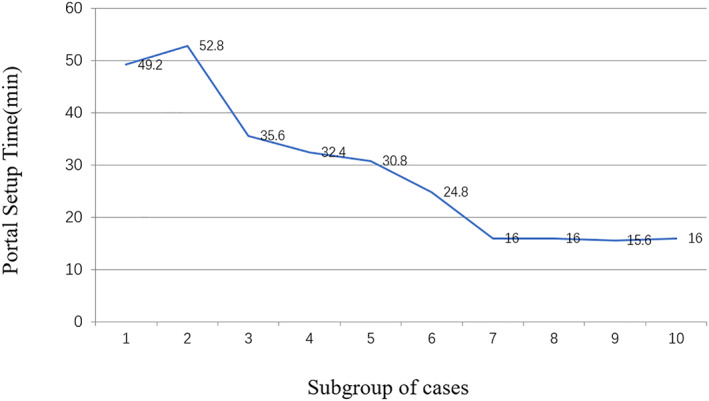
Patients were followed up for 16.4 months on average (range, 13-27 months). The early group of patients had a mean age of 35.2 years and the late group a mean age of 26.5 years. The most common procedures performed for the early group were debridement (17 patients, 68%), and in the late group, most patients underwent labral repair (18 patients, 72%). Mean total surgical time was 168 min for the early group and 143 min for the late group, and there was no statistically significant difference between two groups. The portal setup time in the early group and late group was 40.2 ± 12.4 min and 18.5 ± 6.2 min, respectively (P < 0.001), and the portal setup time was significantly longer in the early group. Further analysis of the learning curve of portal setup showed that the average portal setup time was not statistically significant changed after 30 cases. There were six complications including iatrogenic cartilage injury and iatrogenic labrum injury in the early group and five complications including perineal crush injury and nerve stretch injury in the late group. The functional score of patients in the late group was significantly higher than that in the early group during follow-up.
The steep learning curve of hip arthroscopy is mainly caused by the challenge of portal setup and portalrelated complications were more common in the early group than in the late group. Surgical time is not an effective indicator for evaluating progress on the learning curve of hip arthroscopy.
分析基于患者人口统计学、手术时间、入路建立时间和术后并发症的髋关节镜学习曲线经验,并找到学习曲线的关键点。
自 2016 年 5 月至 2019 年 2 月,对我院髋关节镜学习曲线经验进行前瞻性研究。我们评估了一位医生连续完成的前 50 例髋关节镜手术。其中 9 例为女性,41 例为男性,平均年龄 30.8 岁。我们根据手术日期将患者分为早期组和晚期组,每组各 25 例。收集患者人口统计学、手术类型、手术时间、入路建立时间和术后并发症等数据。采用改良 Harris 髋关节评分(mHHS)评估功能评分。
患者平均随访 16.4 个月(13-27 个月)。早期组患者的平均年龄为 35.2 岁,晚期组为 26.5 岁。早期组最常见的手术类型为清创术(17 例,68%),而晚期组最常见的手术类型为盂唇修复术(18 例,72%)。早期组和晚期组的总手术时间分别为 168 分钟和 143 分钟,两组间无统计学差异。早期组和晚期组入路建立时间分别为 40.2±12.4 分钟和 18.5±6.2 分钟(P<0.001),早期组入路建立时间明显较长。进一步分析入路建立的学习曲线发现,30 例后平均入路建立时间无统计学意义上的变化。早期组有 6 例并发症,包括医源性软骨损伤和医源性盂唇损伤,晚期组有 5 例并发症,包括会阴部挤压伤和神经牵拉伤。随访中晚期组患者的功能评分明显高于早期组。
髋关节镜的陡峭学习曲线主要是由于入路建立的挑战造成的,而早期组与晚期组相比,入路相关并发症更为常见。手术时间不是评估髋关节镜学习曲线进展的有效指标。