Departamento de Ecología Evolutiva, Instituto de Ecología, Universidad Nacional Autónoma de México, 04510, Mexico City, Mexico.
Departamento de Sistemas y Procesos Naturales, Escuela Nacional de Estudios Superiores - Merida, Universidad Nacional Autónoma de México, Yucatán, Mexico.
BMC Ecol Evol. 2021 Oct 20;21(1):190. doi: 10.1186/s12862-021-01924-4.
In parasitism arm race processes and red queen dynamics between host and parasites reciprocally mold many aspects of their genetics and evolution. We performed a parallel assessment of population genetics and demography of two species of pinworms with different degrees of host specificity (Trypanoxyuris multilabiatus, species-specific; and T. minutus, genus-specific) and their host, the mantled howler monkey (Alouatta palliata), based on mitochondrial DNA sequences and microsatellite loci (these only for the host). Given that pinworms and primates have a close co-evolutionary history, covariation in several genetic aspects of their populations is expected.
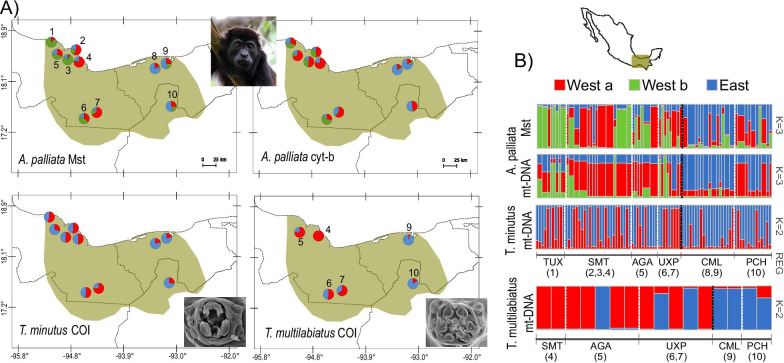
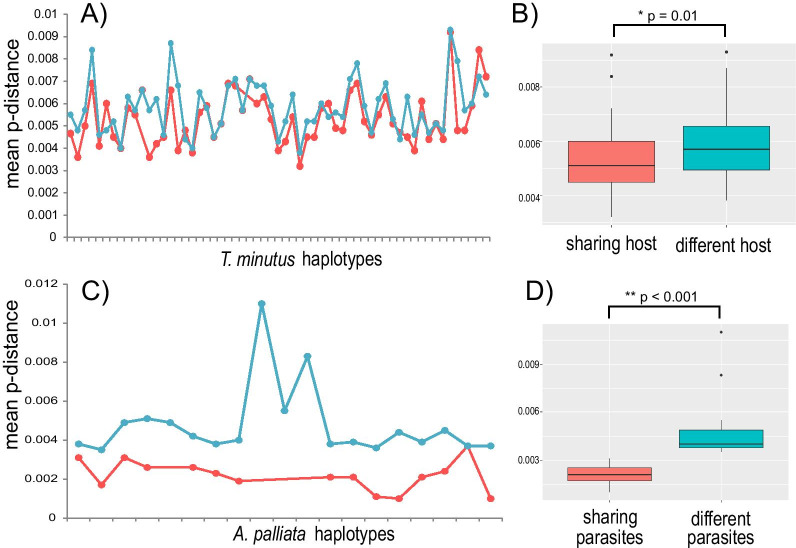
Mitochondrial DNA revealed two genetic clusters (West and East) in both pinworm species and howler monkeys, although population structure and genetic differentiation were stronger in the host, while genetic diversity was higher in pinworms than howler populations. Co-divergence tests showed no congruence between host and parasite phylogenies; nonetheless, a significant correlation was found between both pinworms and A. palliata genetic pairwise distances suggesting that the parasites' gene flow is mediated by the host dispersal. Moreover, the parasite most infective and the host most susceptible haplotypes were also the most frequent, whereas the less divergent haplotypes tended to be either more infective (for pinworms) or more susceptible (for howlers). Finally, a positive correlation was found between pairwise p-distance of host haplotypes and that of their associated pinworm haplotypes.
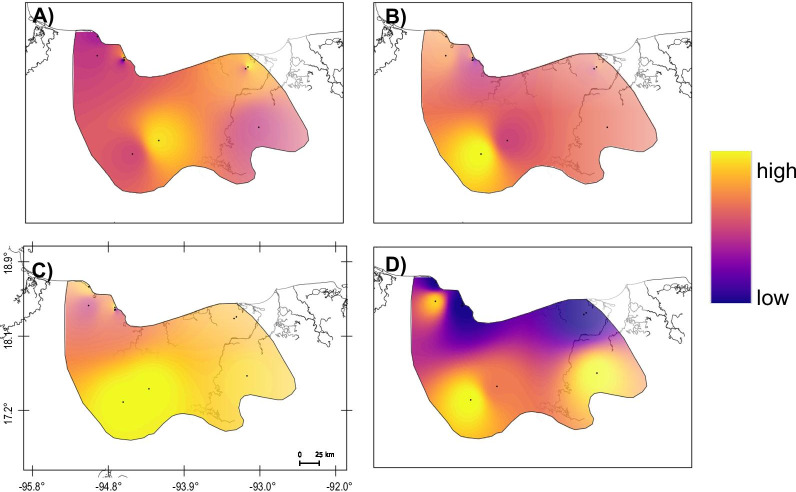
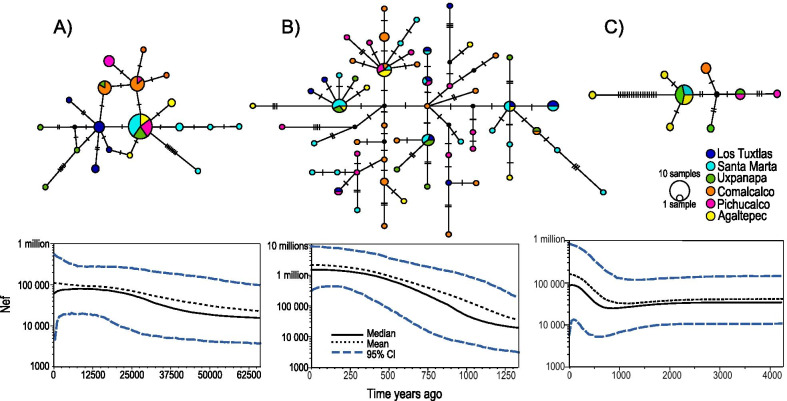
The genetic configuration of pinworm populations appears to be molded by their own demography and life history traits in conjunction with the biology and evolutionary history of their hosts, including host genetic variation, social interactions, dispersal and biogeography. Similarity in patterns of genetic structure, differentiation and diversity is higher between howler monkeys and T. multilabiatus in comparison with T. minutus, highlighting the role of host-specificity in coevolving processes. Trypanoxyuris minutus exhibits genetic specificity towards the most frequent host haplotype as well as geographic specificity. Results suggest signals of potential local adaptation in pinworms and further support the notion of correlated evolution between pinworms and their primate hosts.
在寄生虫军备竞赛过程和宿主与寄生虫之间的红色皇后动态中,双方的遗传和进化的许多方面都相互塑造。我们对具有不同宿主特异性程度的两种旋毛虫(物种特异性的 Trypanoxyuris multilabiatus 和属特异性的 T. minutus)及其宿主——卷尾猴(Alouatta palliata)进行了种群遗传学和种群动态的平行评估,基于线粒体 DNA 序列和微卫星基因座(这些仅针对宿主)。鉴于旋毛虫和灵长类动物具有密切的共同进化历史,预计它们的种群在几个遗传方面会存在协同变化。
线粒体 DNA 揭示了两种旋毛虫和卷尾猴都有两个遗传群(西部和东部),尽管宿主的种群结构和遗传分化更强,而旋毛虫的遗传多样性高于卷尾猴。共进化检验表明,宿主和寄生虫的系统发育之间没有一致性;尽管如此,两种旋毛虫与 A. palliata 遗传对之间的距离之间发现了显著的相关性,这表明寄生虫的基因流是由宿主的扩散介导的。此外,最具感染力的寄生虫和最易感的宿主单倍型也是最常见的,而分化程度较低的单倍型往往更容易感染(对于旋毛虫)或更容易感染(对于卷尾猴)。最后,发现宿主单倍型的成对 p-距离与它们相关的旋毛虫单倍型的成对 p-距离之间存在正相关。
旋毛虫种群的遗传结构似乎是由其自身的种群动态和生活史特征与宿主的生物学和进化历史共同塑造的,包括宿主的遗传变异、社交互动、扩散和生物地理学。与 T. minutus 相比,卷尾猴和 T. multilabiatus 之间的遗传结构、分化和多样性模式的相似性更高,这突出了宿主特异性在共同进化过程中的作用。T. minutus 对最常见的宿主单倍型表现出遗传特异性,以及地理特异性。研究结果表明,旋毛虫可能存在潜在的局部适应信号,并进一步支持旋毛虫与其灵长类宿主之间存在相关进化的观点。