Faust Christina, Dobson Andrew P
Department of Ecology and Evolutionary Biology, Princeton University, Princeton, NJ, USA.
One Health. 2015 Oct 24;1:66-75. doi: 10.1016/j.onehlt.2015.10.001. eCollection 2015 Dec.
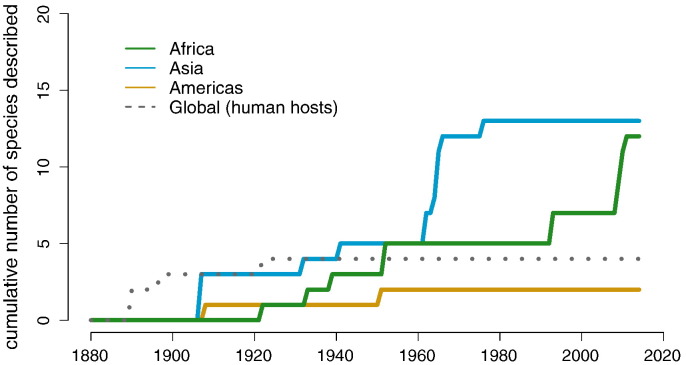
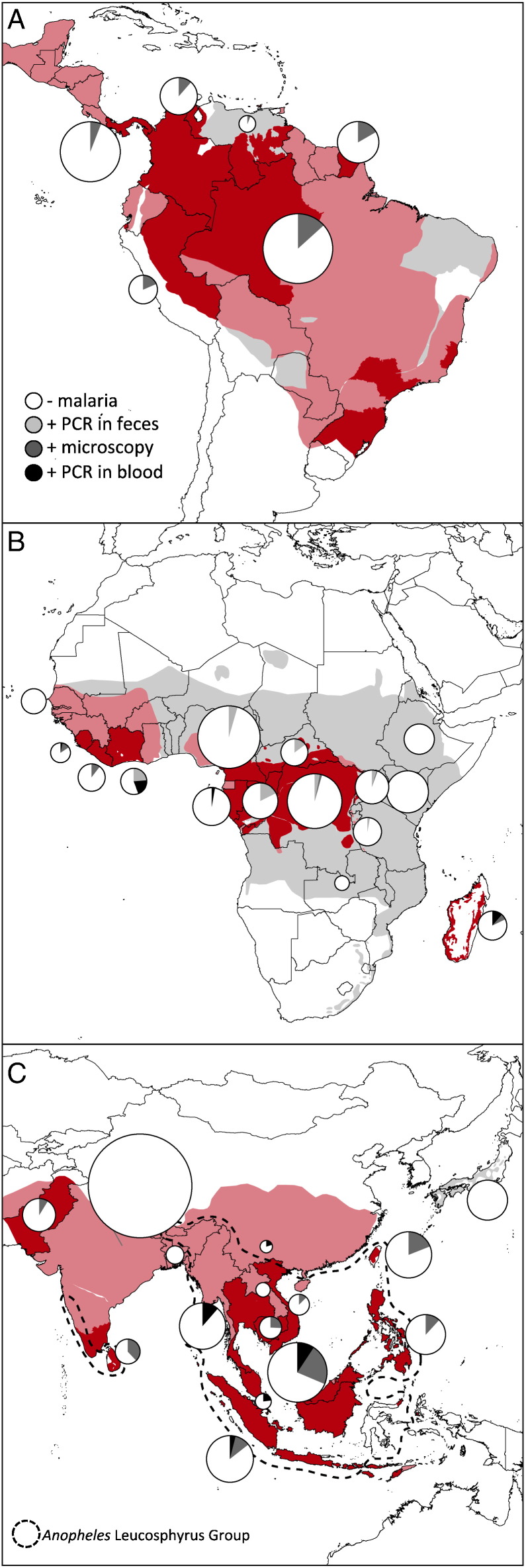
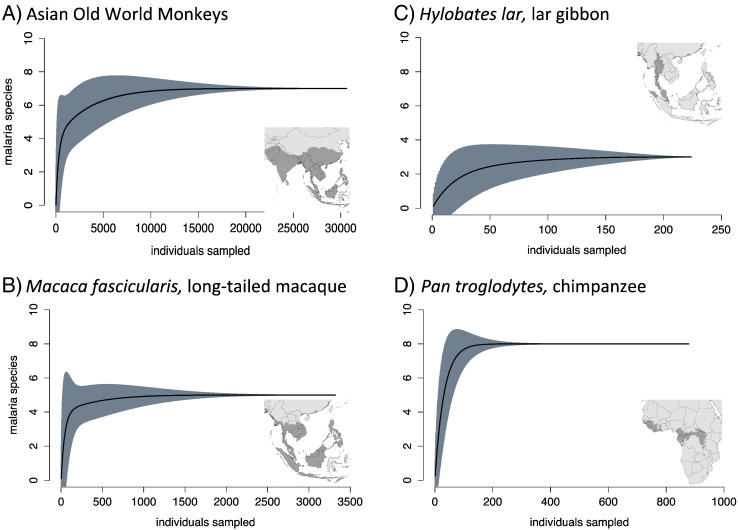
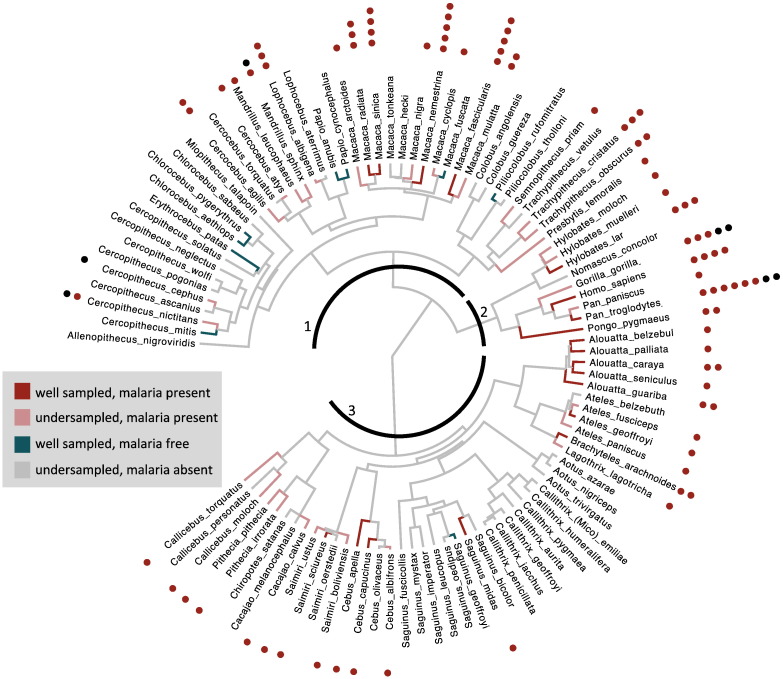
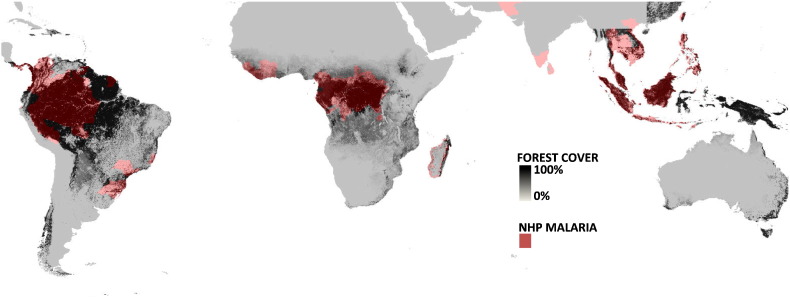
Protozoans within the genus are well-known as the causative agents of malaria in humans. Numerous species parasites also infect a wide range of non-human primate hosts in tropical and sub-tropical regions worldwide. Studying this diversity can provide critical insight into our understanding of human malarias, as several human malaria species are a result of host switches from non-human primates. Current spillover of a monkey malaria, , in Southeast Asia highlights the permeability of species barriers in . Also recently, surveys of apes in Africa uncovered a previously undescribed diversity of in chimpanzees and gorillas. Therefore, we carried out a meta-analysis to quantify the global distribution, host range, and diversity of known non-human primate malaria species. We used published records of parasites found in non-human primates to estimate the total diversity of non-human primate malarias globally. We estimate that at least three undescribed primate malaria species exist in sampled primates, and many more likely exist in unstudied species. The diversity of malaria parasites is especially uncertain in regions of low sampling such as Madagascar, and taxonomic groups such as African Old World Monkeys and gibbons. Presence-absence data of malaria across primates enables us to highlight the close association of forested regions and non-human primate malarias. This distribution potentially reflects a long coevolution of primates, forest-adapted mosquitoes, and malaria parasites. The diversity and distribution of primate malaria are an essential prerequisite to understanding the mechanisms and circumstances that allow to jump species barriers, both in the evolution of malaria parasites and current cases of spillover into humans.
属内的原生动物是人类疟疾的著名病原体。许多物种的寄生虫还感染全球热带和亚热带地区的多种非人类灵长类宿主。研究这种多样性可以为我们理解人类疟疾提供关键见解,因为几种人类疟疾病种是宿主从非人类灵长类动物转换而来的结果。目前东南亚一种猴疟原虫的溢出突出了疟原虫物种屏障的通透性。同样最近,对非洲猿类的调查发现了黑猩猩和大猩猩中以前未描述过的疟原虫多样性。因此,我们进行了一项荟萃分析,以量化已知非人类灵长类疟疾病种的全球分布、宿主范围和多样性。我们利用在非人类灵长类动物中发现的疟原虫的已发表记录来估计全球非人类灵长类疟疾的总多样性。我们估计在抽样的灵长类动物中至少存在三种未描述的灵长类疟疾病种,并且在未研究的物种中可能存在更多。在采样率低的地区,如马达加斯加,以及分类群体,如非洲旧世界猴和长臂猿中,疟原虫的多样性尤其不确定。灵长类动物中疟疾的有无数据使我们能够突出森林地区与非人类灵长类疟疾的密切关联。这种分布可能反映了灵长类动物、适应森林的蚊子和疟原虫的长期共同进化。灵长类疟疾的多样性和分布是理解疟原虫跨越物种屏障的机制和情况的重要前提,这在疟原虫的进化以及当前溢出到人类的病例中都存在。