Department of Breast and Endocrine Surgery, Osaka City University Graduate School of Medicine, 1-4-3 Asahi-machi, Abeno-ku, Osaka, 545-8585, Japan.
Department of Gastrointestinal Surgery, Osaka City University Graduate School of Medicine, 1-4-3 Asahi-machi, Abeno-ku, Osaka, 545-8585, Japan.
BMC Cancer. 2021 Oct 20;21(1):1129. doi: 10.1186/s12885-021-08857-7.
The body mass index (BMI) is commonly used as a simple indicator of obesity; patients with early-stage breast cancer who are obese (OB) per BMI measurements have been shown to have high postoperative recurrence and low survival rates. On the other hand, it has been shown that lymphocytes present in the vicinity of malignant growths that are involved in the tumors' immune responses influence the efficacy chemotherapy. Therefore, we hypothesized that OB patients with breast cancer have a lower density of tumor-infiltrating lymphocytes (TILs), which may influence the therapeutic effect of preoperative chemotherapy (POC). In this study, we measured pretreatment BMI and TILs in patients with breast cancer who underwent POC, examined the correlations between these two factors, and retrospectively analyzed their therapeutic outcomes and prognoses.
The participants in this study were 421 patients with breast cancer who underwent surgical treatment after POC between February 2007 and January 2019. The patient's height and weight were measured before POC to calculate the BMI (weight [kg] divided by the square of the height [m]). According to the World Health Organization categorization, patients who weighed under 18.5 kg/m were classified as underweight (UW), those ≥18.5 kg/m and > 25 kg/m were considered normal weight (NW), those ≥25 kg/m and < 30 kg/m were overweight (OW), and those ≥30 kg/m were OB. The TILs were those lymphocytes that infiltrated the tumor stroma according to the definition of the International TILs Working Group 2014.
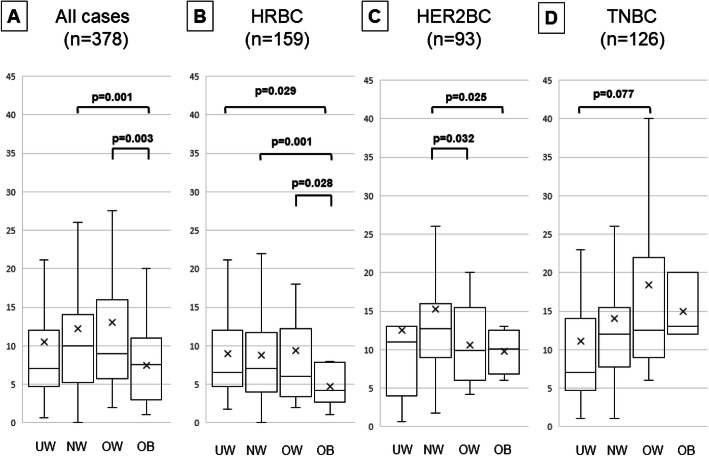
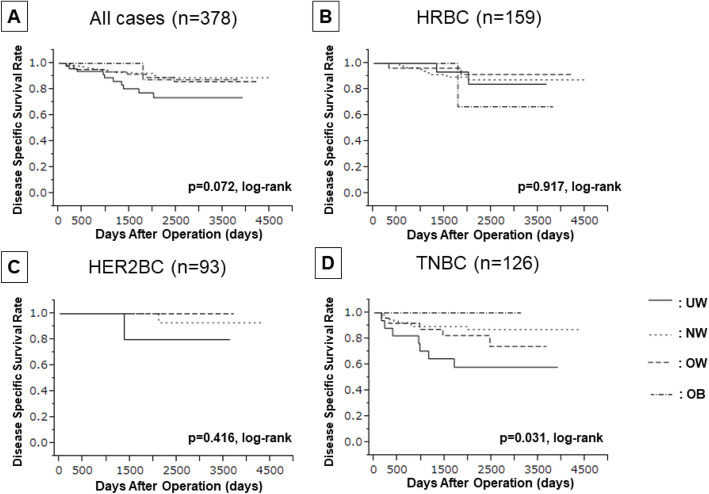
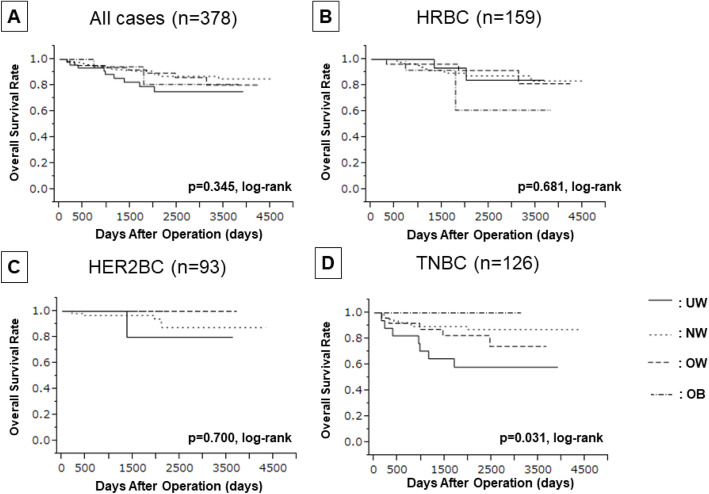
The median BMI was 21.9 kg/m (range, 14.3-38.5 kg/m); most patients (244; 64.5%) were NW. Among all 378 patients with breast cancer, the TIL density was significantly lower in OB than in NW and OW patients (vs. NW: p = 0.001; vs. OW: p = 0.003). Furthermore, when examining patients with each breast cancer type individually, the OS of those with TNBC who had low BMIs was significantly poorer than that of their high-BMI counterparts (log rank p = 0.031).
Our data did not support the hypothesis that obesity affects the tumor immune microenvironment; however, we showed that being UW does affect the tumor immune microenvironment.
体重指数(BMI)通常被用作肥胖的简单指标;根据 BMI 测量,患有早期乳腺癌且肥胖(OB)的患者术后复发率高,生存率低。另一方面,已经表明,存在于恶性生长物附近的淋巴细胞参与肿瘤的免疫反应,影响化疗的疗效。因此,我们假设患有乳腺癌的 OB 患者肿瘤浸润淋巴细胞(TIL)密度较低,这可能会影响术前化疗(POC)的治疗效果。在这项研究中,我们测量了接受 POC 的乳腺癌患者的预处理 BMI 和 TIL,检查了这两个因素之间的相关性,并回顾性分析了他们的治疗结果和预后。
本研究的参与者为 421 名接受 POC 后接受手术治疗的乳腺癌患者。在 POC 之前测量患者的身高和体重,以计算 BMI(体重[kg]除以身高[m]的平方)。根据世界卫生组织的分类,体重不足(UW)的患者体重低于 18.5 kg/m,正常体重(NW)的患者体重为 18.5 kg/m 及以上且>25 kg/m,超重(OW)的患者体重为 25 kg/m 及以上且<30 kg/m,肥胖(OB)的患者体重大于 30 kg/m。TIL 是指根据 2014 年国际 TIL 工作组的定义浸润肿瘤基质的淋巴细胞。
BMI 的中位数为 21.9 kg/m(范围,14.3-38.5 kg/m);大多数患者(244 例,64.5%)为 NW。在所有 378 例乳腺癌患者中,OB 患者的 TIL 密度明显低于 NW 和 OW 患者(与 NW 相比:p=0.001;与 OW 相比:p=0.003)。此外,当单独检查每种乳腺癌类型的患者时,BMI 较低的三阴性乳腺癌患者的 OS 明显不如 BMI 较高的患者(对数秩检验 p=0.031)。
我们的数据不支持肥胖影响肿瘤免疫微环境的假设;然而,我们表明 UW 确实会影响肿瘤免疫微环境。