Clinical Medical Research Center, Guangdong Provincial Engineering Research Center of Autoimmune Disease Precision Medicine, Shenzhen Engineering Research Center of Autoimmune Disease, The Second Clinical Medical College of Jinan University, The First Affiliated Hospital Southern University of Science and Technology, Shenzhen People's Hospital, Shenzhen 518020, Guangdong, People's Republic of China.
Guangxi Key Laboratory of Metabolic Disease Research, Guilin No. 924 Hospital, Guilin 541002, Nanning, People's Republic of China.
Aging (Albany NY). 2021 Oct 20;13(20):23689-23701. doi: 10.18632/aging.203641.
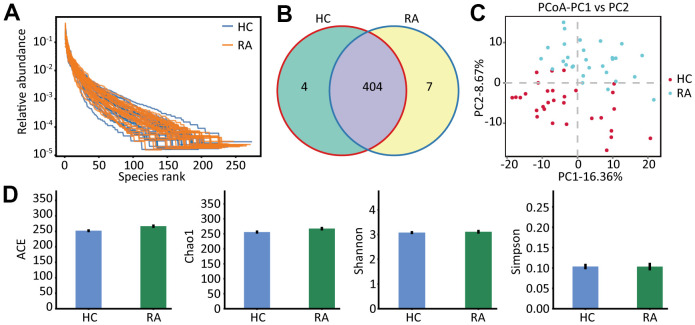
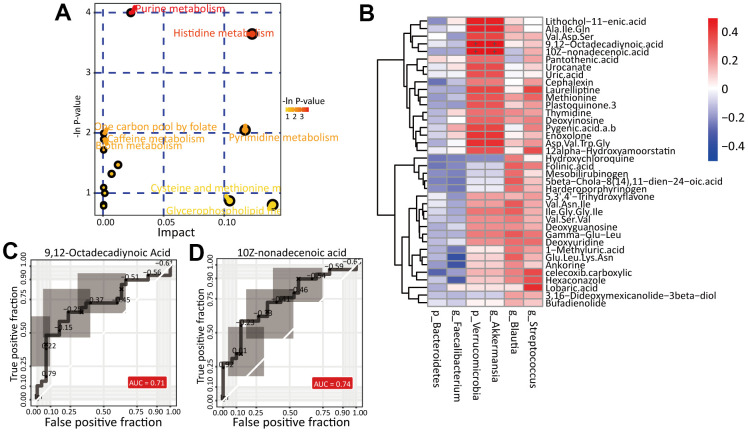
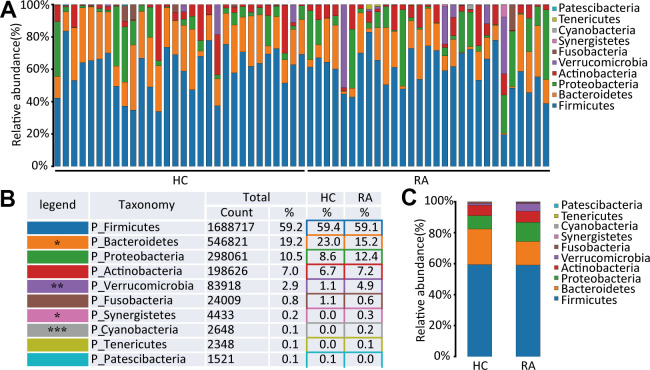
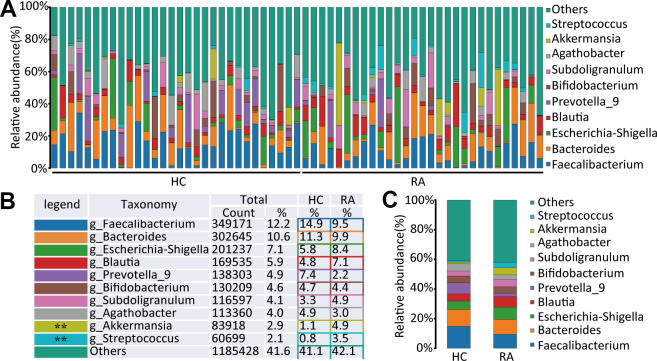
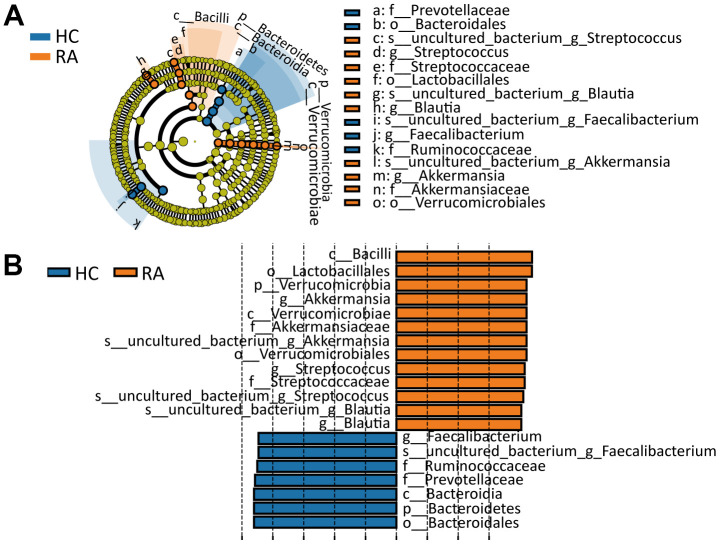
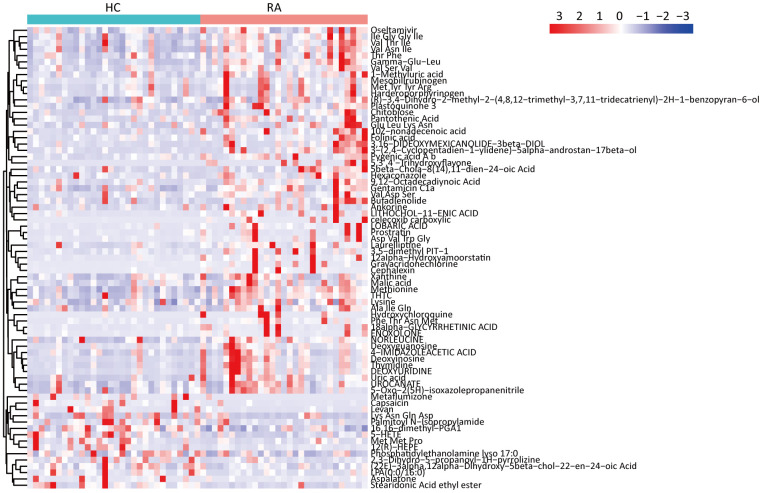
Rheumatoid arthritis (RA) is an autoimmune disease described by joint destruction, synovitis and pannus formation. The gut microbiota acts as an environmental factor that plays an important role in RA, but little research regarding the etiopathogenic mechanisms of the microbiome in RA has been carried out. We used an integrated approach of 16S rRNA gene sequencing and ultrahigh-performance liquid chromatography-mass spectrometry-based metabolomics to analyze the structure and diversity of the intestinal flora and metabolites of the gut microbiota in RA patients compared with healthy subjects. In this study, α-diversity analysis of the gut microbiota showed that there was no significant difference between the healthy control (HC) and RA groups. However, β-diversity analysis showed that there was a significant difference between the two groups. Further analysis of alteration of the gut microbiota revealed that at the phylum level, the relative abundance of p_Bacteroidetes was significantly decreased in the RA group, while that of Verrucomicrobia and Proteobacteria was significantly increased in the RA group. At the genus level, Bacteroides, Faecalibacterium and some probiotics were decreased in the RA group, while 97 genera, including , and , were increased in the RA group. Seventy-four differentially abundant metabolites were identified between the HC and RA groups, and we identified two potential biomarkers (9,12-octadecadiynoic acid and 10Z-nonadecenoic acid) in RA.
类风湿关节炎(RA)是一种以关节破坏、滑膜炎和血管翳形成为特征的自身免疫性疾病。肠道微生物群作为一种环境因素,在 RA 中起着重要作用,但关于 RA 中微生物组的发病机制的研究很少。我们采用 16S rRNA 基因测序和基于超高效液相色谱-质谱的代谢组学相结合的方法,分析了 RA 患者与健康对照者肠道菌群的结构和多样性。在这项研究中,肠道微生物群的α多样性分析表明,健康对照组(HC)和 RA 组之间没有显著差异。然而,β多样性分析表明,两组之间存在显著差异。进一步分析肠道微生物群的改变表明,在门水平上,RA 组 p_Bacteroidetes 的相对丰度显著降低,而 Verrucomicrobia 和 Proteobacteria 的相对丰度显著增加。在属水平上,RA 组的拟杆菌属、粪杆菌属和一些益生菌减少,而 RA 组的 97 个属增加,包括 、 和 。在 HC 和 RA 组之间鉴定出 74 个差异丰度代谢物,我们在 RA 中鉴定出两个潜在的生物标志物(9,12-十八碳二炔酸和 10Z-十一碳烯酸)。