School of Public Affairs, University of South Florida, 4202 E. Fowler Ave, SOC 107, Tampa, FL, 33620, USA.
School of Information, University of South Florida, 4202 E. Fowler Ave, CIS 1040, Tampa, FL, 33620, USA.
J Gen Intern Med. 2022 Jan;37(1):179-187. doi: 10.1007/s11606-021-07171-z. Epub 2021 Oct 20.
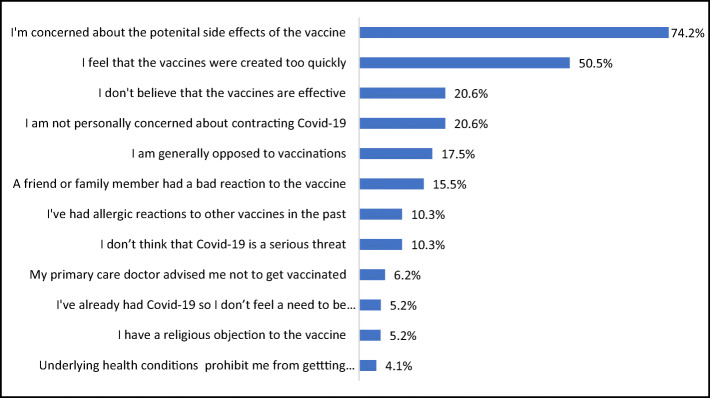
Despite the widespread availability of SARS-CoV-2 vaccines in the USA, vaccine hesitancy continues to represent a significant impediment to the attainment of herd immunity and the end of the COVID-19 pandemic. This survey analysis provides an update for clinical healthcare providers and public health officials regarding current trends in misinformation exposure, as well as common objections to COVID-19 vaccination.
We conducted a web-based survey of 600 adults in the state of Florida between June 3 and June 14, 2021. Access to the sample was purchased through an industry-leading market research provider (Prodege MR), and survey respondents were selected using a stratified, quota sampling approach to ensure representativeness. Balanced quotas were determined (by region of the state) for gender, age, race, education, and ethnicity. The survey responses were analyzed using basic descriptive statistics, as well as chi-square testing and a logit regression model.
High levels of misinformation exposure were observed among participants, with 73% reporting some exposure to misinformation about COVID-19 vaccines in the past 6 months. Exposure to misinformation was directly correlated with vaccine hesitancy. Among those who did not report any exposure to misinformation, 73.8% of respondents were vaccinated. That number fell to 62.9% with exposure to just one misinformation theme and 52.2% for six or more (χ = 11.349; φ = 0.138; p ≤ 0.05). Politicization was also found to be a major factor in vaccine hesitancy, with 73.4% of self-identified Democrats being vaccinated, compared to only 58.5% of Republicans and 56.5% of Independents (χ = 16.334; φ = 0.165; p ≤ 0.001). Both misinformation exposure and political affiliation were strong predictors of vaccination even after accounting for other demographic predictors.
The survey results add to previous research on misinformation and vaccine hesitancy by quantifying exposure to specific misinformation themes and identifying its relationship to vaccine hesitancy. Overcoming these impediments to vaccination will require strategic and targeted messaging on the part of public health professionals, which may be aided by collaboration with political thought leaders. Understanding the volume and nature of misinformation themes the public is exposed to regarding COVID-19 vaccines may aid public health officials in targeting this vaccine messaging to more directly address reasons for vaccine hesitancy.
尽管 SARS-CoV-2 疫苗在美国广泛供应,但疫苗犹豫仍然是实现群体免疫和结束 COVID-19 大流行的重大障碍。这项调查分析为临床医疗保健提供者和公共卫生官员提供了关于当前错误信息暴露趋势的最新信息,以及对 COVID-19 疫苗接种的常见反对意见。
我们在 2021 年 6 月 3 日至 6 月 14 日期间对佛罗里达州的 600 名成年人进行了一项基于网络的调查。通过一家领先的行业市场研究提供商(Prodege MR)获得了对样本的访问权限,通过分层、配额抽样方法选择调查受访者,以确保代表性。根据州的区域确定了平衡的配额(性别、年龄、种族、教育和族裔)。使用基本描述性统计数据以及卡方检验和对数回归模型分析了调查结果。
研究参与者中观察到高水平的错误信息暴露,73%的人报告在过去 6 个月内接触过 COVID-19 疫苗的错误信息。错误信息暴露与疫苗犹豫直接相关。在没有报告任何错误信息接触的人中,73.8%的受访者已接种疫苗。在接触到一个错误信息主题的人中,这一数字下降到 62.9%,而接触到六个或更多主题的人则下降到 52.2%(χ=11.349;φ=0.138;p≤0.05)。政治化也被发现是疫苗犹豫的一个主要因素,73.4%的自认为是民主党的人接种了疫苗,而只有 58.5%的共和党人和 56.5%的独立人士接种了疫苗(χ=16.334;φ=0.165;p≤0.001)。即使考虑到其他人口统计学预测因素,错误信息暴露和政治派别也是接种疫苗的强有力预测因素。
调查结果通过量化特定错误信息主题的暴露程度并确定其与疫苗犹豫的关系,补充了先前关于错误信息和疫苗犹豫的研究。克服这些接种障碍需要公共卫生专业人员采取战略性和有针对性的信息传递措施,这可能得益于与政治思想领袖的合作。了解公众接触 COVID-19 疫苗错误信息的主题的数量和性质可能有助于公共卫生官员将此疫苗信息传递到更直接地解决疫苗犹豫的原因。