Department of Systems Biology, College of Life Science and Biotechnology, Yonsei University, Seoul 03722, Korea.
BMB Rep. 2021 Dec;54(12):592-600. doi: 10.5483/BMBRep.2021.54.12.107.
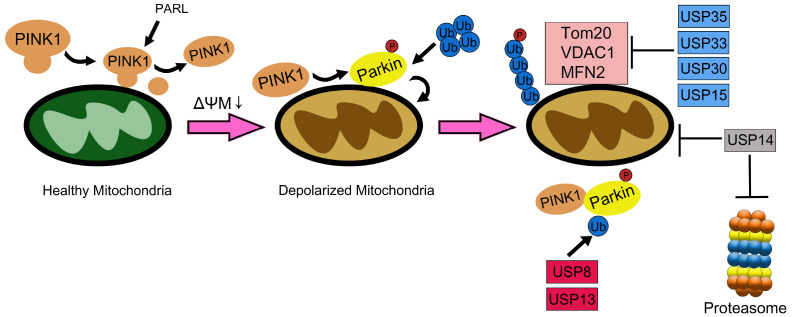
Parkinson's disease (PD) is one of the most common neurodegenerative diseases in the elderly population and is caused by the loss of dopaminergic neurons. PD has been predominantly attributed to mitochondrial dysfunction. The structural alteration of α-synuclein triggers toxic oligomer formation in the neurons, which greatly contributes to PD. In this article, we discuss the role of several familial PD-related proteins, such as α-synuclein, DJ-1, LRRK2, PINK1, and parkin in mitophagy, which entails a selective degradation of mitochondria via autophagy. Defective changes in mitochondrial dynamics and their biochemical and functional interaction induce the formation of toxic α-synucleincontaining protein aggregates in PD. In addition, these gene products play an essential role in ubiquitin proteasome system (UPS)-mediated proteolysis as well as mitophagy. Interestingly, a few deubiquitinating enzymes (DUBs) additionally modulate these two pathways negatively or positively. Based on these findings, we summarize the close relationship between several DUBs and the precise modulation of mitophagy. For example, the USP8, USP10, and USP15, among many DUBs are reported to specifically regulate the K48- or K63-linked de-ubiquitination reactions of several target proteins associated with the mitophagic process, in turn upregulating the mitophagy and protecting neuronal cells from α-synuclein-derived toxicity. In contrast, USP30 inhibits mitophagy by opposing parkin-mediated ubiquitination of target proteins. Furthermore, the association between these changes and PD pathogenesis will be discussed. Taken together, although the functional roles of several PD-related genes have yet to be fully understood, they are substantially associated with mitochondrial quality control as well as UPS. Therefore, a better understanding of their relationship provides valuable therapeutic clues for appropriate management strategies. [BMB Reports 2021; 54(12): 592-600].
帕金森病(PD)是老年人中最常见的神经退行性疾病之一,其病因是多巴胺能神经元的丧失。PD 主要归因于线粒体功能障碍。α-突触核蛋白的结构改变触发神经元中有毒寡聚物的形成,这极大地促成了 PD。在本文中,我们讨论了几种家族性 PD 相关蛋白的作用,如α-突触核蛋白、DJ-1、LRRK2、PINK1 和 parkin 在自噬体中选择性降解线粒体的作用,即自噬体。线粒体动力学的缺陷变化及其生化和功能相互作用导致 PD 中有毒的α-突触核蛋白包含的蛋白聚集体的形成。此外,这些基因产物在泛素蛋白酶体系统(UPS)介导的蛋白水解以及自噬体中发挥重要作用。有趣的是,几种去泛素化酶(DUBs)也会对这两种途径产生负向或正向的调节作用。基于这些发现,我们总结了几种 DUBs 与自噬体的精确调节之间的密切关系。例如,USP8、USP10 和 USP15 等许多 DUBs 被报道可特异性调节与自噬体过程相关的几种靶蛋白的 K48 或 K63 连接的去泛素化反应,从而上调自噬体并保护神经元细胞免受α-突触核蛋白衍生的毒性。相反,USP30 通过拮抗 parkin 介导的靶蛋白泛素化来抑制自噬体。此外,还将讨论这些变化与 PD 发病机制之间的关系。总之,尽管几种 PD 相关基因的功能作用尚未完全了解,但它们与线粒体质量控制和 UPS 密切相关。因此,更好地了解它们之间的关系为适当的管理策略提供了有价值的治疗线索。[BMB 报告 2021;54(12):592-600]。