Kugler Lisa, Kuhbandner Christof, Gerum Sarah, Hierl Christian, Münster Tino, Offereins Bernadette, Lutterbach Lea Sophie
Department of Psychology, University of Regensburg, Regensburg, Germany.
Clinic for Anesthesia and Intensive Care Medicine, Hospital Barmherzige Brüder, Regensburg, Germany.
J Pain Res. 2021 Oct 7;14:3121-3133. doi: 10.2147/JPR.S313868. eCollection 2021.
Humor and laughter are positively associated with psychological as well as with physical well-being. As there is little research examining to what extent patients suffering from chronic pain could benefit from a humor intervention, the goal of this study was to develop a pain-specific humor training and to evaluate its feasibility and effectiveness as component of regular, multimodal pain therapy.
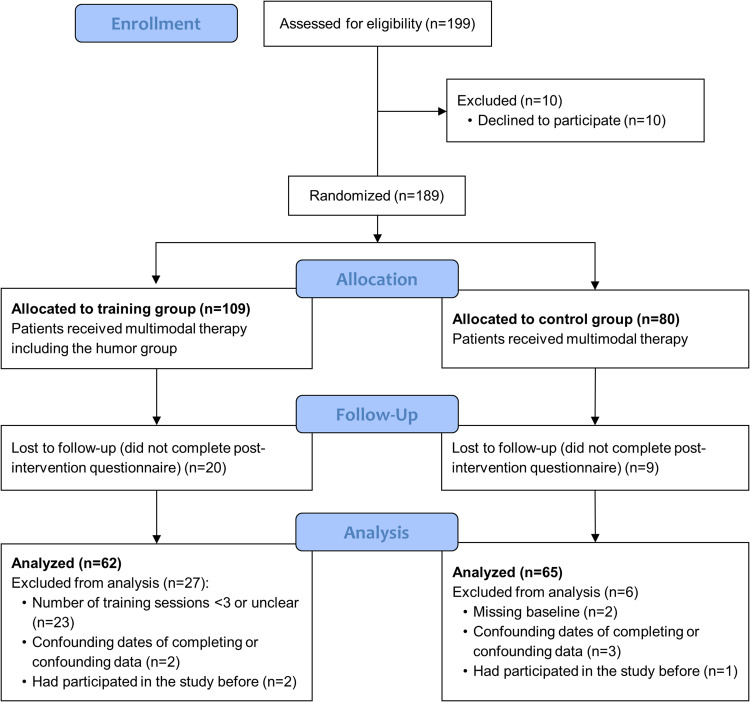
Patients from inpatient treatment groups for chronic pain in a German hospital were randomly assigned to the training group (final n = 62) and the control group (final n = 65). The training consisted of four sessions that were implemented in the usual therapy throughout two weeks. Outcomes were divided into primary (perceived current pain intensity and depression) and secondary ones (quality of life impairment by pain, cheerfulness, and self-enhancing humor) and were assessed prior to and after intervention.
Results showed improvements in all outcomes for both groups. For primary outcomes, a trend for a greater reduction in current pain intensity was found for the training group compared to the control group ( = 0.060, η = 0.02), as well as, for secondary outcomes, a trend for greater reduction of quality of life impairment by pain ( = 0.079, η = 0.02) and a trend for greater increase in self-enhancing humor ( = 0.086, η = 0.02). Depression and cheerfulness remained unaffected. Feedback indicated feasibility of the training within multimodal therapy, showing overall acceptance as well as providing specific suggestions for improvement.
As the first study evaluating a specific humor training for patients with chronic pain within a randomized controlled trial, its results are promising regarding an additional contribution that humor interventions can make towards multimodal pain therapy.
幽默与欢笑与心理和身体健康呈正相关。由于几乎没有研究探讨慢性疼痛患者在多大程度上能从幽默干预中获益,本研究的目的是开发一种针对疼痛的幽默训练,并评估其作为常规多模式疼痛治疗组成部分的可行性和有效性。
德国一家医院慢性疼痛住院治疗组的患者被随机分配到训练组(最终n = 62)和对照组(最终n = 65)。训练包括四个疗程,在两周内的常规治疗中实施。结果分为主要结果(当前感知疼痛强度和抑郁)和次要结果(疼痛导致的生活质量损害、愉悦感和自我提升幽默),并在干预前后进行评估。
两组的所有结果均有改善。对于主要结果,与对照组相比,训练组当前疼痛强度有更大降低的趋势(P = 0.060,η² = 0.02);对于次要结果,疼痛导致的生活质量损害有更大降低的趋势(P = 0.079,η² = 0.02),自我提升幽默有更大增加的趋势(P = 0.086,η² = 0.02)。抑郁和愉悦感未受影响。反馈表明该训练在多模式治疗中的可行性,显示出总体接受度,并提供了具体的改进建议。
作为第一项在随机对照试验中评估针对慢性疼痛患者的特定幽默训练的研究,其结果对于幽默干预对多模式疼痛治疗的额外贡献很有前景。