Wellenzohn Sara, Proyer René T, Ruch Willibald
Department of Psychology, University of Zurich, Zurich, Switzerland.
Department of Psychology, Martin Luther University of Halle-Wittenberg, Halle, Germany.
Front Psychol. 2018 May 28;9:821. doi: 10.3389/fpsyg.2018.00821. eCollection 2018.
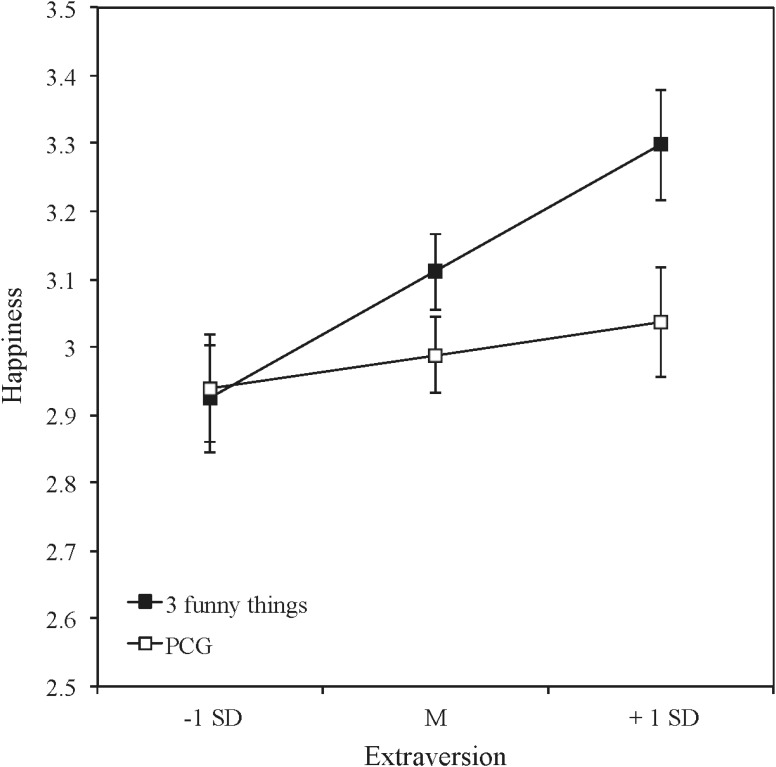
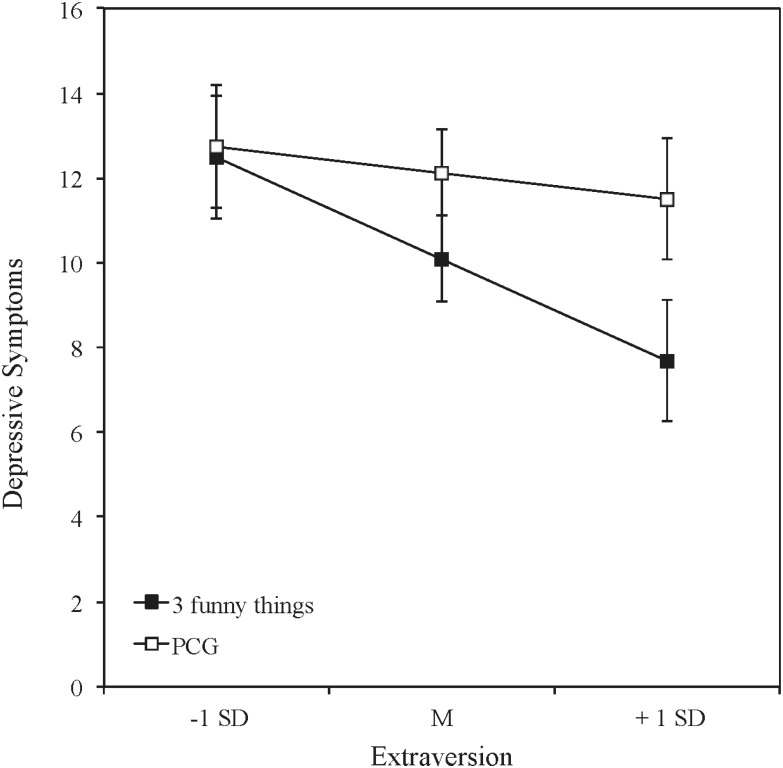
The evidence for the effectiveness of humor-based positive psychology interventions (PPIs; i.e., interventions aimed at enhancing happiness and lowering depressive symptoms) is steadily increasing. However, little is known about who benefits most from them. We aim at narrowing this gap by examining whether personality traits and sense of humor moderate the long-term effects of humor-based interventions on happiness and depressive symptoms. We conducted two placebo-controlled online-intervention studies testing for moderation effects. In Study 1 ( = 104) we tested for moderation effects of basic personality traits (i.e., psychoticism, extraversion, and neuroticism) in the three funny things intervention, a humor-based PPI. In Study 2 ( = 632) we tested for moderation effects of the sense of humor in five different humor-based interventions. Happiness and depressive symptoms were assessed before and after the intervention, as well as after 1, 3, and 6 months. In Study 2, we assessed sense of humor before and 1 month after the intervention to investigate if changes in sense of humor go along with changes in happiness and depressive symptoms. We found moderating effects only for extraversion. Extraverts benefitted more from the three funny things intervention than introverts. For neuroticism and psychoticism no moderation effects were found. For sense of humor, no moderating effects were found for the effectiveness of the five humor-based interventions tested in Study 2. However, changes in sense of humor from pretest to the 1-month follow-up predicted changes in happiness and depressive symptoms. Taking a closer look, the playful attitude- and sense of humor-subscales predicted changes in happiness and depression for up to 6 months. Overall, moderating effects for personality (i.e., extraversion) were found, but none for sense of humor at baseline. However, increases in sense of humor during and after the intervention were associated with the interventions' effectiveness. Thus, we found humor-based interventions to be equally suited for humorous and non-humorous people, but increases in the sense of humor during the intervention phase could serve as an indicator whether it is worth continuing the intervention in the long-term.
基于幽默的积极心理学干预措施(PPIs,即旨在提升幸福感并减轻抑郁症状的干预措施)有效性的证据正在稳步增加。然而,对于谁能从这些干预措施中获益最多却知之甚少。我们旨在通过研究人格特质和幽默感是否会调节基于幽默的干预措施对幸福感和抑郁症状的长期影响来缩小这一差距。我们进行了两项安慰剂对照的在线干预研究来测试调节效应。在研究1(N = 104)中,我们在三项有趣之事干预(一种基于幽默的PPIs)中测试了基本人格特质(即精神质、外向性和神经质)的调节效应。在研究2(N = 632)中,我们在五种不同的基于幽默的干预措施中测试了幽默感的调节效应。在干预前后以及干预后1个月、3个月和6个月对幸福感和抑郁症状进行了评估。在研究2中,我们在干预前和干预后1个月评估了幽默感,以调查幽默感的变化是否与幸福感和抑郁症状的变化同步。我们仅发现了外向性的调节效应。外向者比内向者从三项有趣之事干预中获益更多。对于神经质和精神质,未发现调节效应。对于幽默感,在研究2中测试的五种基于幽默的干预措施的有效性方面未发现调节效应。然而,从预测试到1个月随访期间幽默感的变化预测了幸福感和抑郁症状的变化。进一步观察发现,嬉戏态度和幽默感子量表在长达6个月的时间里预测了幸福感和抑郁的变化。总体而言,发现了人格(即外向性)的调节效应,但基线时幽默感没有调节效应。然而,干预期间及之后幽默感的增加与干预措施的有效性相关。因此,我们发现基于幽默的干预措施对幽默和不幽默的人同样适用,但干预阶段幽默感的增加可以作为是否值得长期继续干预的一个指标。