
通过双色荧光杂交检测人乳头瘤病毒(HPV)和人类染色体位点揭示宫颈癌中HPV整合位点的复发及异质性
Detection of HPV and Human Chromosome Sites by Dual-Color Fluorescence Hybridization Reveals Recurrent HPV Integration Sites and Heterogeneity in Cervical Cancer.
作者信息
Xiong Jinfeng, Cheng Jing, Shen Hui, Ren Ci, Wang Liming, Gao Chun, Zhu Tong, Li Xiaomin, Ding Wencheng, Zhu Da, Wang Hui
机构信息
Department of Obstetrics and Gynecology, Tongji Hospital, Tongji Medical College, Huazhong University of Science and Technology, Wuhan, China.
Department of Obstetrics and Gynecology, Zhongnan Hospital, Wuhan University, Wuhan, China.
出版信息
Front Oncol. 2021 Oct 5;11:734758. doi: 10.3389/fonc.2021.734758. eCollection 2021.
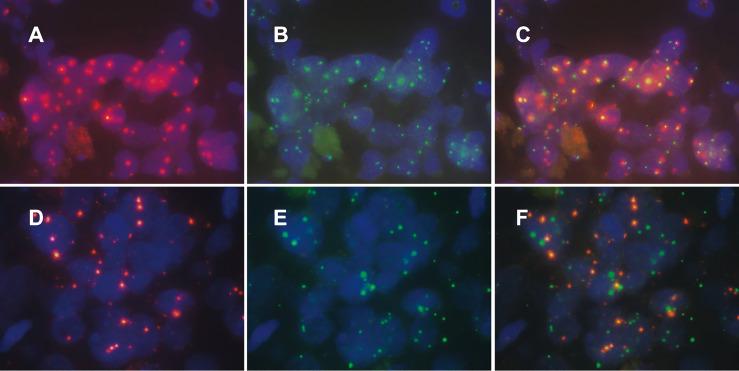
Human papillomavirus (HPV) integration in the human genome is suggested to be an important cause of cervical cancer. With the development of sequencing technologies, an increasing number of integration "hotspots" have been identified. However, this HPV integration information was derived from analysis of whole cervical cancer tissue, and we know very little about the integration in different cancer cell subgroups or individual cancer cells. This study optimized the preparation of probes and provided a dual-color fluorescence hybridization (FISH) method to detect HPV integration sites in paraffin-embedded cervical cancer samples. We used both HPV probes and site-specific probes: 3p14 (), 8q24 (), 13q22 (/), 3q28 (), and 5p15 (). We detected HPV signals in 75 of the 96 cases of cervical cancer; 62 cases showed punctate signals, and 13 cases showed diffuse punctate signals. We identified 3p14 as a high-frequency HPV integration site in 4 cervical cancer cases. HPV integration at 8p14 occurred in 2 cases of cervical cancer. In the same cervical cancer tissue of sample No.1321, two distinct subgroups of cells were observed based on the HPV probe but showed no difference in cell and nucleus morphology. Our study provides a new method to investigate the frequent HPV integration sites in cervical cancer and reports the heterogeneity within cervical cancer from the perspective of HPV integration.
人乳头瘤病毒(HPV)整合进人类基因组被认为是宫颈癌的一个重要病因。随着测序技术的发展,越来越多的整合“热点”被识别出来。然而,这种HPV整合信息来源于对整个宫颈癌组织的分析,而我们对不同癌细胞亚群或单个癌细胞中的整合情况知之甚少。本研究优化了探针制备,并提供了一种双色荧光原位杂交(FISH)方法来检测石蜡包埋宫颈癌样本中的HPV整合位点。我们使用了HPV探针和位点特异性探针:3p14()、8q24()、13q22(/)、3q28()和5p15()。在96例宫颈癌病例中的75例检测到了HPV信号;62例显示点状信号,13例显示弥漫性点状信号。我们在4例宫颈癌病例中确定3p14为高频HPV整合位点。8p14处的HPV整合发生在2例宫颈癌病例中。在样本编号1321的同一宫颈癌组织中,基于HPV探针观察到两个不同的细胞亚群,但在细胞和细胞核形态上没有差异。我们的研究提供了一种新方法来研究宫颈癌中常见的HPV整合位点,并从HPV整合的角度报道了宫颈癌内部的异质性。


 Zotero 插件