School of Public Health, Xinjiang Medical University, Urumqi, China.
Teaching and Research Department of Basic Nursing, School of Nursing, Xinjiang Medical University, Urumqi, China.
Medicine (Baltimore). 2021 Oct 22;100(42):e27600. doi: 10.1097/MD.0000000000027600.
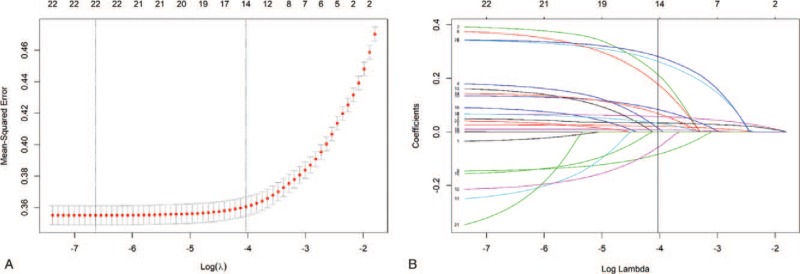
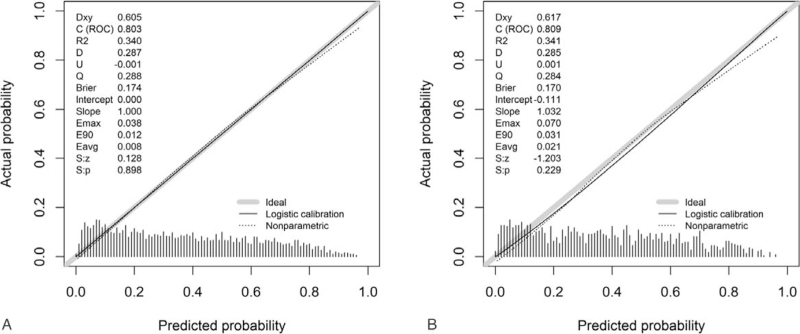
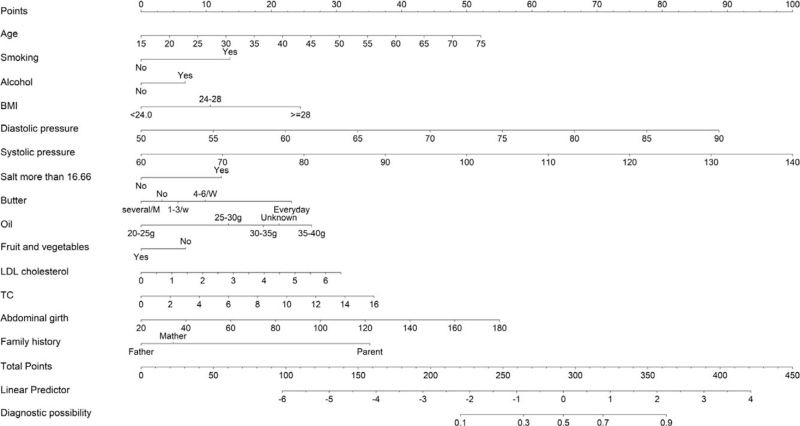
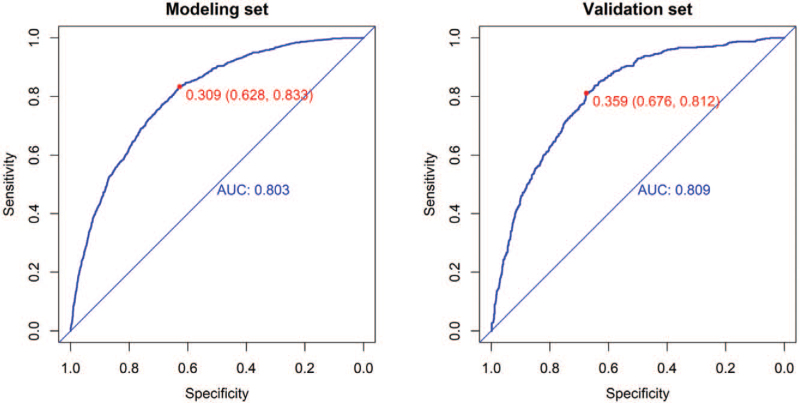
Hypertension is the main risk factor for cardiovascular and renal diseases. It is of great importance to develop effective risk prediction models to identify high-risk groups of hypertension. This study is to establish and verify a nomogram model for predicting the risk of hypertension among Kazakh herders in Xinjiang, China.This is a prospective cohort study. Totally, 5327 Kazakh herders from the Nanshan pastoral area of Xinjiang were enrolled. They were randomly divided into the modeling set of 3729 cases (70%) and the validation set of 1598 cases (30%). In the modeling set, univariate analysis, least absolute shrinkage and selection operator regression and multivariate Logistic regression were used to analyze the influencing factors of hypertension, and a nomogram prediction model was constructed. We then validated the model in the validation set, and evaluated the accuracy of the model using receiver operating characteristic and calibration curve.Based on univariate analysis, least absolute shrinkage and selection operator regression and multivariate logistic regression analysis, we identified 14 independent predictors of hypertension in the modeling set, including age, smoking, alcohol consumption, baseline body mass index, baseline diastolic blood pressure, baseline systolic blood pressure, daily salt intake, yak-butter intake, daily oil intake, fruit and vegetable intake, low-density lipoprotein, cholesterol, abdominal circumference, and family history. The area under the receiver operating characteristic curve of the modeling set and the verification set was 0.803 and 0.809, respectively. Moreover, the calibration curve showed a higher agreement between the nomogram prediction and the actual observation of hypertension.The risk prediction nomogram model has good predictive ability and could be used as an effective tool for the risk prediction of hypertension among Kazakh herders in Xinjiang.
高血压是心血管疾病和肾脏疾病的主要危险因素。开发有效的风险预测模型来识别高血压高危人群具有重要意义。本研究旨在建立和验证一个用于预测中国新疆哈萨克牧民高血压风险的列线图模型。这是一项前瞻性队列研究。共纳入新疆南山牧区的 5327 名哈萨克牧民。他们被随机分为建模集 3729 例(70%)和验证集 1598 例(30%)。在建模集中,采用单因素分析、最小绝对收缩和选择算子回归以及多因素 Logistic 回归分析高血压的影响因素,并构建列线图预测模型。然后在验证集中验证模型,并使用接受者操作特征和校准曲线评估模型的准确性。基于单因素分析、最小绝对收缩和选择算子回归以及多因素 Logistic 回归分析,我们在建模集中确定了 14 个高血压的独立预测因素,包括年龄、吸烟、饮酒、基线体重指数、基线舒张压、基线收缩压、每日盐摄入量、牦牛黄油摄入量、每日油摄入量、水果和蔬菜摄入量、低密度脂蛋白、胆固醇、腰围和家族史。建模集和验证集的接受者操作特征曲线下面积分别为 0.803 和 0.809。此外,校准曲线显示列线图预测与高血压实际观察之间具有更高的一致性。该风险预测列线图模型具有良好的预测能力,可作为预测新疆哈萨克牧民高血压风险的有效工具。