Ziółkowska Barbara
Department of Molecular Neuropharmacology, Maj Institute of Pharmacology, Polish Academy of Sciences, 12 Smętna Str., 31-343 Kraków, Poland.
Brain Sci. 2021 Oct 2;11(10):1311. doi: 10.3390/brainsci11101311.
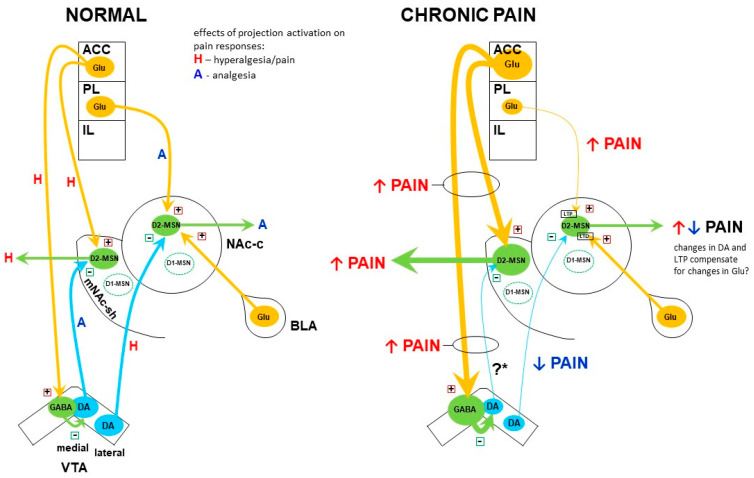
There is increasing recognition of the involvement of the nigrostriatal and mesolimbic dopamine systems in the modulation of chronic pain. The first part of the present article reviews the evidence indicating that dopamine exerts analgesic effects during persistent pain by stimulating the D2 receptors in the dorsal striatum and nucleus accumbens (NAc). Thereby, dopamine inhibits striatal output via the D2 receptor-expressing medium spiny neurons (D2-MSN). Dopaminergic neurotransmission in the mesostriatal pathways is hampered in chronic pain states and this alteration maintains and exacerbates pain. The second part of this article focuses on the glutamatergic inputs from the medial prefrontal cortex to the NAc, their activity changes in chronic pain, and their role in pain modulation. Finally, interactions between dopaminergic and glutamatergic inputs to the D2-MSN are considered in the context of persistent pain. Studies using novel techniques indicate that pain is regulated oppositely by two independent dopaminergic circuits linking separate parts of the ventral tegmental area and of the NAc, which also interact with distinct regions of the medial prefrontal cortex.
黑质纹状体和中脑边缘多巴胺系统在慢性疼痛调节中的作用日益受到关注。本文第一部分回顾了相关证据,表明多巴胺通过刺激背侧纹状体和伏隔核(NAc)中的D2受体,在持续性疼痛期间发挥镇痛作用。由此,多巴胺通过表达D2受体的中型多棘神经元(D2-MSN)抑制纹状体输出。在慢性疼痛状态下,中脑纹状体通路中的多巴胺能神经传递受到阻碍,这种改变会维持并加剧疼痛。本文第二部分重点关注内侧前额叶皮质到NAc的谷氨酸能输入、它们在慢性疼痛中的活动变化以及它们在疼痛调节中的作用。最后,在持续性疼痛的背景下,考虑了多巴胺能和谷氨酸能输入到D2-MSN之间的相互作用。使用新技术的研究表明,疼痛由连接腹侧被盖区和NAc不同部分的两个独立多巴胺能回路进行相反调节,这两个回路也与内侧前额叶皮质的不同区域相互作用。