Califano Daniela, Gallo Daniela, Rampioni Vinciguerra Gian Luca, De Cecio Rossella, Arenare Laura, Signoriello Simona, Russo Daniela, Ferrandina Gabriella, Citron Francesca, Losito Nunzia Simona, Gargiulo Piera, Simeon Vittorio, Scambia Giovanni, Cecere Sabrina Chiara, Montella Marco, Colombo Nicoletta, Tognon Germana, Bignotti Eliana, Zannoni Gian Franco, Canzonieri Vincenzo, Ciucci Alessandra, Spina Anna, Scognamiglio Giosuè, Del Sesto Michele, Schettino Clorinda, Piccirillo Maria Carmela, Perrone Francesco, Chiodini Paolo, Pignata Sandro, Baldassarre Gustavo
Microenvironment Molecular Targets Unit, Istituto Nazionale Tumori IRCCS, Fondazione G. Pascale, 80131 Napoli, Italy.
Department of Woman and Child Health, Fondazione Policlinico Universitario A. Gemelli IRCCS, 00168 Roma, Italy.
Cancers (Basel). 2021 Oct 14;13(20):5152. doi: 10.3390/cancers13205152.
Epithelial ovarian cancer (EOC) is a rare, highly lethal disease. In a subset of high grade EOC patients, maintenance therapy with the antiangiogenic drug Bevacizumab (BEV) is a valuable option. To date, no validated predictive or prognostic biomarkers exist for selecting EOC patients that might benefit from BEV treatment.
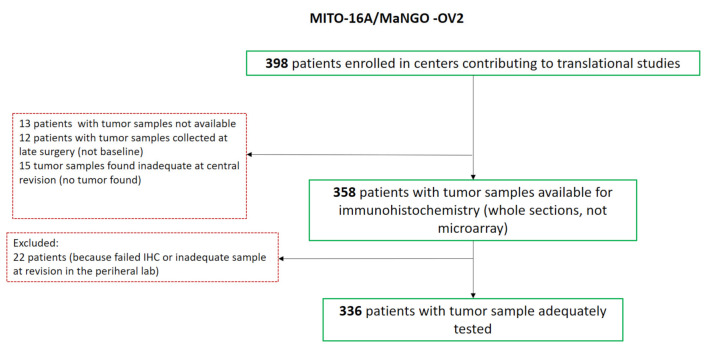
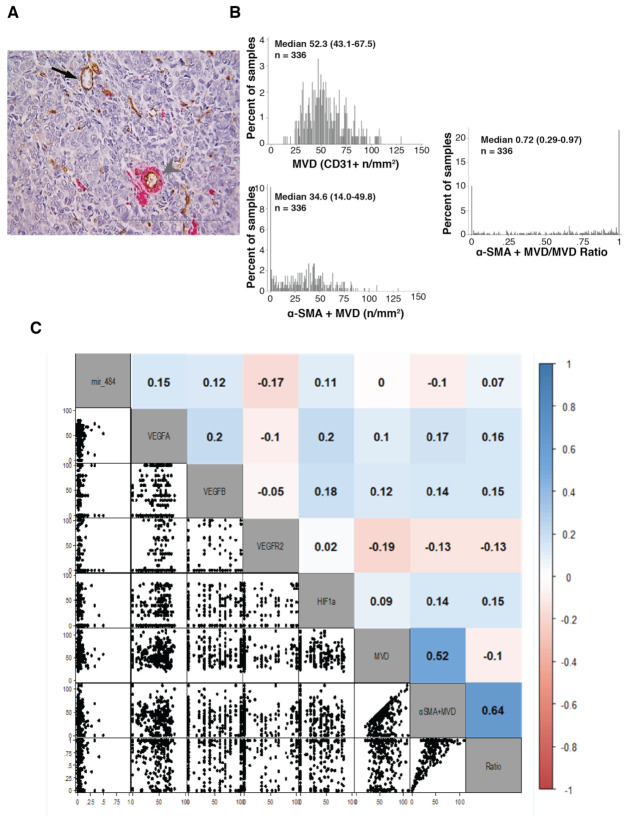
Immunohistochemistry and RT-qPCR evaluated the expression of seven angiogenesis-related proteins and of a twelve microRNAs angio-signature in EOC patients, treated in first line with chemotherapy plus BEV (MITO16A/ManGO OV-2 phase IV trial). Centralized statistical analyses assessed the associations between each biomarker, clinical prognostic factors and survival outcomes.
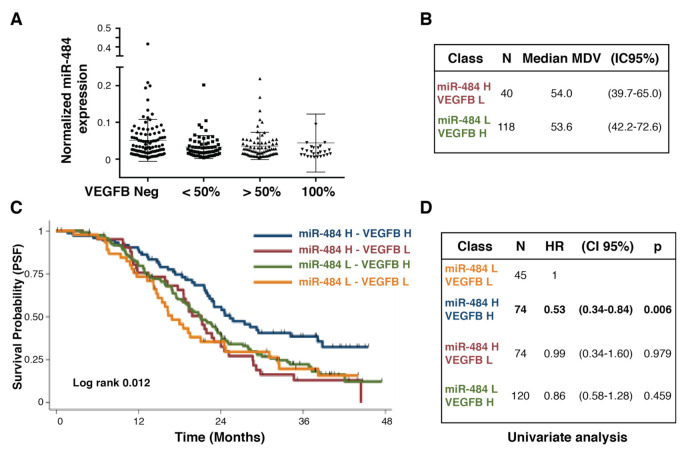
High miR-484 expression was associated with longer progression-free and overall survival. Notably, the combined expression of miR-484 and its target VEGFB identified a subset of patients that might mostly benefit from BEV treatment. No other significant correlations were found between the other analyzed biomarkers and patients' survival. The application of a shrinkage procedure to adjust for over-fitting hazard ratio estimates reduced the association significance.
The analysis of angiogenesis related biomarkers in EOC patients homogenously treated with BEV in first line provides novel insight in their prognostic value and suggests that some of them might merit to be tested as predictive markers of drug activity in dedicated randomized trials.
上皮性卵巢癌(EOC)是一种罕见的、高致死性疾病。在一部分高级别EOC患者中,使用抗血管生成药物贝伐单抗(BEV)进行维持治疗是一种有价值的选择。迄今为止,尚无经过验证的预测或预后生物标志物可用于选择可能从BEV治疗中获益的EOC患者。
免疫组织化学和RT-qPCR评估了一线接受化疗加BEV治疗的EOC患者(MITO16A/ManGO OV-2 IV期试验)中七种血管生成相关蛋白和十二种microRNA血管生成特征的表达。集中式统计分析评估了每种生物标志物、临床预后因素与生存结果之间的关联。
miR-484高表达与更长的无进展生存期和总生存期相关。值得注意的是,miR-484及其靶标VEGFB的联合表达确定了一部分可能最从BEV治疗中获益的患者。在其他分析的生物标志物与患者生存之间未发现其他显著相关性。应用收缩程序调整过度拟合的风险比估计值降低了关联的显著性。
对一线接受BEV均匀治疗的EOC患者的血管生成相关生物标志物进行分析,为其预后价值提供了新的见解,并表明其中一些生物标志物可能值得在专门的随机试验中作为药物活性的预测标志物进行检测。