Yang Yuting, Luo Liang, Tian Lixia, Zhao Changwei, Niu Hongli, Hu Yifeng, Shi Caihua, Xie Wen, Zhang Youjun
Forewarning and Management of Agricultural and Forestry Pests, Hubei Engineering Technology Center, Yangtze University, Jingzhou 434025, China.
Institute of Plant and Environment Protection Beijing Academy of Agriculture and Forestry Sciences, Beijing 100081, China.
Insects. 2021 Sep 28;12(10):879. doi: 10.3390/insects12100879.
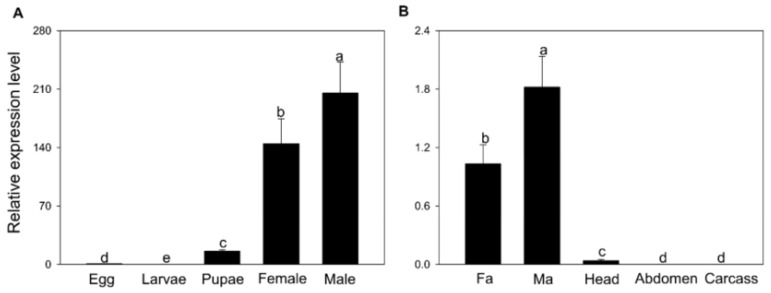
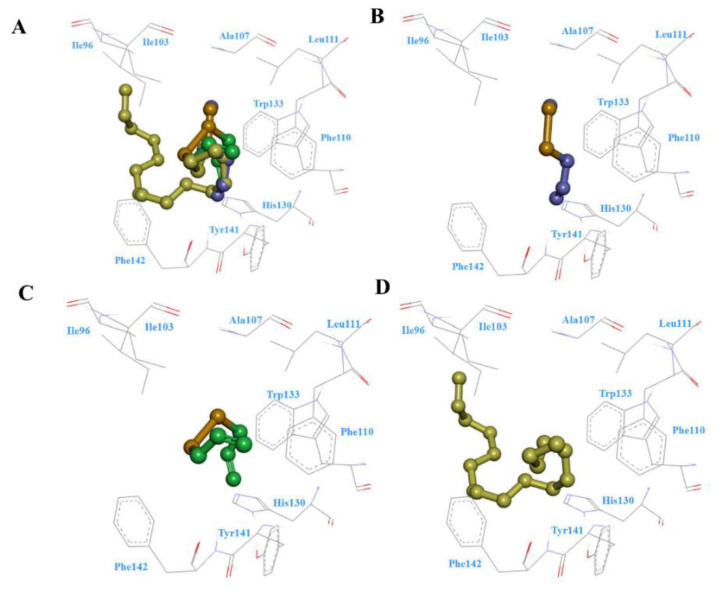
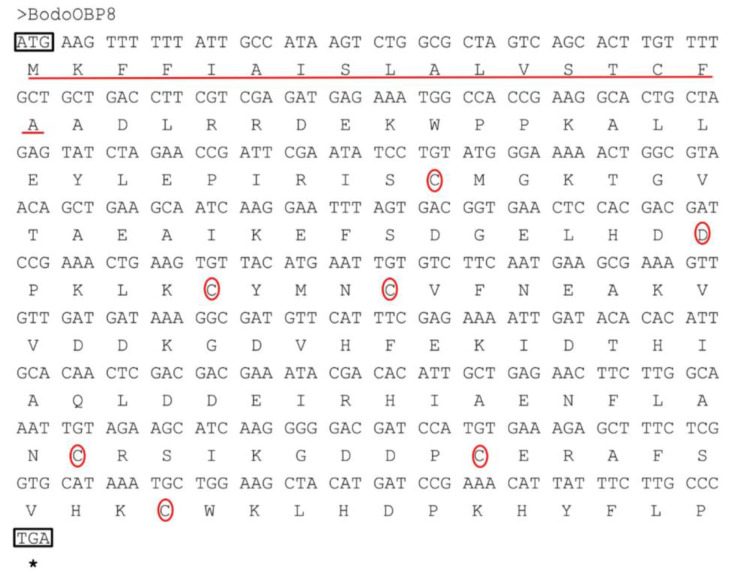
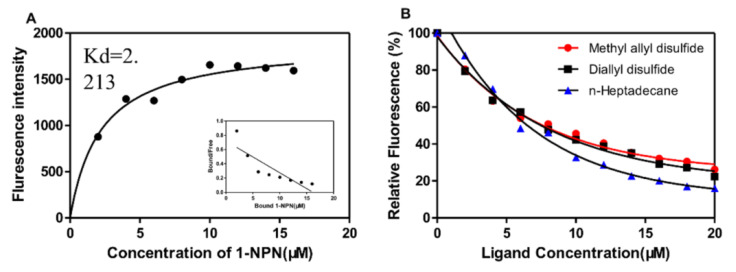
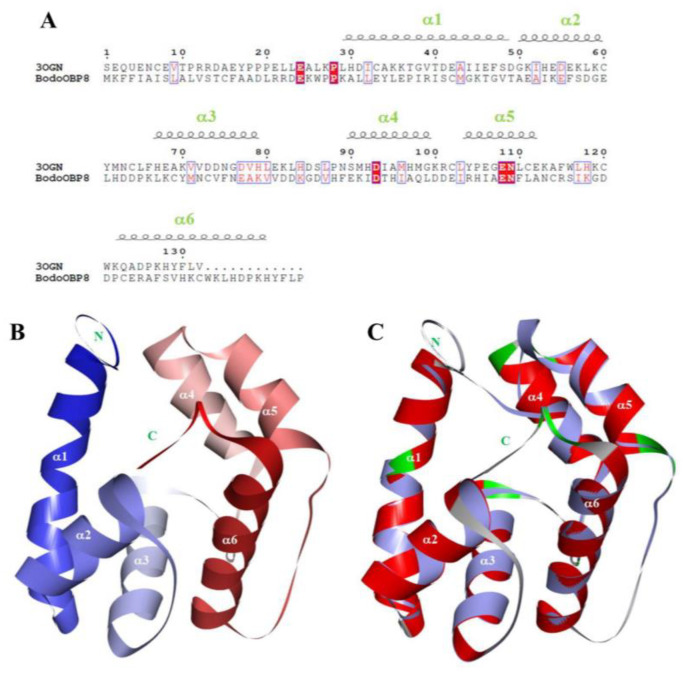
The belowground pest (Diptera: Sciaridae) has a sophisticated and sensitive olfactory system to detect semiochemical signals from the surrounding environment. In particular, odorant-binding proteins (OBPs) are crucial in capturing and transporting these semiochemical signals across the sensilla lymph to the corresponding odorant receptors. In this study, we cloned a full-length cDNA sequence of from . Real-time PCR (qRT-PCR) analysis revealed that has the highest expression levels in males, with more pronounced expression in the male antennae than in other tissues. In this study, the recombinant protein BodoOBP8 was successfully expressed by a bacterial system to explore its function. Competitive binding assays with 33 host plant volatiles and one putative sex pheromone (n-heptadecane) revealed that purified BodoOBP8 strongly bound to two sulfur compounds (methyl allyl disulfide and diallyl disulfide) and to n-heptadecane; the corresponding dissolution constants (Ki) were 4.04, 6.73, and 4.04 μM, respectively. Molecular docking indicated that Ile96, Ile103, Ala107, and Leu111, located in the hydrophobic cavity of BodoOBP8, are the key residues mediating the interaction of BodoOBP8 with two sulfur compounds (methyl allyl disulfide and diallyl disulfide) and n-heptadecane. These results show that BodoOBP8 plays a role in the recognition of plant volatiles and sex pheromones, suggesting its application as a molecular target for the screening of attractants and repellents and facilitating a new mechanism of control.
地下害虫(双翅目:眼蕈蚊科)拥有一套复杂且灵敏的嗅觉系统,用于探测来自周围环境的化学信号。特别是,气味结合蛋白(OBPs)在捕获和运输这些化学信号穿过感器淋巴至相应的气味受体过程中起着关键作用。在本研究中,我们从[具体来源]克隆了[某种生物]的全长cDNA序列。实时荧光定量PCR(qRT-PCR)分析表明,[该生物]在雄性个体中表达水平最高,且在雄性触角中的表达比其他组织更为显著。在本研究中,通过细菌系统成功表达了重组蛋白BodoOBP8以探究其功能。与33种寄主植物挥发物和一种假定的性信息素(正十七烷)进行的竞争结合试验表明,纯化后的BodoOBP8与两种含硫化合物(甲基烯丙基二硫化物和二烯丙基二硫化物)以及正十七烷有强烈结合;相应的解离常数(Ki)分别为4.04、6.73和4.04 μM。分子对接表明,位于BodoOBP8疏水腔内的Ile96、Ile103、Ala107和Leu111是介导BodoOBP8与两种含硫化合物(甲基烯丙基二硫化物和二烯丙基二硫化物)以及正十七烷相互作用的关键残基。这些结果表明,BodoOBP8在植物挥发物和性信息素的识别中发挥作用,提示其可作为筛选引诱剂和驱避剂的分子靶点,并有助于揭示一种新的害虫防治机制。