Hubei Engineering Technology Center for Pest Forewarning and Management, Institute of Insect Sciences, College of Agriculture, Yangtze University, Jingzhou 434000, Hubei, China.
Department of Plant Protection, Institute of Vegetables and Flowers, Chinese Academy of Agricultural Sciences, Beijing, China.
J Insect Sci. 2023 Jan 1;23(1). doi: 10.1093/jisesa/iead004.
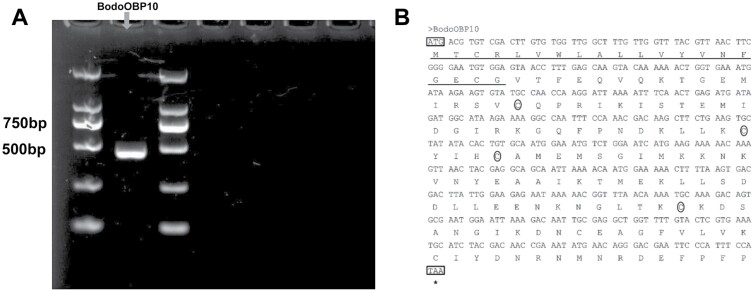
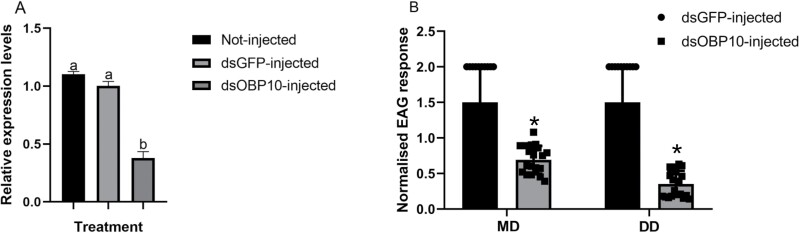
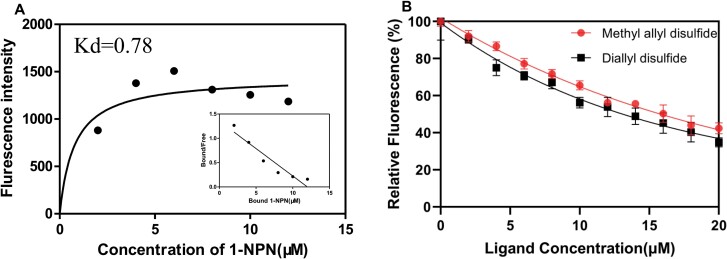
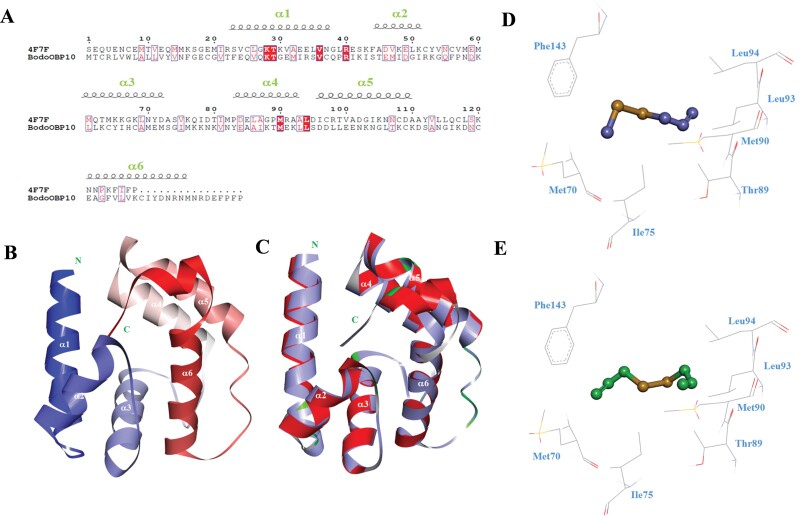
Bradysia odoriphaga (Diptera: Sciaridae) is a major insect pest of seven plant families including 30 commercial crops in Asia. The long-term use of chemical pesticides leads to problems such as insect resistance, environmental issues, and food contamination. Against this background, a novel pest control method should be developed. In insects, odorant-binding proteins (OBPs) transport odor molecules, including pheromones and plant volatiles, to olfactory receptors. Here, we expressed and characterized the recombinant B. odoriphaga OBP BodoOBP10, observing that it could bind the sulfur-containing compounds diallyl disulfide and methyl allyl disulfide with Ki values of 8.01 μM and 7.00 μM, respectively. Homology modeling showed that the BodoOBP10 3D structure was similar to that of a typical OBP. Both diallyl disulfide and methyl allyl disulfide bound to the same site on BodoOBP10, mediated by interactions with six hydrophobic residues Met70, Ile75, Thr89, Met90, Leu93, and Leu94, and one aromatic residue, Phe143. Furthermore, silencing BodoOBP10 expression via RNAi significantly reduced the electroantennogram (EAG) response to diallyl disulfide and methyl allyl disulfide. These findings suggest that BodoOBP10 should be involved in the recognition and localization of host plants.
黄曲条跳甲(双翅目:摇蚊科)是亚洲 30 种商业作物等 7 科植物的主要害虫。长期使用化学农药会导致抗药性、环境问题和食物污染等问题。在此背景下,应该开发一种新的害虫防治方法。在昆虫中,气味结合蛋白(OBP)将气味分子(包括信息素和植物挥发物)运输到嗅觉受体。在这里,我们表达和表征了重组 B. odoriphaga OBP BodoOBP10,观察到它可以分别以 8.01 μM 和 7.00 μM 的 Ki 值结合含硫化合物二烯丙基二硫和甲基丙烯基二硫。同源建模表明,BodoOBP10 的 3D 结构与典型 OBP 相似。二烯丙基二硫和甲基丙烯基二硫都结合在 BodoOBP10 的相同位点上,由与六个疏水性残基 Met70、Ile75、Thr89、Met90、Leu93 和 Leu94 以及一个芳香族残基 Phe143 相互作用介导。此外,通过 RNAi 沉默 BodoOBP10 表达显著降低了对二烯丙基二硫和甲基丙烯基二硫的触角电位(EAG)反应。这些发现表明 BodoOBP10 应该参与了对宿主植物的识别和定位。