Spring Ecology Research Group, Department of Environmental Sciences, University of Basel, 4056 Basel, Switzerland.
Genes (Basel). 2021 Sep 23;12(10):1481. doi: 10.3390/genes12101481.
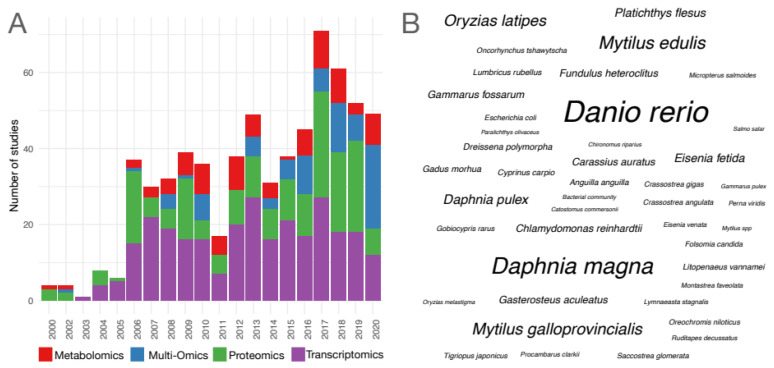
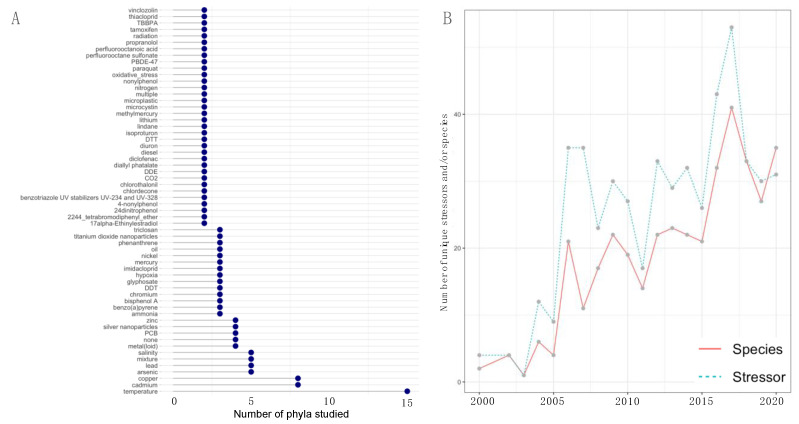
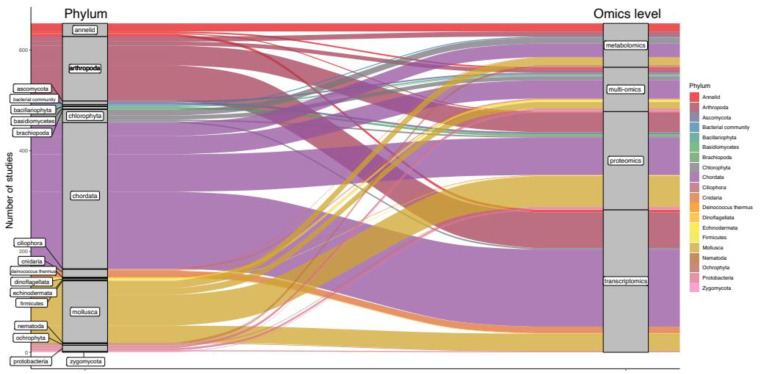
Our ability to predict and assess how environmental changes such as pollution and climate change affect components of the Earth's biome is of paramount importance. This need positioned the fields of ecotoxicology and stress ecology at the center of environmental monitoring efforts. Advances in these interdisciplinary fields depend not only on conceptual leaps but also on technological advances and data integration. High-throughput "omics" technologies enabled the measurement of molecular changes at virtually all levels of an organism's biological organization and thus continue to influence how the impacts of stressors are understood. This bibliometric review describes literature trends (2000-2020) that indicate that more different stressors than species are studied each year but that only a few stressors have been studied in more than two phyla. At the same time, the molecular responses of a diverse set of non-model species have been investigated, but cross-species comparisons are still rare. While transcriptomics studies dominated until 2016, a shift towards proteomics and multiomics studies is apparent. There is now a wealth of data at functional omics levels from many phylogenetically diverse species. This review, therefore, addresses the question of how to integrate omics information across species.
我们预测和评估环境变化(如污染和气候变化)如何影响地球生物群落组成部分的能力至关重要。这种需求使生态毒理学和应激生态学领域成为环境监测工作的核心。这些跨学科领域的进展不仅取决于概念上的飞跃,还取决于技术进步和数据集成。高通量“组学”技术使人们几乎可以在生物体的所有生物学组织层面上测量分子变化,从而继续影响人们对胁迫影响的理解方式。本文献计量学综述描述了(2000-2020 年)文献趋势,表明每年研究的不同胁迫因素多于物种,但只有少数胁迫因素在两个以上门中进行了研究。同时,对大量非模式物种的分子反应进行了研究,但跨物种比较仍然很少。尽管转录组学研究直到 2016 年一直占据主导地位,但向蛋白质组学和多组学研究的转变是明显的。现在,许多系统发育上多样化的物种在功能组学水平上都有大量的数据。因此,本综述探讨了如何在物种间整合组学信息的问题。