School of Life Sciences, University of Technology Sydney, Sydney, NSW 2007, Australia.
Research Centre, The Seventh Affiliated Hospital of Sun Yat-sen University, Shenzhen 518107, China.
Int J Mol Sci. 2021 Oct 18;22(20):11207. doi: 10.3390/ijms222011207.
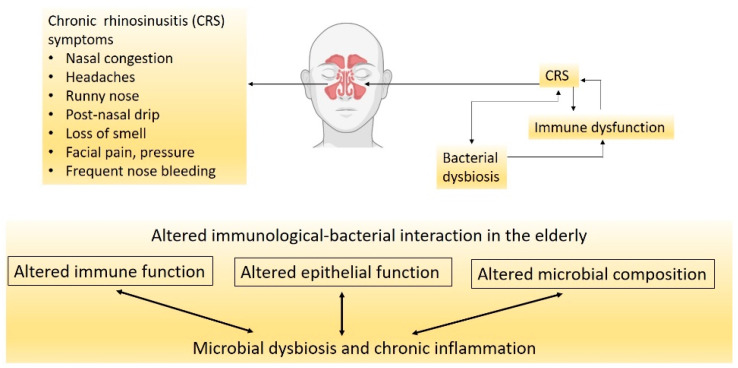
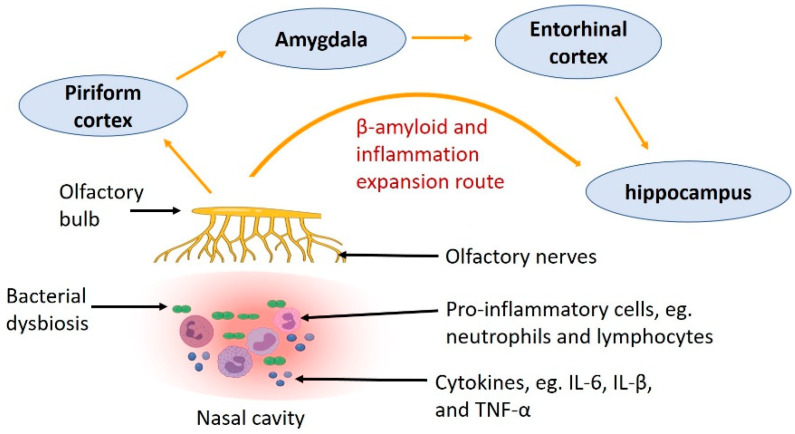
Among millions of sufferers of chronic rhinosinusitis (CRS), the challenge is not only constantly coping with CRS-related symptoms, such as congested nose, sinus pain, and headaches, but also various complications, such as attention difficulties and possible depression. These complications suggest that neural activity in the central nervous system may be altered in those patients, leading to unexpected conditions, such as neurodegeneration in elderly patients. Recently, some studies linked the presence of CRS and cognitive impairments that could further develop into Alzheimer's disease (AD). AD is the leading cause of dementia in the elderly and is characterised by progressive memory loss, cognitive behavioural deficits, and significant personality changes. The microbiome, especially those in the gut, has been recognised as a human organ and plays an important role in the development of various conditions, including AD. However, less attention has been paid to the microbiome in the nasal cavity. Increased nasal inflammatory responses due to CRS may be an initial event that changes local microbiome homeostasis, which may further affect neuronal integrity in the central nervous system resulting in AD. Evidence suggests a potential of β-amyloid deposition starting in olfactory neurons, which is then expanded from the nasal cavity to the central nervous system. In this paper, we reviewed currently available evidence that suggests this potential mechanism to advise the need to investigate the link between these two conditions.
在数百万慢性鼻-鼻窦炎(CRS)患者中,不仅要不断应对与 CRS 相关的症状,如鼻塞、鼻窦疼痛和头痛,还要应对各种并发症,如注意力困难和可能的抑郁。这些并发症表明,中枢神经系统的神经活动可能在这些患者中发生改变,导致意想不到的情况,如老年患者的神经退行性变。最近,一些研究将 CRS 的存在与认知障碍联系起来,这些认知障碍可能进一步发展为阿尔茨海默病(AD)。AD 是老年人痴呆症的主要原因,其特征是进行性记忆丧失、认知行为缺陷和显著的人格变化。微生物组,特别是肠道中的微生物组,已被认为是人类的一个器官,并在各种疾病的发展中发挥重要作用,包括 AD。然而,人们对鼻腔微生物组的关注较少。CRS 引起的鼻腔炎症反应增加可能是改变局部微生物组平衡的初始事件,这可能进一步影响中枢神经系统中的神经元完整性,导致 AD。有证据表明,β-淀粉样蛋白沉积可能始于嗅觉神经元,然后从鼻腔扩展到中枢神经系统。在本文中,我们回顾了目前可用的证据,这些证据表明了这种潜在的机制,并建议有必要研究这两种情况之间的联系。