De Roo Chloë, Tilleman Kelly
Department for Reproductive Medicine, Ghent University Hospital, 9000 Ghent, Belgium.
J Clin Med. 2021 Oct 13;10(20):4680. doi: 10.3390/jcm10204680.
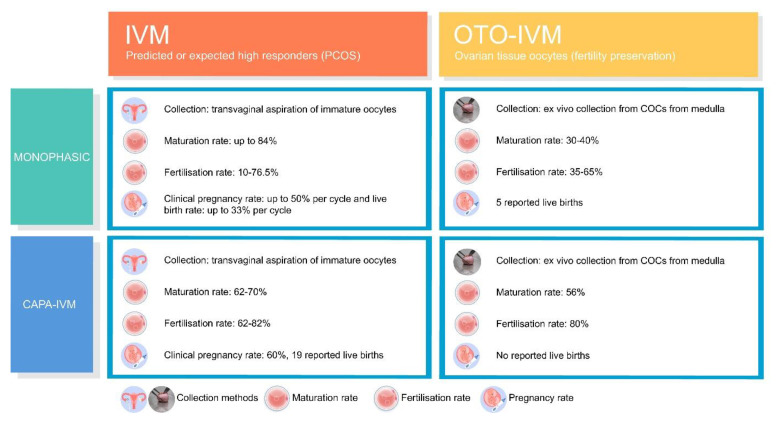
In vitro maturation (IVM) of transvaginally aspirated immature oocytes is an effective and safe assisted reproductive treatment for predicted or high responder patients. Currently, immature oocytes are also being collected from the contralateral ovary during laparoscopy/laparotomy and even ex vivo from the excised ovary or the spent media during ovarian tissue preparation prior to ovarian cortex cryopreservation. The first live births from in vitro-matured ovarian tissue oocytes (OTO-IVM) were reported after monophasic OTO-IVM, showing the ability to achieve mature OTO-IVM oocytes. However, fertilisations rates and further embryological developmental capacity appeared impaired. The introduction of a biphasic IVM, also called capacitation (CAPA)-IVM, has been a significant improvement of the oocytes maturation protocol. However, evidence on OTO-IVM is still scarce and validation of the first results is of utmost importance to confirm reproducibility, including the follow-up of OTO-IVM children. Differences between IVM and OTO-IVM should be well understood to provide realistic expectations to patients.
经阴道抽吸未成熟卵母细胞的体外成熟(IVM)对于预测反应良好或高反应性患者而言是一种有效且安全的辅助生殖治疗方法。目前,在腹腔镜检查/剖腹手术期间,也会从对侧卵巢采集未成熟卵母细胞,甚至在卵巢皮质冷冻保存前的卵巢组织制备过程中,从切除的卵巢或废弃培养基中离体采集未成熟卵母细胞。在单相卵巢组织卵母细胞体外成熟(OTO-IVM)后,首次报道了经体外成熟的卵巢组织卵母细胞(OTO-IVM)活产,显示出获得成熟OTO-IVM卵母细胞的能力。然而,受精率和进一步的胚胎发育能力似乎受到损害。双相IVM(也称为获能(CAPA)-IVM)的引入是卵母细胞成熟方案的一项重大改进。然而,关于OTO-IVM的证据仍然很少,对首批结果进行验证对于确认可重复性至关重要,包括对OTO-IVM儿童的随访。应充分了解IVM和OTO-IVM之间的差异,以便为患者提供切合实际的期望。