Kuo Yu-Lun, Lee Jian-Tao, Yeh Mei-Yu
Department of Nursing, Tzu Chi University of Science and Technology, Hualien 970, Taiwan.
School of Nursing, College of Medicine, Chang Gung University, Taoyuan 333, Taiwan.
Healthcare (Basel). 2021 Sep 29;9(10):1291. doi: 10.3390/healthcare9101291.
The development of nursing students' ability to practice humanistic care is extremely important.
This study explored students' learning experience when providing humanistic care for older adults with chronic diseases while employing intergenerational narrative learning. An exploratory descriptive qualitative study design was adopted.
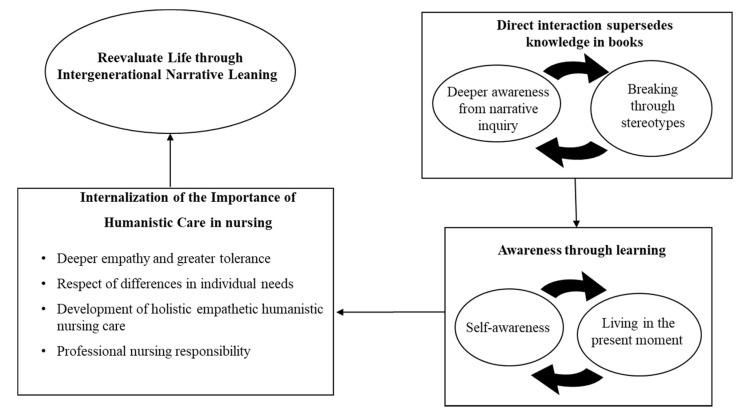
We analyzed evaluations from 35 students who completed the course, in which intergenerational narrative learning was employed. Evaluations contained open-ended questions that asked students to reflect upon their experiences and describe their perceptions, thoughts, and feelings after the course. Three main themes were revealed by thematic analysis: direct interaction supersedes knowledge in books, the framework for improving humanistic caring, and internalization of the importance of humanistic care in nursing.
An awareness of patients' perspectives inspired the students in their development toward a more profound caring attitude. The intergenerational narrative learning teaching strategy could foster professional and humanistic-centered care in nursing students.
培养护生的人文关怀实践能力极其重要。
本研究采用代际叙事学习法,探讨护生为慢性病老年人提供人文关怀时的学习体验。采用探索性描述性定性研究设计。
我们分析了35名完成该课程(采用代际叙事学习法)的学生的评价。评价包含开放式问题,要求学生反思他们的经历,并描述课程结束后的看法、想法和感受。主题分析揭示了三个主要主题:直接互动比书本知识更重要、改善人文关怀的框架以及护理中人文关怀重要性的内化。
对患者观点的认识激发了学生培养更深刻关怀态度的发展。代际叙事学习教学策略可以促进护生以专业和人文为中心的护理。