Pereira Ana Rita, Oliveira Andreia
Faculty of Health Sciences (Nutrition Sciences), University Fernando Pessoa, Rua Carlos da Maia 296, 4200-150 Porto, Portugal.
EPIUnit-Instituto de Saúde Pública da Universidade do Porto (Institute of Public Health of the University of Porto), Rua das Taipas 135, 4050-600 Porto, Portugal.
Nutrients. 2021 Sep 28;13(10):3447. doi: 10.3390/nu13103447.
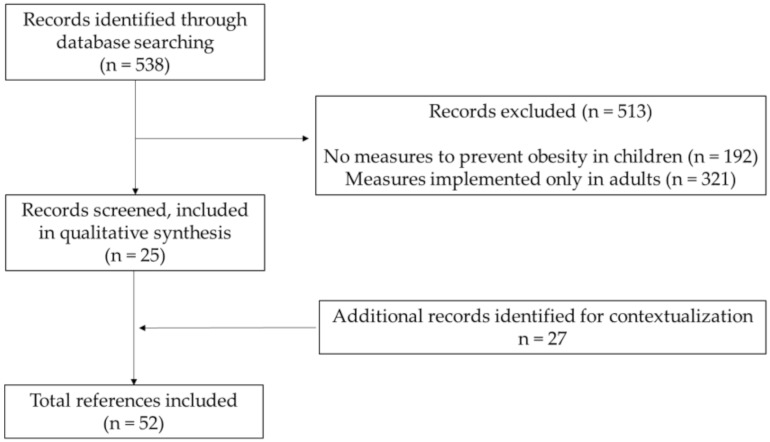
Several dietary interventions have been conducted to prevent/reduce childhood obesity, but most of them are known to have failed in tackling the obesity epidemic. This study aimed to review the existing literature on dietary interventions for the prevention of childhood obesity and their effectiveness. A literature search was conducted using PubMed Central. Only articles published between 2009 and 2021, written in English, conducted in humans, and including children and/or adolescents (<18 years old) were considered. The majority of studies were school-based interventions, with some addressing the whole community, and including some interventions in the food sector (e.g., taxation of high fat/sugar foods, front-of-pack labelling) and through mass media (e.g., restrictions on food advertising for children) that directly or indirectly could help to manage childhood obesity. Most of the programs/interventions conducted focus mainly on person-based educational approaches, such as nutrition/diet education sessions, allied to the promotion of physical activity and lifestyles to students, parents, and school staff, and less on environmental changes to offer healthier food choices. Only a few trials have focused on capacity building and macro-policy changes, such as the adaptation of the built environment of the school, serving smaller portion sizes, and increasing the availability and accessibility of healthy foods and water in schools, and restricting the access to vending machines, for example. Overall, most of the intervention studies showed no consistent effects on changing the body mass index of children; they have only reported small weight reductions, clinically irrelevant, or no effects at all. Little is known about the sustainability of interventions over time.
已经开展了多项饮食干预措施来预防/减少儿童肥胖,但其中大多数在应对肥胖流行方面都失败了。本研究旨在综述关于预防儿童肥胖的饮食干预措施及其有效性的现有文献。使用美国国立医学图书馆的生物医学文献数据库进行了文献检索。仅纳入2009年至2021年间发表的、英文撰写的、以人为研究对象且包括儿童和/或青少年(<18岁)的文章。大多数研究是基于学校的干预措施,有些针对整个社区,还包括食品行业的一些干预措施(如对高脂肪/高糖食品征税、食品包装正面标签)以及通过大众媒体(如限制儿童食品广告),这些措施可直接或间接有助于控制儿童肥胖。所开展的大多数项目/干预措施主要侧重于基于个人的教育方法,如营养/饮食教育课程,并向学生、家长和学校工作人员推广体育活动和生活方式,而较少关注环境变化以提供更健康的食物选择。只有少数试验侧重于能力建设和宏观政策变化,例如学校建筑环境的改造、提供更小份的食物、增加学校健康食品和水的供应及可及性,以及限制自动售货机的使用等。总体而言,大多数干预研究对改变儿童体重指数没有一致的效果;它们仅报告了少量的体重减轻,在临床上无意义,或者根本没有效果。关于干预措施随时间的可持续性知之甚少。