Chinese Center for Disease Control and Prevention, National Institute for Nutrition and Health, Beijing 100050, China.
Nutrients. 2021 Oct 1;13(10):3488. doi: 10.3390/nu13103488.
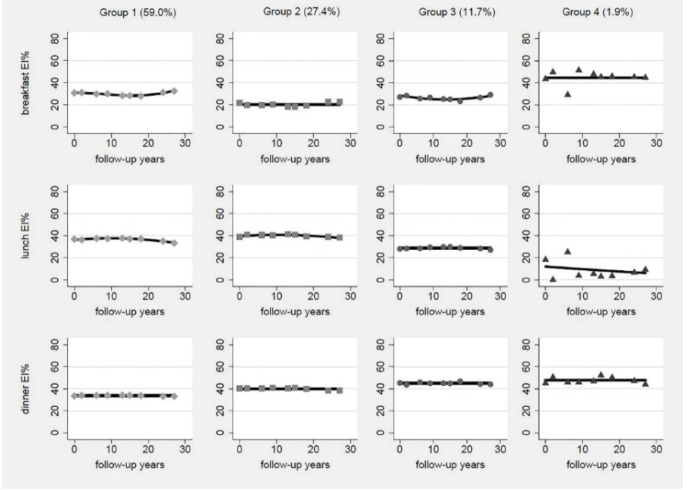
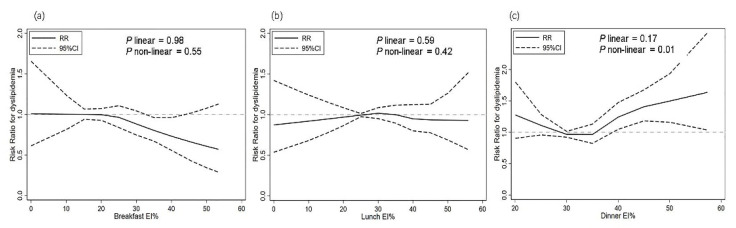
Few studies have examined the secular trend of energy intake distribution. This study aims to describe trajectories of energy intake distribution and determine their association with dyslipidemia risk. Data of 2843 adult participants from the China Health and Nutrition Survey (CHNS) were analyzed. Trajectory groups of energy intake distribution were identified by multi-trajectory model over 27 years. Multilevel mixed-effects modified Poisson regression with robust estimation of variance was used to calculate risk ratio for incident dyslipidemia in a 9-year follow-up. Four trajectory groups were identified: "Energy evenly distributed group" (Group 1), "Lunch and dinner energy dominant group" (Group 2), "Dinner energy dominant group" (Group 3), "breakfast and dinner energy dominant group" (Group 4). Compared with Group 1, Group 3 was associated with higher risk of dyslipidemia (RR = 1.48, 95% CI = 1.26, 1.75), hypercholesterolemia (RR = 1.96, 95% CI = 1.37, 2.81) and high low-density lipoproteins cholesterols (LDL-C) (RR = 2.41, 95% CI = 1.82, 3.20). A U-shape was observed between cumulative average proportion of dinner energy and dyslipidemia risk ( for non-linear = 0.01), with stronger relationship at 40% and above. Energy intake distribution characterized by higher proportion of dinner energy, especially over 40% was associated with higher dyslipidemia risk in Chinese adults.
很少有研究探讨能量摄入分布的长期趋势。本研究旨在描述能量摄入分布轨迹,并确定其与血脂异常风险的关系。本研究分析了来自中国健康与营养调查(CHNS)的 2843 名成年参与者的数据。通过多轨迹模型在 27 年内识别能量摄入分布的轨迹组。采用多层混合效应修正泊松回归模型,以稳健方差估计计算 9 年随访期间血脂异常的发病风险比。确定了 4 个轨迹组:“能量均匀分布组”(第 1 组)、“午餐和晚餐能量主导组”(第 2 组)、“晚餐能量主导组”(第 3 组)、“早餐和晚餐能量主导组”(第 4 组)。与第 1 组相比,第 3 组发生血脂异常的风险更高(RR=1.48,95%CI=1.26,1.75)、高胆固醇血症(RR=1.96,95%CI=1.37,2.81)和高 LDL-C(RR=2.41,95%CI=1.82,3.20)。晚餐能量的累积平均比例与血脂异常风险之间呈 U 型关系(非线性=0.01),在 40%及以上时相关性更强。晚餐能量占比更高的能量摄入分布特征,尤其是占比超过 40%,与中国成年人血脂异常风险增加有关。