Al-Hazzaa Hazzaa M, Albawardi Nada M
Lifestyle and Health Research Center, Health Sciences Research Center, Princess Nourah Bint Abdulrahman University, Riyadh 11552, Saudi Arabia.
Life (Basel). 2021 Oct 13;11(10):1078. doi: 10.3390/life11101078.
Undesirable lifestyle behaviors are associated with many adverse health outcomes. This study revisited the lifestyle behaviors, dietary habits, and overweight/obesity status of Saudi adolescents from Riyadh during the year 2019/2020. We report on the rationale, design, and methodology of the current study and provide preliminary findings of the changes that occurred between the two cross-sectional studies within the span of a ten-year period.
A comparison was made between two cross-sectional studies, one conducted in 2009/2010 and the other in 2019/2020, using the same design, methods, and instruments. A multistage stratified cluster random sampling technique was used to select adolescents attending public and private secondary schools. Measurements included demographics, weight, height, waist circumference, physical activity (using valid questionnaire and accelerometer), sedentary time, sleep duration, and dietary habits.
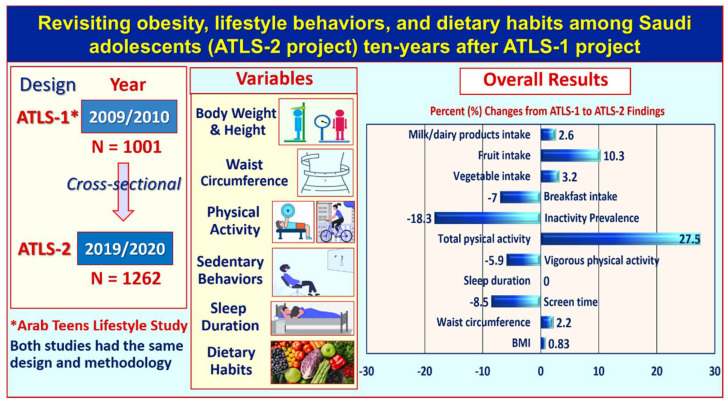
The total number of participants was 1262 adolescents, of which 52.4% were male, with a mean (SD) age of 16.4 ± 0.95 years. About 41% of paternal and 39.1% of maternal education levels were university degrees. Over 37% of the families earned more than SAR 20,000/month. Body mass index and waist circumference of males was larger than that of females and the overall prevalence of overweight/obesity was 40.5% with significance ( < 0.001) difference between males (47.3%) and females (32.8%). Between 2009/2010 and 2019/2020 datasets, there were significant changes in age ( < 0.001), waist circumference ( < 0.001), screen time ( < 0.001), moderate-intensity physical activity ( < 0.001), vigorous-intensity physical activity ( < 0.001), total physical activity ( < 0.001), and consumption of breakfast ( = 0.015) and fruits ( = 0.002).
The most notable change between the two studies was a significant reduction in the prevalence of physical inactivity among Saudi adolescents, which was due to increased levels of moderate-intensity physical activity among Saudi females, as a result of recent positive sociopolitical changes occurring in the country over the past four years. The findings provided rich information that can be used to explore trends in overweight/obesity, lifestyle behaviors, and dietary habits among Saudi adolescents over the past ten-year period.
不良生活方式行为与许多不良健康后果相关。本研究重新审视了2019/2020年利雅得沙特青少年的生活方式行为、饮食习惯和超重/肥胖状况。我们报告了当前研究的基本原理、设计和方法,并提供了在十年期间两项横断面研究之间发生变化的初步结果。
使用相同的设计、方法和工具,对2009/2010年进行的一项横断面研究和2019/2020年进行的另一项横断面研究进行比较。采用多阶段分层整群随机抽样技术,选取公立和私立中学的青少年。测量内容包括人口统计学特征、体重、身高、腰围、身体活动(使用有效问卷和加速度计)、久坐时间、睡眠时间和饮食习惯。
参与者总数为1262名青少年,其中52.4%为男性,平均(标准差)年龄为16.4±0.95岁。约41%的父亲和39.1%的母亲教育水平为大学学位。超过37%的家庭月收入超过20000沙特里亚尔。男性的体重指数和腰围大于女性,超重/肥胖的总体患病率为40.5%,男性(47.3%)和女性(32.8%)之间存在显著差异(<0.001)。在2009/2010年和2019/2020年的数据集之间,年龄(<0.001)、腰围(<0.001)、屏幕时间(<0.001)、中等强度身体活动(<0.001)、高强度身体活动(<0.001)、总身体活动(<0.001)以及早餐(=0.015)和水果(=0.002)的摄入量均有显著变化。
两项研究之间最显著的变化是沙特青少年身体活动不足患病率显著降低,这是由于沙特女性中等强度身体活动水平增加,这是过去四年该国发生的积极社会政治变化的结果。这些发现提供了丰富的信息,可用于探索过去十年沙特青少年超重/肥胖、生活方式行为和饮食习惯的趋势。