Department of Medical Microbiology, School of Nutrition and Translational Research in Metabolism (NUTRIM), Maastricht University Medical Center+, 6229 ER Maastricht, The Netherlands.
Department of Medical Microbiology, Faculty of Applied Medical Sciences, Jazan University, Jazan 45142, Saudi Arabia.
Cells. 2021 Oct 19;10(10):2795. doi: 10.3390/cells10102795.
In the past, many studies suggested a crucial role for dysbiosis of the gut microbiota in the etiology of Crohn's disease (CD). However, despite being important players in host-bacteria interaction, the role of bacterial membrane vesicles (MV) has been largely overlooked in the pathogenesis of CD. In this study, we addressed the composition of the bacterial and MV composition in fecal samples of CD patients and compared this to the composition in healthy individuals.
Fecal samples from six healthy subjects (HC) in addition to twelve CD patients (six active, six remission) were analyzed in this study. Fecal bacterial membrane vesicles (fMVs) were isolated by a combination of ultrafiltration and size exclusion chromatography. DNA was obtained from the fMV fraction, the pellet of dissolved feces as bacterial DNA (bDNA), or directly from feces as fecal DNA (fDNA). The fMVs were characterized by nanoparticle tracking analysis and cryo-electron microscopy. Amplicon sequencing of 16s rRNA V4 hypervariable gene regions was conducted to assess microbial composition of all fractions.
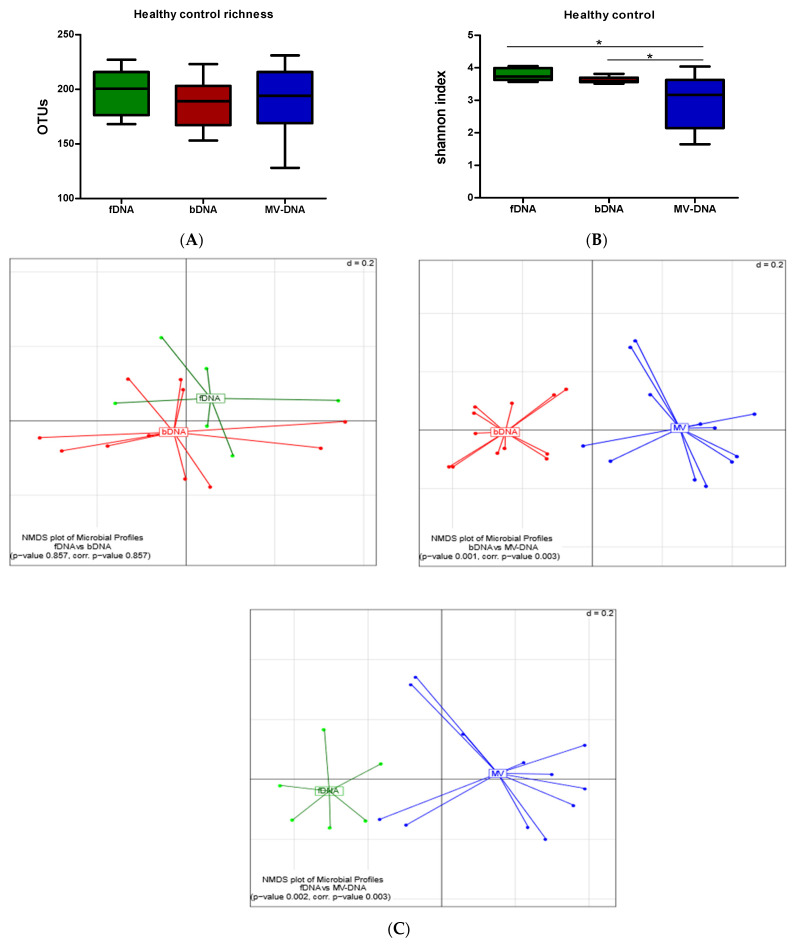
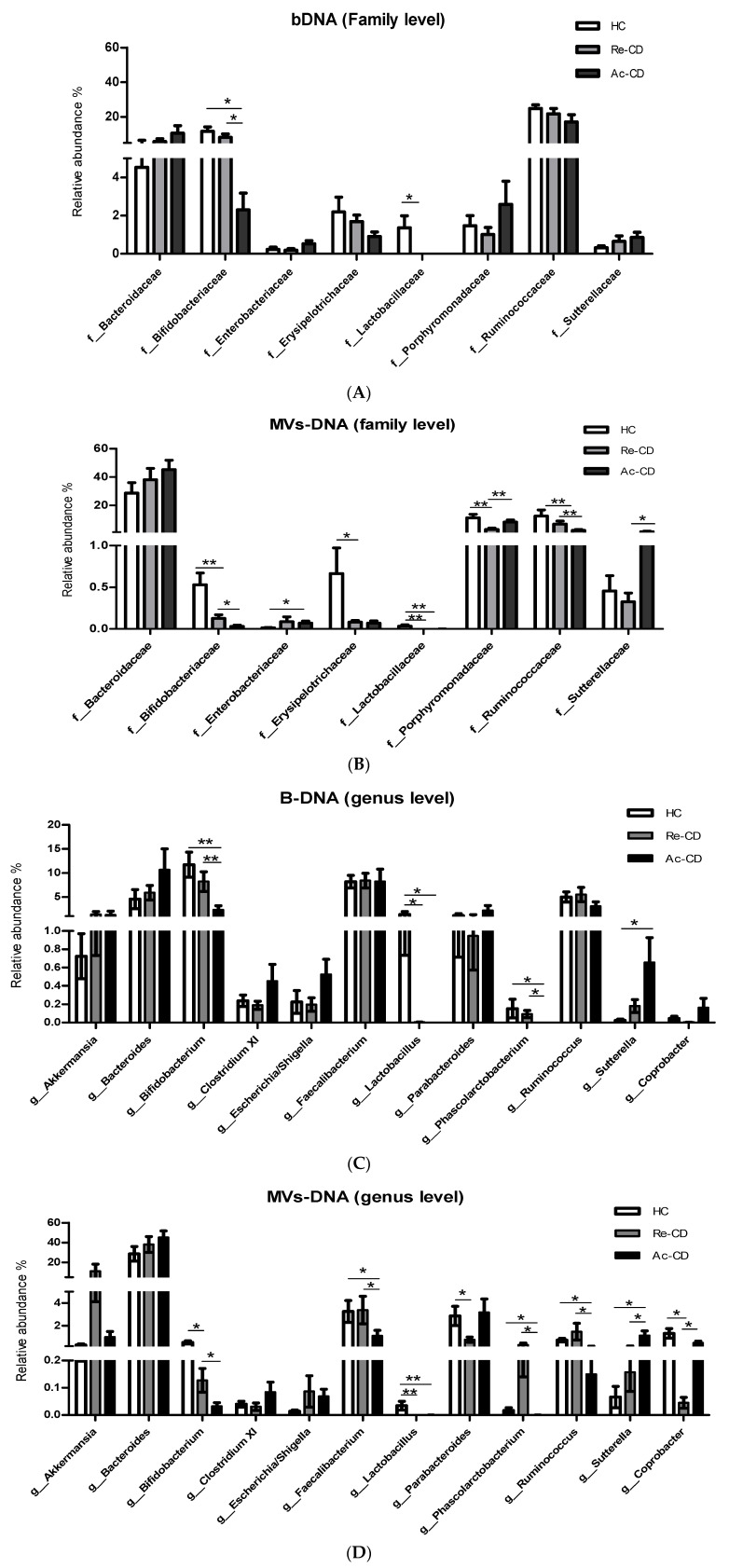
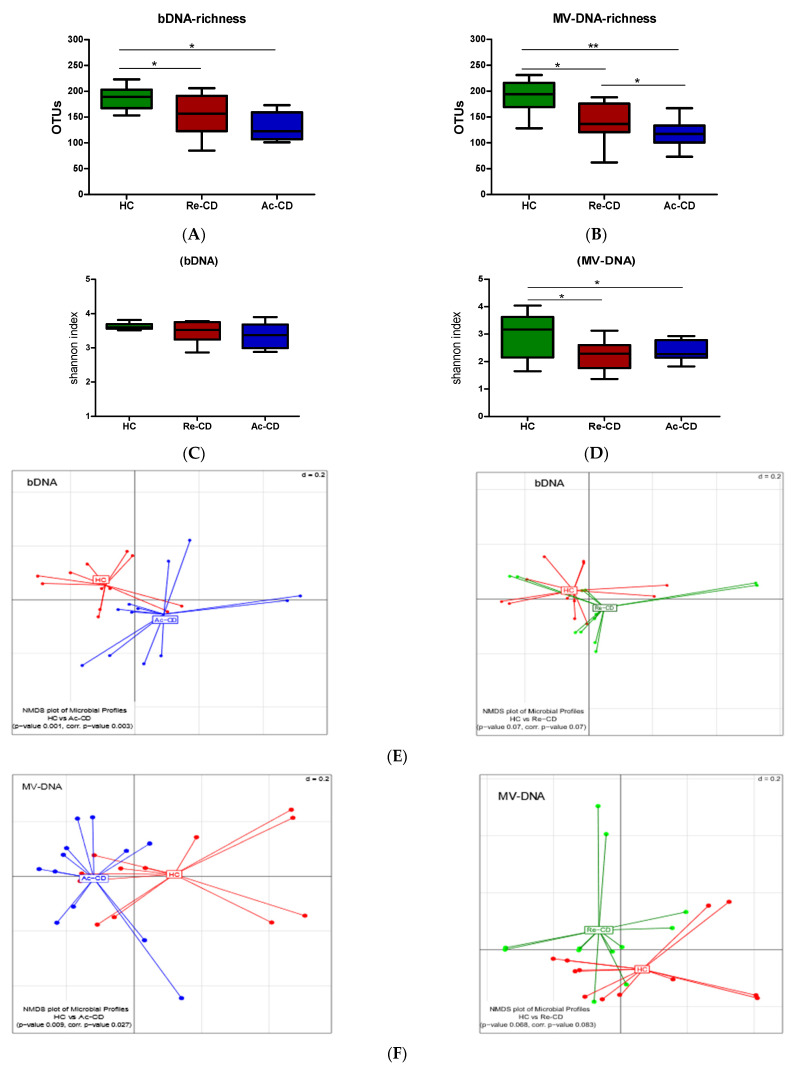
Beta-diversity analysis showed that the microbial community structure of the fMVs was significantly different from the microbial profiles of the fDNA and bDNA. However, no differences were observed in microbial composition between fDNA and bDNA. The microbial richness of fMVs was significantly decreased in CD patients compared to HC, and even lower in active patients. Profiling of fDNA and bDNA demonstrated that was the most dominant phylum in these fractions, while in fMVs was dominant. In fMV, several families and genera belonging to and were significantly altered in CD patients when compared to HC.
The microbial alterations of MVs in CD patients particularly in and suggest a possible role of MVs in host-microbe symbiosis and induction or progression of inflammation in CD pathogenesis. Yet, the exact role for these fMV in the pathogenesis of the disease needs to be elucidated in future studies.
过去,许多研究表明肠道微生物群失调在克罗恩病(CD)的发病机制中起关键作用。然而,尽管细菌膜泡(MV)在宿主-细菌相互作用中是重要的参与者,但在 CD 的发病机制中,MV 的作用在很大程度上被忽视了。在这项研究中,我们研究了 CD 患者粪便样本中的细菌和 MV 组成,并将其与健康个体的组成进行了比较。
本研究分析了六名健康受试者(HC)和十二名 CD 患者(六名活动期,六名缓解期)的粪便样本。通过超滤和大小排阻色谱的组合分离粪便细菌膜泡(fMVs)。从 fMV 部分、溶解粪便的沉淀中获得细菌 DNA(bDNA)或直接从粪便中获得粪便 DNA(fDNA)中获得 DNA。通过纳米颗粒跟踪分析和冷冻电子显微镜对 fMVs 进行了表征。对 16s rRNA V4 高变区进行扩增子测序,以评估所有馏分的微生物组成。
β多样性分析表明,fMVs 的微生物群落结构与 fDNA 和 bDNA 的微生物谱明显不同。然而,fDNA 和 bDNA 之间的微生物组成没有差异。与 HC 相比,CD 患者的 fMVs 微生物丰富度显著降低,活动期患者的丰富度甚至更低。fDNA 和 bDNA 的分析表明,在这些馏分中,是最主要的门,而在 fMVs 中,是最主要的门。在 fMV 中,与 HC 相比,CD 患者中属于 和 的几个科和属发生了显著改变。
CD 患者的 MV 微生物改变,特别是在 和 中,提示 MV 可能在宿主-微生物共生和诱导或进展炎症中发挥作用在 CD 的发病机制中。然而,这些 fMV 在疾病发病机制中的确切作用需要在未来的研究中阐明。