Institute for Clinical Chemistry, University Medical Center Goettingen, 37075 Goettingen, Germany.
DZHK (German Centre for Cardiovascular Research), Partner Site Goettingen, 37075 Goettingen, Germany.
Cells. 2021 Oct 19;10(10):2796. doi: 10.3390/cells10102796.
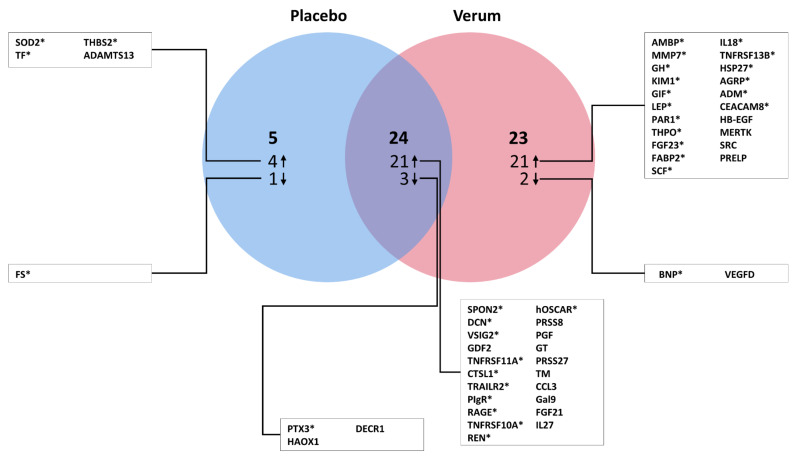
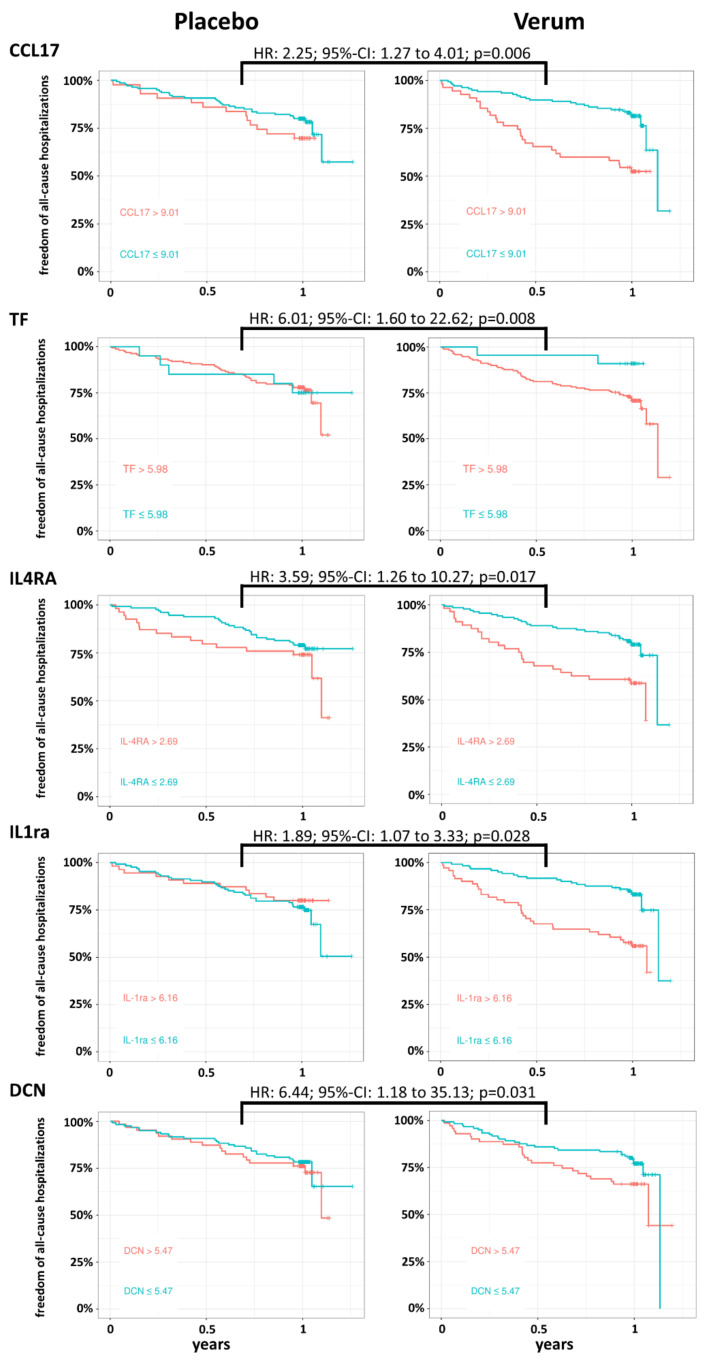
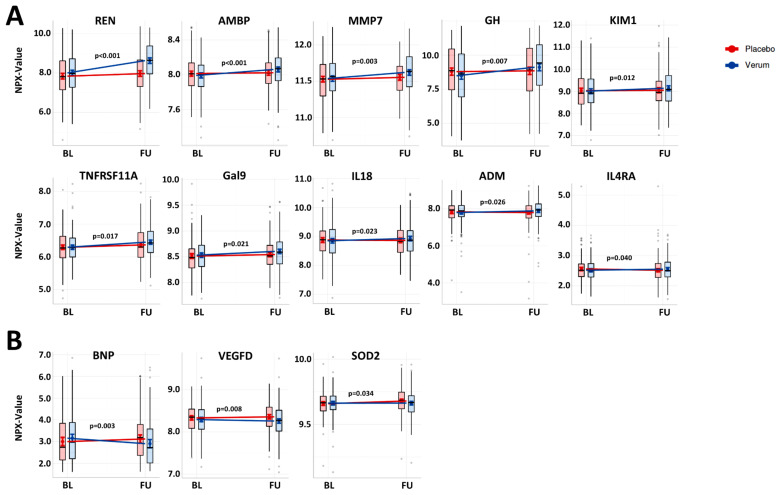
The pathophysiology of heart failure with preserved ejection fraction (HFpEF) is poorly understood and therapeutic strategies are lacking. This study aimed to identify plasma proteins with pathophysiological relevance in HFpEF and with respect to spironolactone-induced effects. We assessed 92 biomarkers in plasma samples from 386 HFpEF patients-belonging to the Aldo-DHF trial-before (baseline, BL) and after one-year treatment (follow up, FU) with spironolactone (verum) or a placebo. At BL, various biomarkers showed significant associations with the two Aldo-DHF primary end point parameters: 33 with E/e' and 20 with peak VO. Ten proteins including adrenomedullin, FGF23 and inflammatory peptides (e.g., TNFRSF11A, TRAILR2) were significantly associated with both parameters, suggesting a role in the clinical HFpEF presentation. For 13 proteins, expression changes from BL to FU were significantly different between verum and placebo. Among them were renin, growth hormone, adrenomedullin and inflammatory proteins (e.g., TNFRSF11A, IL18 and IL4RA), indicating distinct spironolactone-mediated effects. BL levels of five proteins, e.g., inflammatory markers such as CCL17, IL4RA and IL1ra, showed significantly different effects on the instantaneous risk for hospitalization between verum and placebo. This study identified plasma proteins with different implications in HFpEF and following spironolactone treatment. Future studies need to define their precise mechanistic involvement.
心力衰竭伴射血分数保留(HFpEF)的病理生理学机制尚不清楚,治疗策略也缺乏。本研究旨在确定与 HFpEF 病理生理相关且与螺内酯诱导作用相关的血浆蛋白。我们评估了 386 例 HFpEF 患者(来自 Aldo-DHF 试验)的血浆样本中的 92 种生物标志物,这些患者在基线(BL)和螺内酯(阳性)或安慰剂治疗一年后(随访,FU)进行了评估。在 BL 时,各种生物标志物与 Aldo-DHF 的两个主要终点参数之间存在显著相关性:33 个与 E/e'相关,20 个与峰值 VO 相关。包括肾上腺髓质素、FGF23 和炎症肽(如 TNFRSF11A、TRAILR2)在内的 10 种蛋白质与两个参数均显著相关,提示其在 HFpEF 临床表现中起作用。在 BL 到 FU 的表达变化,在阳性和安慰剂之间有 13 种蛋白质有显著差异。其中包括肾素、生长激素、肾上腺髓质素和炎症蛋白(如 TNFRSF11A、IL18 和 IL4RA),表明存在螺内酯介导的不同作用。BL 水平的五种蛋白质,如炎症标志物如 CCL17、IL4RA 和 IL1ra,在阳性和安慰剂之间对住院的即时风险有显著不同的影响。本研究确定了与 HFpEF 和螺内酯治疗后具有不同影响的血浆蛋白。未来的研究需要确定它们的确切机制参与。