State Key Laboratory of Translational Medicine and Innovative Drug Development, Jiangsu Simcere Pharmaceutical Co. Ltd, Nanjing, Jiangsu, China.
DMPK and Clinical Pharmacology, Suzhou Ribo Life Science Co. Ltd, Kushan, Jiangsu, China.
BMC Cancer. 2021 Oct 22;21(1):1134. doi: 10.1186/s12885-021-08859-5.
Signaling through VEGF/VEGFR induces cancer angiogenesis and affects immune cells. An increasing number of studies have recently focused on combining anti-VEGF/VEGFR agents and immune checkpoint inhibitors (ICIs) to treat cancer in preclinical and clinical settings. BD0801 is a humanized rabbit anti-VEGF monoclonal antibody in the clinical development stage.
In this study, the anti-cancer activities of BD0801 and its potential synergistic anti-tumor effects when combined with different immunotherapies were assessed by using in vitro assays and in vivo tumor models. Ex vivo studies were conducted to reveal the possible mechanisms of actions (MOA) underlying the tumor microenvironment modification.
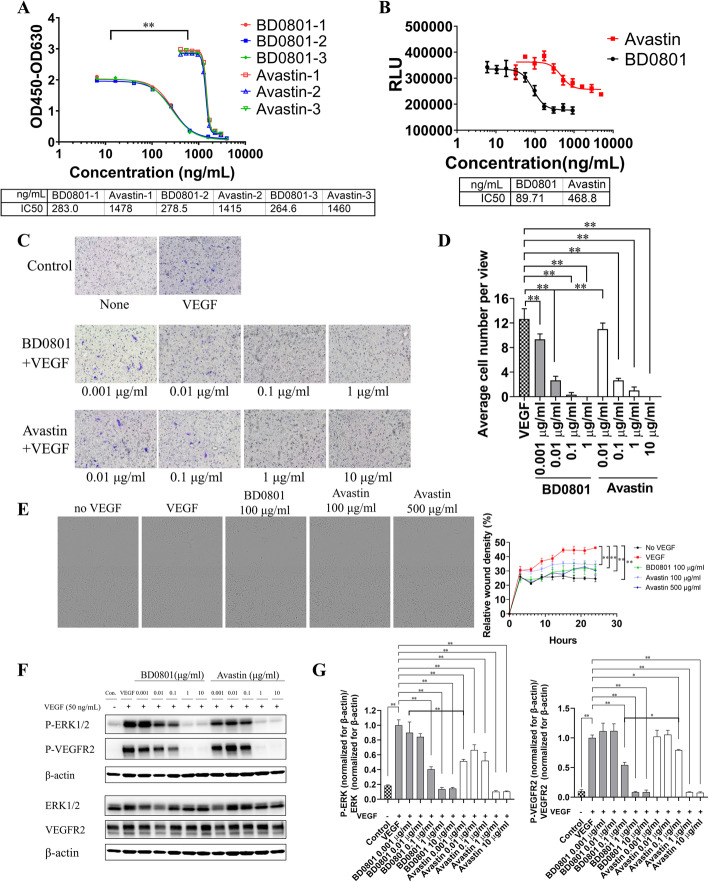
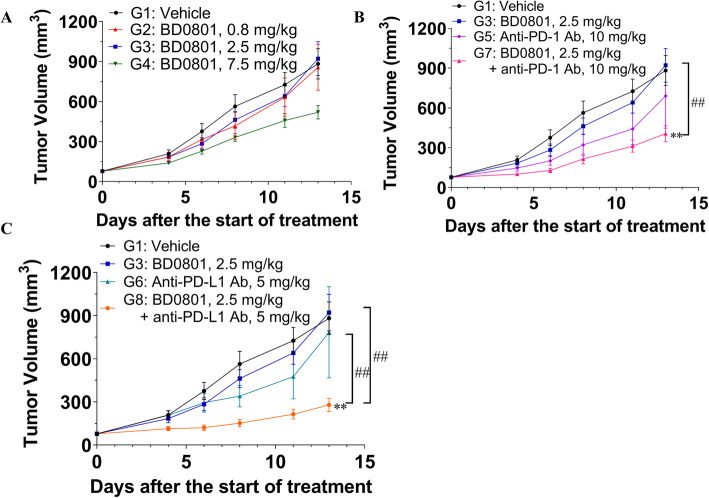
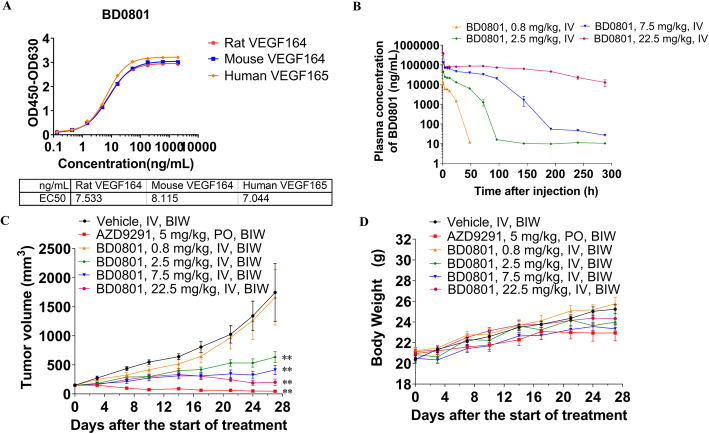
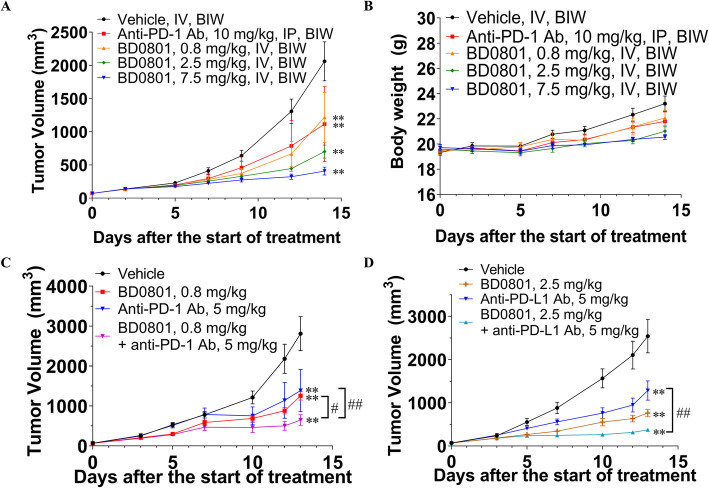
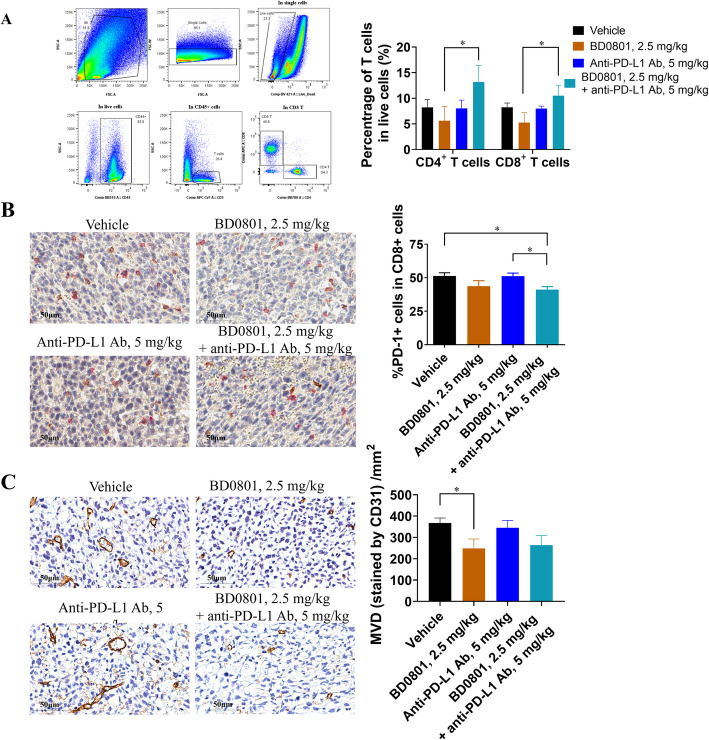
BD0801 showed more potent antitumor activity than bevacizumab, reflected by stronger blockade of VEGF/VEGFR binding and enhanced inhibitory effects on human umbilical vein endothelial cells (HUVECs). BD0801 exhibited dose-dependent tumor growth inhibitory activities in xenograft and murine syngeneic tumor models. Notably, combining BD0801 with either anti-PD-1 or anti-PD-L1 antibodies showed synergistic antitumor efficacy in both lung and colorectal cancer mouse models. Furthermore, the mechanistic studies suggested that the MOA of the antitumor synergy involves improved tumor vasculature normalization and enhanced T-cell mediated immunity, including increased tumor infiltration of CD8 and CD4 T cells and reduced double-positive CD8PD-1 T cells.
These data provide a solid rationale for combining antiangiogenic agents with immunotherapy for cancer treatment and support further clinical development of BD0801 in combination with ICIs.
VEGF/VEGFR 信号通路可诱导癌症血管生成,并影响免疫细胞。最近越来越多的研究集中在将抗 VEGF/VEGFR 药物与免疫检查点抑制剂(ICI)联合用于临床前和临床治疗癌症。BD0801 是一种处于临床开发阶段的人源化兔抗 VEGF 单克隆抗体。
在这项研究中,通过体外检测和体内肿瘤模型评估了 BD0801 的抗癌活性及其与不同免疫疗法联合应用的潜在协同抗肿瘤作用。进行了离体研究以揭示肿瘤微环境修饰的可能作用机制(MOA)。
BD0801 比 bevacizumab 具有更强的抗肿瘤活性,这反映在更强的 VEGF/VEGFR 结合阻断作用和对人脐静脉内皮细胞(HUVEC)的更强抑制作用上。BD0801 在异种移植和小鼠同源肿瘤模型中表现出剂量依赖性的肿瘤生长抑制活性。值得注意的是,BD0801 与抗 PD-1 或抗 PD-L1 抗体联合使用,在肺癌和结直肠癌小鼠模型中均显示出协同抗肿瘤疗效。此外,机制研究表明,抗肿瘤协同作用的作用机制涉及改善肿瘤血管正常化和增强 T 细胞介导的免疫,包括增加肿瘤浸润的 CD8 和 CD4 T 细胞和减少双阳性 CD8PD-1 T 细胞。
这些数据为将抗血管生成药物与免疫疗法联合用于癌症治疗提供了坚实的理论依据,并支持 BD0801 与 ICI 联合进一步临床开发。