ICAP at Columbia University, Columbia University Mailman School of Public Health, New York, New York, USA
Department of Epidemiology, Columbia University Mailman School of Public Health, New York, New York, USA.
BMJ Open. 2021 Oct 22;11(10):e048443. doi: 10.1136/bmjopen-2020-048443.
Isoniazid preventive therapy initiation and completion rates are suboptimal among children. Shorter tuberculosis (TB) preventive treatment (TPT) regimens have demonstrated safety and efficacy in children and may improve adherence but are not widely used in high TB burden countries. Understanding preferences regarding TPT regimens' characteristics and service delivery models is key to designing services to improve TPT initiation and completion rates. We examined paediatric TPT preferences in Eswatini, a high TB burden country.
We conducted a sequential mixed-methods study utilising qualitative methods to inform the design of a discrete choice experiment (DCE) among HIV-positive children, caregivers and healthcare providers (HCP). Drug regimen and service delivery characteristics included pill size and formulation, dosing frequency, medication taste, treatment duration and visit frequency, visit cost, clinic wait time, and clinic operating hours. An unlabelled, binary choice design was used; data were analysed using fixed and mixed effects logistic regression models, with stratified models for children, caregivers and HCP.
The study was conducted in 20 healthcare facilities providing TB/HIV care in Manzini, Eswatini, from November 2018 to December 2019.
Ninety-one stakeholders completed in-depth interviews to inform the DCE design; 150 children 10-14 years, 150 caregivers and 150 HCP completed the DCE.
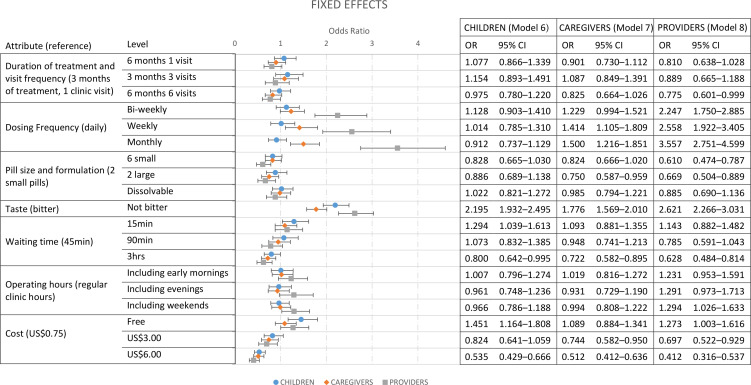
Despite some heterogeneity, the results were fairly consistent among participants, with palatability of medications viewed as the most important TPT attribute; fewer and smaller pills were also preferred. Additionally, shorter waiting times and cost of visit were found to be significant drivers of choices.
Palatable medication, smaller/fewer pills, low visit costs and shorter clinic wait times are important factors when designing TPT services for children and should be considered as new paediatric TPT regimens in Eswatini are rolled out. More research is needed to determine the extent to which preferences drive TPT initiation, adherence and completion rates.
异烟肼预防治疗(IPT)在儿童中的起始率和完成率均不理想。较短的结核病(TB)预防治疗(TPT)方案已在儿童中证明了安全性和有效性,并且可能提高依从性,但在高 TB 负担国家并未广泛使用。了解 TPT 方案特征和服务提供模式的偏好是设计服务以提高 TPT 起始率和完成率的关键。我们在 TB 负担沉重的斯威士兰研究了儿科 TPT 偏好。
我们进行了一项顺序混合方法研究,利用定性方法为艾滋病毒阳性儿童、照顾者和医疗保健提供者(HCP)中的离散选择实验(DCE)设计提供信息。药物方案和服务提供特征包括药丸大小和剂型、给药频率、药物口感、治疗持续时间和就诊频率、就诊费用、诊所等待时间和诊所营业时间。使用无标签、二进制选择设计;使用固定和混合效应逻辑回归模型分析数据,并为儿童、照顾者和 HCP 分层模型。
该研究于 2018 年 11 月至 2019 年 12 月在斯威士兰曼齐尼的 20 个提供结核病/艾滋病毒护理的医疗保健设施中进行。
91 名利益相关者完成了深入访谈,为 DCE 设计提供信息;150 名 10-14 岁儿童、150 名照顾者和 150 名 HCP 完成了 DCE。
尽管存在一些异质性,但结果在参与者中相当一致,药物的可接受性被视为 TPT 的最重要属性;较少和较小的药丸也受到青睐。此外,较短的等待时间和就诊费用被认为是选择的重要驱动因素。
当为儿童设计 TPT 服务时,适口性药物、较小/较少的药丸、较低的就诊费用和较短的诊所等待时间是重要因素,并且应该在推出新的斯威士兰儿科 TPT 方案时考虑这些因素。需要进一步研究以确定偏好在多大程度上驱动 TPT 的起始、依从性和完成率。