Department of Rehabilitation Medicine, Shijiazhuang People's Hospital, Shijiazhuang, Hebei, China (mainland).
School of Nursing and Rehabilitation, North China University of Science and Technology, Tangshan, Hebei, China (mainland).
Med Sci Monit. 2021 Oct 23;27:e931914. doi: 10.12659/MSM.931914.
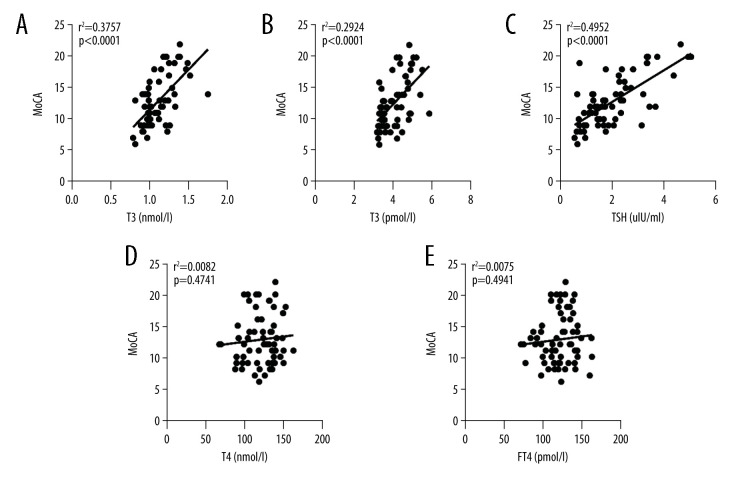
BACKGROUND This single-center study aimed to investigate the effects of repetitive transcranial magnetic stimulation (rTMS) on modulation of thyroid hormone levels and cognition in the recovery stage of patients with cognitive dysfunction following stroke. MATERIAL AND METHODS Seventy post-stroke patients who had cognitive impairment were randomly assigned to either the rTMS group or the control (sham) group. Both groups were administered basic treatment, with the rTMS group receiving rTMS (1 Hz, 90% MT, 1000 pulse/20 min, once a day for 5 days, for a total of 20 times), the stimulation site was the contralateral dorsolateral prefrontal cortex (DLPFC), and the sham group receiving sham stimulation which had the same stimulation parameters and site, except that the coil plane was placed perpendicular to the surface of the scalp. Cognitive function assessment and thyroid function tests were performed before and after 4 weeks of treatment. RESULTS Serum levels of triiodothyronine (T3), free triiodothyronine (FT3), and thyroid stimulating hormone (TSH) showed a positive correlation with Montreal Cognitive Assessment (MoCA) scale score of stroke patients in the recovery phase. The post-treatment change in the scores of MoCA and Modified Barthel Index (MBI) and scores of 3 cognitive domains (visuospatial function, memory, and attention), as well as serum T3, FT3, and TSH levels, were improved more significantly in the rTMS group, and T3 and FT3 levels significantly affected the MoCA scores within the reference range. CONCLUSIONS Serum T3, FT3, and TSH levels of stroke patients in the recovery phase were positively correlated with MoCA score. rTMS increased T3, FT3, and TSH levels and also improved MoCA and MBI of patients in the recovery phase of stroke.
本单中心研究旨在探讨重复经颅磁刺激(rTMS)对中风后认知功能障碍患者恢复期甲状腺激素水平和认知功能的调节作用。
将 70 例伴有认知障碍的中风后患者随机分为 rTMS 组和对照组(假刺激组)。两组均给予基础治疗,rTMS 组给予 rTMS(1 Hz、90% MT、1000 脉冲/20 min、每天 1 次、共 5 天、共 20 次),刺激部位为对侧背外侧前额叶皮质(DLPFC),假刺激组给予相同的刺激参数和部位,但线圈平面与头皮表面垂直。治疗前和治疗 4 周后进行认知功能评估和甲状腺功能检查。
血清三碘甲状腺原氨酸(T3)、游离三碘甲状腺原氨酸(FT3)和促甲状腺激素(TSH)水平与恢复期中风患者蒙特利尔认知评估(MoCA)量表评分呈正相关。rTMS 组治疗后 MoCA 和改良巴氏指数(MBI)评分以及 3 个认知域(视空间功能、记忆和注意力)评分的变化,以及血清 T3、FT3 和 TSH 水平均较对照组改善更明显,T3 和 FT3 水平在参考范围内显著影响 MoCA 评分。
恢复期中风患者血清 T3、FT3 和 TSH 水平与 MoCA 评分呈正相关。rTMS 可提高 T3、FT3 和 TSH 水平,改善中风恢复期患者的 MoCA 和 MBI。