Translational Early Development, Bristol-Myers Squibb Research and Development, 3551 Lawrenceville Road, Princeton, NJ, 08540, USA.
Informatics and Predictive Sciences, Bristol-Myers Squibb Research and Development, Princeton, NJ, USA.
Respir Res. 2021 Oct 24;22(1):273. doi: 10.1186/s12931-021-01860-3.
Idiopathic pulmonary fibrosis (IPF) is a fatal lung disease with a significant unmet medical need. Development of transformational therapies for IPF is challenging in part to due to lack of robust predictive biomarkers of prognosis and treatment response. Importantly, circulating biomarkers of IPF are limited and none are in clinical use.
We previously reported dysregulated pathways and new disease biomarkers in advanced IPF through RNA sequencing of lung tissues from a cohort of transplant-stage IPF patients (n = 36) in comparison to normal healthy donors (n = 19) and patients with acute lung injury (n = 11). Here we performed proteomic profiling of matching plasma samples from these cohorts through the Somascan-1300 SomaLogics platform.
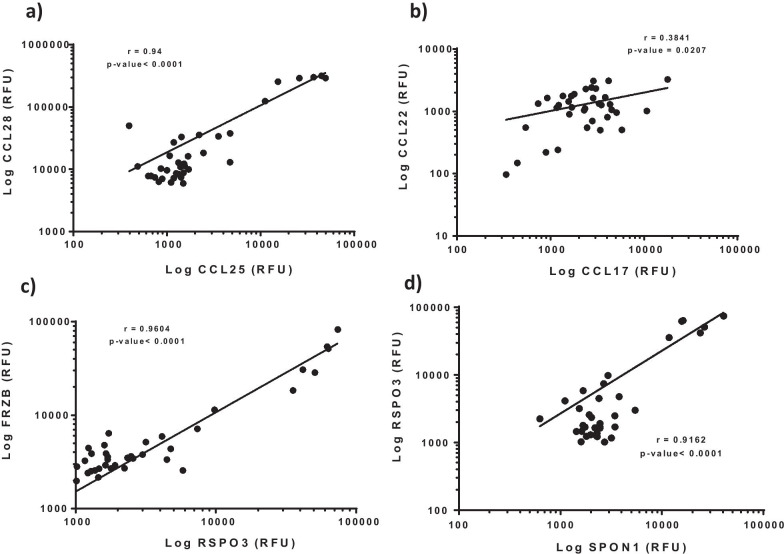
Comparative analyses of lung transcriptomic and plasma proteomic signatures identified a set of 34 differentially expressed analytes (fold change (FC) ≥ ± 1.5, false discovery ratio (FDR) ≤ 0.1) in IPF samples compared to healthy controls. IPF samples showed strong enrichment of chemotaxis, tumor infiltration and mast cell migration pathways and downregulated extracellular matrix (ECM) degradation. Mucosal (CCL25 and CCL28) and Th2 (CCL17 and CCL22) chemokines were markedly upregulated in IPF and highly correlated within the subjects. The mast cell maturation chemokine, CXCL12, was also upregulated in IPF plasma (fold change 1.92, FDR 0.006) and significantly correlated (Pearson r = - 0.38, p = 0.022) to lung function (%predicted FVC), with a concomitant increase in the mast cell Tryptase, TPSB2. Markers of collagen III and VI degradation (C3M and C6M) were significantly downregulated (C3M p < 0.001 and C6M p < 0.0001 IPF vs control) and correlated, Pearson r = 0.77) in advanced IPF consistent with altered ECM homeostasis.
Our study identifies a panel of tissue and circulating biomarkers with clinical utility in IPF that can be validated in future studies across larger cohorts.
特发性肺纤维化(IPF)是一种致命的肺部疾病,存在着巨大的未满足的医疗需求。由于缺乏对预后和治疗反应的强大预测性生物标志物,因此开发变革性的 IPF 疗法具有挑战性。重要的是,目前 IPF 的循环生物标志物有限,且没有一种被用于临床。
我们之前通过对一组处于移植阶段的 IPF 患者(n=36)、正常健康供体(n=19)和急性肺损伤患者(n=11)的肺组织进行 RNA 测序,报告了晚期 IPF 中失调的途径和新的疾病生物标志物。在此,我们通过 Somascan-1300 SomaLogics 平台对这些队列的匹配血浆样本进行了蛋白质组学分析。
肺转录组和血浆蛋白质组特征的比较分析鉴定了一组 34 种在 IPF 样本中与健康对照相比差异表达的分析物(FC≥±1.5,错误发现率(FDR)≤0.1)。与健康对照组相比,IPF 样本显示趋化、肿瘤浸润和肥大细胞迁移途径强烈富集,细胞外基质(ECM)降解下调。粘膜(CCL25 和 CCL28)和 Th2(CCL17 和 CCL22)趋化因子在 IPF 中明显上调,且在受试者中高度相关。肥大细胞成熟趋化因子 CXCL12 在 IPF 血浆中也上调(FC 为 1.92,FDR 为 0.006),并与肺功能(%预测 FVC)显著相关(皮尔逊 r=-0.38,p=0.022),同时伴有肥大细胞胰蛋白酶 TPSB2 增加。III 型和 VI 型胶原降解标志物(C3M 和 C6M)明显下调(IPF 与对照组相比,C3M p<0.001,C6M p<0.0001),且存在相关性(皮尔逊 r=0.77),这与 ECM 稳态的改变一致。
我们的研究确定了一组具有 IPF 临床应用价值的组织和循环生物标志物,这些标志物可以在未来更大队列的研究中得到验证。