Alkhalaf Amina A, Bukhari Raneem A, Alshehri Elham A, Alshehri Samah O, Badr Aisha F
Department of Pharmacy Practice, College of Pharmacy, King Abdulaziz University, Jeddah, KSA.
J Taibah Univ Med Sci. 2021 Jun 3;16(5):700-705. doi: 10.1016/j.jtumed.2021.04.009. eCollection 2021 Oct.
Following the recently conducted local studies on the growing misuse of pregabalin, Pregabalin misuse has received national attention. These studies have led to the authorities restricting the availability of pregabalin to hospital pharmacies alone. While the recent epidemiological studies and case reports found gabapentin to be misused worldwide, it was previously presumed to be free of any abuse potential. This study assesses the likelihood of there being a diversion to Gabapentin abuse following the Pregabalin restriction in Jeddah, KSA.
A cross sectional observational study was conducted between November 2017 and December 2017 using a self-constructed online survey via Twitter and WhatsApp. The survey items included participants' demographics, additional history, Gabapentin for non-medical use (frequency, concurrent use with other drugs, and motivators), and how the participants knew about the Gabapentin misuse. The data was subjected to a descriptive analysis via the utilization of frequencies and percentages. The analysis was carried out by using SPSS V21.
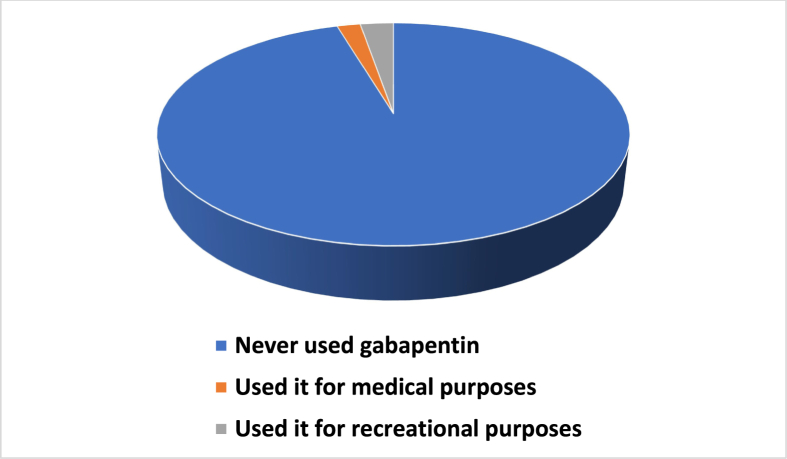
Data of the 370 respondents who took the surveys were collected. Most of the respondents were women (n = 289; 78.1%) and below the age of 30 years (n = 300; 81.1%). A total of 72 respondents (19.5%) had a history of psychoactive drug abuse. Ten of the respondents reported Gabapentin misuse (2.7%). Half of the participants reported prior Pregabalin misuse, and were un-employed. Most of the misusers (n = 8; 80%) came to know about the psychotropic effects of Gabapentin from friends. The most common motives for using it were to 'have fun' and 'peer pressure' (n = 6; 60%). Half of the misusers used Gabapentin on a weekly basis.
The findings of our study suggest a potential diversion from Pregabalin to Gabapentin misuse. Regulations and periodic reviews of the psychoactive prescription medications available in the community pharmacies are essential.
随着近期在当地开展的关于普瑞巴林滥用情况日益增多的研究,普瑞巴林滥用问题已受到国家关注。这些研究促使当局将普瑞巴林的供应限制在仅医院药房。虽然近期的流行病学研究和病例报告发现加巴喷丁在全球范围内存在滥用情况,但此前人们认为它没有任何滥用可能性。本研究评估了沙特阿拉伯吉达市在限制普瑞巴林使用后加巴喷丁被转用于滥用的可能性。
2017年11月至2017年12月期间进行了一项横断面观察性研究,通过推特和WhatsApp使用自行构建的在线调查问卷。调查项目包括参与者的人口统计学信息、用药史、加巴喷丁的非医疗用途(使用频率、与其他药物同时使用情况以及动机),以及参与者了解加巴喷丁滥用情况的途径。通过频率和百分比对数据进行描述性分析。分析使用SPSS V2软件进行。
收集了370名参与调查者的数据。大多数受访者为女性(n = 289;78.1%),年龄在30岁以下(n = 300;81.1%)。共有72名受访者(19.5%)有精神活性药物滥用史。10名受访者报告有加巴喷丁滥用情况(2.7%)。一半的参与者报告曾有普瑞巴林滥用史,且处于失业状态。大多数滥用者(n = 8;80%)是从朋友那里了解到加巴喷丁的精神作用。使用加巴喷丁最常见的动机是“寻求乐趣”和“同伴压力”(n = 6;60%)。一半的滥用者每周使用加巴喷丁。
我们的研究结果表明存在从普瑞巴林转向加巴喷丁滥用的潜在可能性。对社区药房中精神活性处方药进行监管和定期审查至关重要。