Department of Neurology, Union Hospital, Tongji Medical College, Huazhong University of Science and Technology, Wuhan, China.
Front Immunol. 2021 Oct 8;12:719807. doi: 10.3389/fimmu.2021.719807. eCollection 2021.
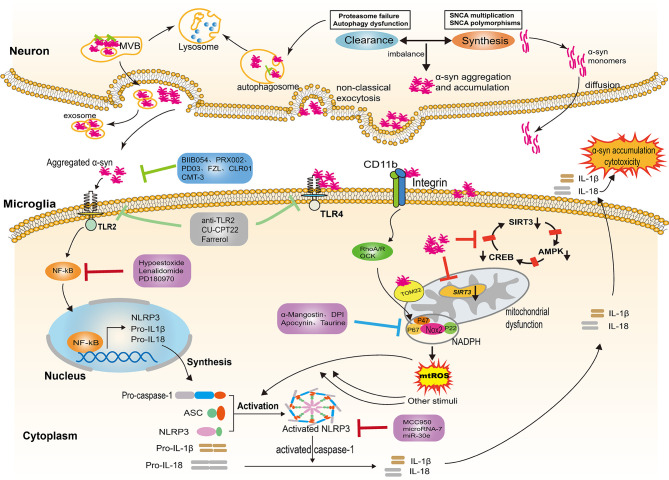
According to emerging studies, the excessive activation of microglia and the subsequent release of pro-inflammatory cytokines play important roles in the pathogenesis and progression of Parkinson's disease (PD). However, the exact mechanisms governing chronic neuroinflammation remain elusive. Findings demonstrate an elevated level of NLRP3 inflammasome in activated microglia in the substantia nigra of PD patients. Activated NLRP3 inflammasome aggravates the pathology and accelerates the progression of neurodegenerative diseases. Abnormal protein aggregation of α-synuclein (α-syn), a pathologically relevant protein of PD, were reported to activate the NLRP3 inflammasome of microglia through interaction with toll-like receptors (TLRs). This eventually releases pro-inflammatory cytokines through the translocation of nuclear factor kappa-B (NF-κB) and causes an impairment of mitochondria, thus damaging the dopaminergic neurons. Currently, therapeutic drugs for PD are primarily aimed at providing relief from its clinical symptoms, and there are no well-established strategies to halt or reverse this disease. In this review, we aimed to update existing knowledge on the role of the α-syn/TLRs/NF-κB/NLRP3 inflammasome axis and microglial activation in PD. In addition, this review summarizes recent progress on the α-syn/TLRs/NF-κB/NLRP3 inflammasome axis of microglia as a potential target for PD treatment by inhibiting microglial activation.
根据新兴研究,小胶质细胞的过度激活以及随后释放的促炎细胞因子在帕金森病(PD)的发病机制和进展中起着重要作用。然而,慢性神经炎症的确切机制仍不清楚。研究结果表明,PD 患者黑质中活化的小胶质细胞中 NLRP3 炎性小体水平升高。活化的 NLRP3 炎性小体加重了病理学并加速了神经退行性疾病的进展。异常聚集的α-突触核蛋白(α-syn)是 PD 的一种与病理学相关的蛋白,据报道,它通过与 Toll 样受体(TLRs)相互作用来激活小胶质细胞的 NLRP3 炎性小体。这最终通过核因子 kappa-B(NF-κB)的易位释放促炎细胞因子,并导致线粒体损伤,从而损害多巴胺能神经元。目前,PD 的治疗药物主要旨在缓解其临床症状,尚无有效的策略来阻止或逆转这种疾病。在这篇综述中,我们旨在更新现有知识,即α-syn/TLRs/NF-κB/NLRP3 炎性小体轴和小胶质细胞激活在 PD 中的作用。此外,该综述还总结了最近关于小胶质细胞中α-syn/TLRs/NF-κB/NLRP3 炎性小体轴作为 PD 治疗靶点的进展,通过抑制小胶质细胞激活来治疗 PD。