Wang Tingting, Wei Dong, Chang Xien, Yu Zhiyong, Zhang Xinyu, Wang Changsui, Hu Yaowu, Fuller Benjamin T
Key Laboratory of Vertebrate Evolution and Human Origins of Chinese Academy of Sciences, Institute of Vertebrate Palaeontology and Palaeoanthropology, Chinese Academy of Sciences, Beijing 100044, China.
Department of Archaeology and Anthropology, University of Chinese Academy of Sciences, Beijing 100049, China.
Natl Sci Rev. 2019 Oct;6(5):1024-1039. doi: 10.1093/nsr/nwx015. Epub 2017 Feb 24.
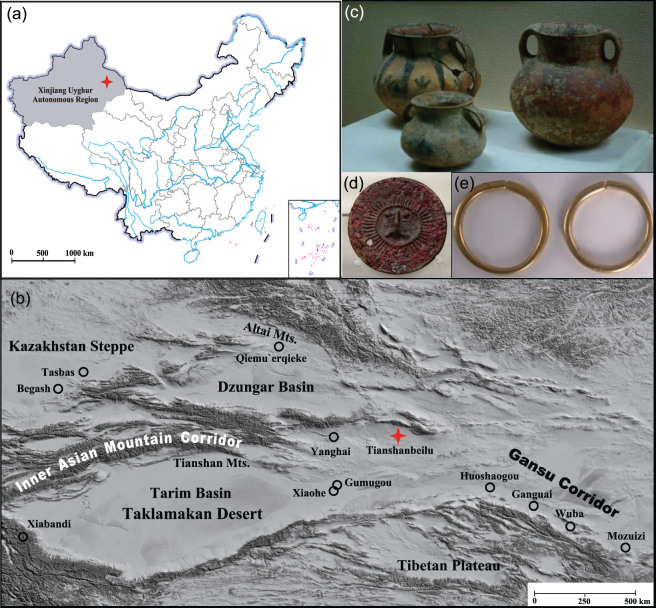
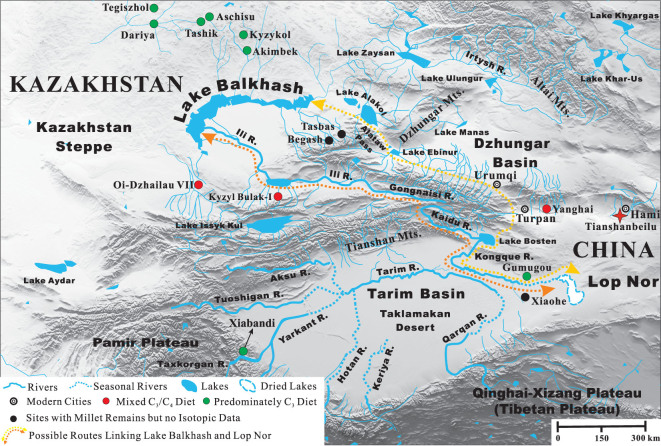
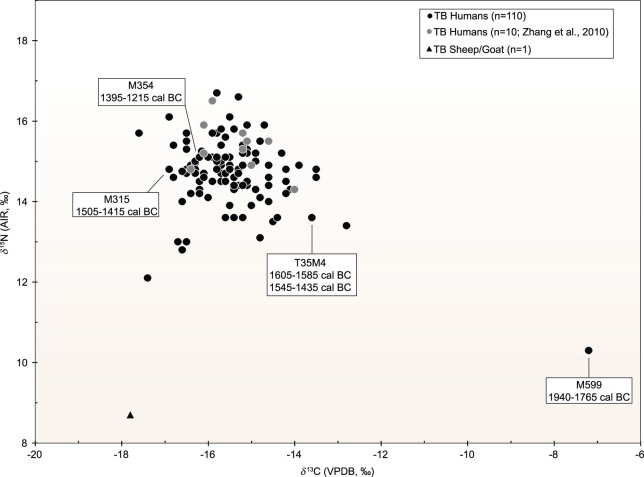
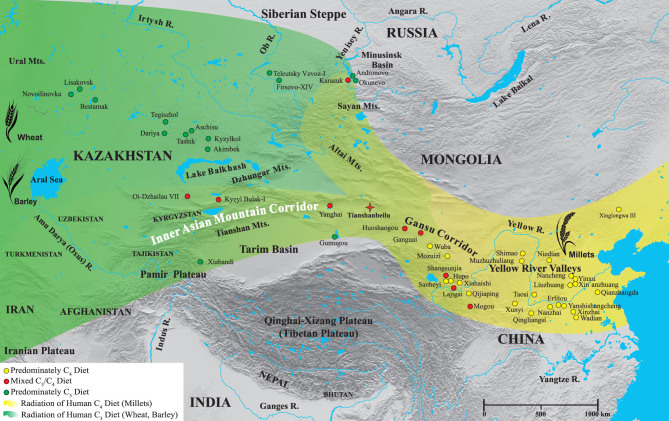
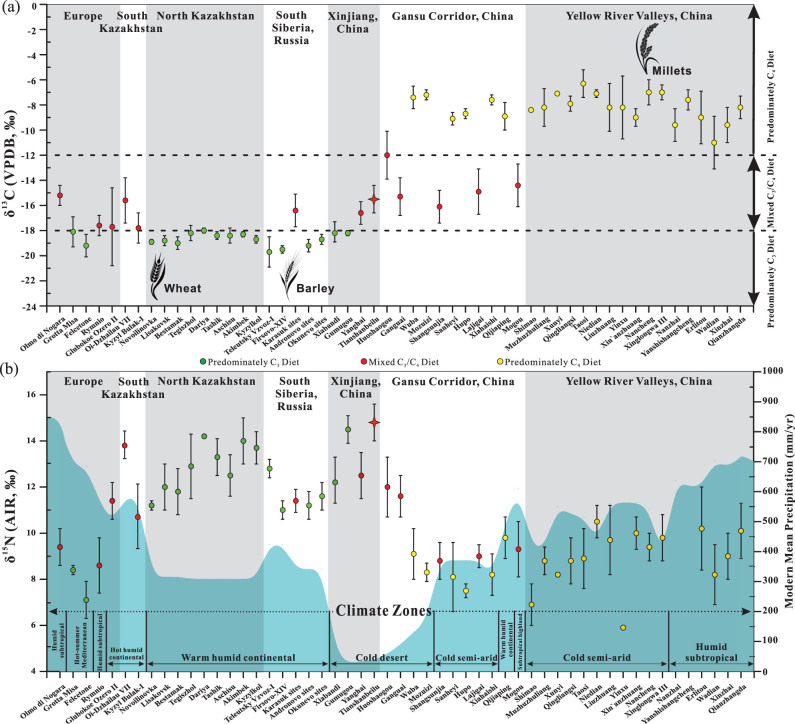
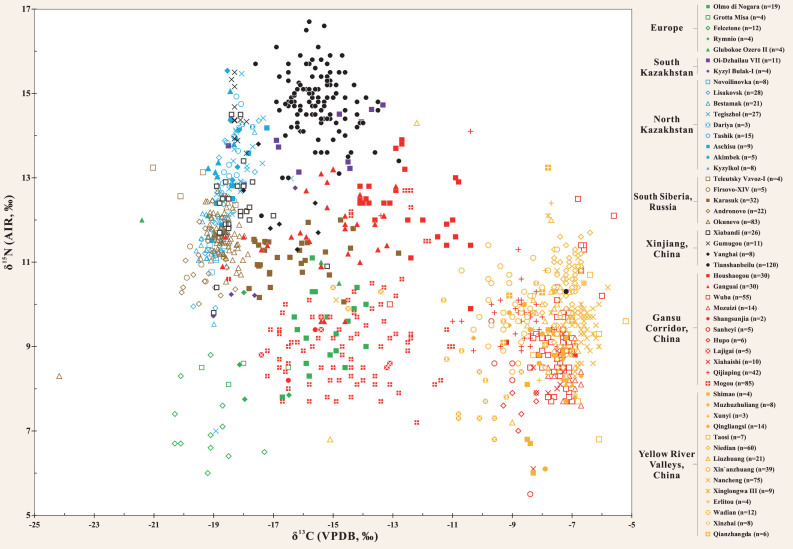
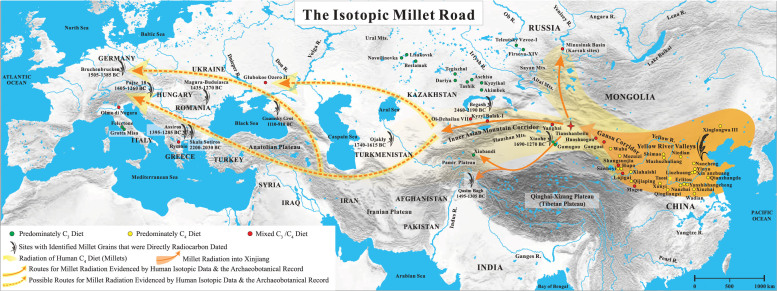
The westward expansion of human millet consumption from north China has important implications for understanding early interactions between the East and West. However, few studies have focused on the Xinjiang Uyghur Autonomous Region, the vast geographical area directly linking the ancient cultures of the Eurasian Steppe and the Gansu Corridor of China. In this study, we present the largest isotopic investigation of Bronze Age China ( = 110) on material from the key site of Tianshanbeilu, in eastern Xinjiang. The large range of δC values (-17.6‰ to -7.2‰; -15.5 ± 1.2‰) provides direct evidence of unique dietary diversity and consumption of significant C resources (millets). The high δN results (10.3‰ to 16.7‰; 14.7 ± 0.8‰) likely reflect sheep/goat and wild game consumption and the arid climate of the Taklamakan Desert. Radiocarbon dates from four individuals indicate Tianshanbeilu was in use between 1940 and 1215 cal bc. The Tianshanbeilu results are then analysed with respect to 52 Bronze Age sites from across Eurasia, to investigate the spread and chronology of significant human millet consumption and human migration. This isotopic survey finds novel evidence that the second millennium bc was a dynamic period, with significant dietary interconnectivity occurring between north China, Central Asia and Siberia. Further, we argue that this 'Isotopic Millet Road' extended all the way to the Mediterranean and Central Europe, and conclude that these C dietary signatures of millet consumption reflect early links (migration and/or resource transfer) between the Bronze Age inhabitants of modern-day China and Europe.
人类粟类消费从中国北方向西扩张,对于理解早期东西方交流具有重要意义。然而,很少有研究关注新疆维吾尔自治区,这片广袤的地理区域直接连接着欧亚草原和中国甘肃走廊的古代文化。在本研究中,我们对来自新疆东部天山北路这一关键遗址的材料进行了中国青铜时代规模最大的同位素调查(样本数量 = 110)。δC值的广泛范围(-17.6‰至-7.2‰;-15.5 ± 1.2‰)为独特的饮食多样性和大量C4资源(粟类)的消费提供了直接证据。高δN结果(10.3‰至16.7‰;14.7 ± 0.8‰)可能反映了绵羊/山羊和野生动物的消费以及塔克拉玛干沙漠的干旱气候。来自四个个体的放射性碳年代测定表明,天山北路在公元前1940年至公元前1215年之间被使用。然后,将天山北路的结果与欧亚大陆各地的52个青铜时代遗址进行分析,以研究人类粟类消费的传播和年代以及人类迁徙情况。这项同位素调查发现了新的证据,即公元前第二个千年是一个动态时期,中国北方、中亚和西伯利亚之间存在显著的饮食相互联系。此外,我们认为这条“同位素粟之路”一直延伸到地中海和中欧,并得出结论,这些粟类消费的C4饮食特征反映了现代中国和欧洲青铜时代居民之间的早期联系(迁徙和/或资源转移)。