Laboratory of Biodiversity and Evolutionary Genomics, Centre for Archaeological Sciences, University of Leuven, Leuven, Belgium.
Institute of Archaeological Science, University of Tübingen and Senckenberg Center for Human Evolution and Palaeoenvironment (HEP), Tübingen Germany.
PLoS One. 2024 Jun 12;19(6):e0301775. doi: 10.1371/journal.pone.0301775. eCollection 2024.
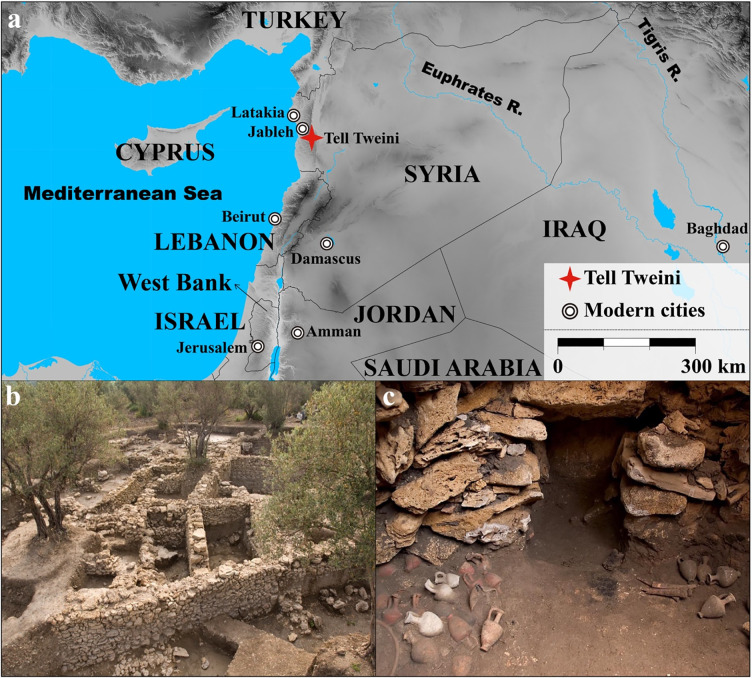
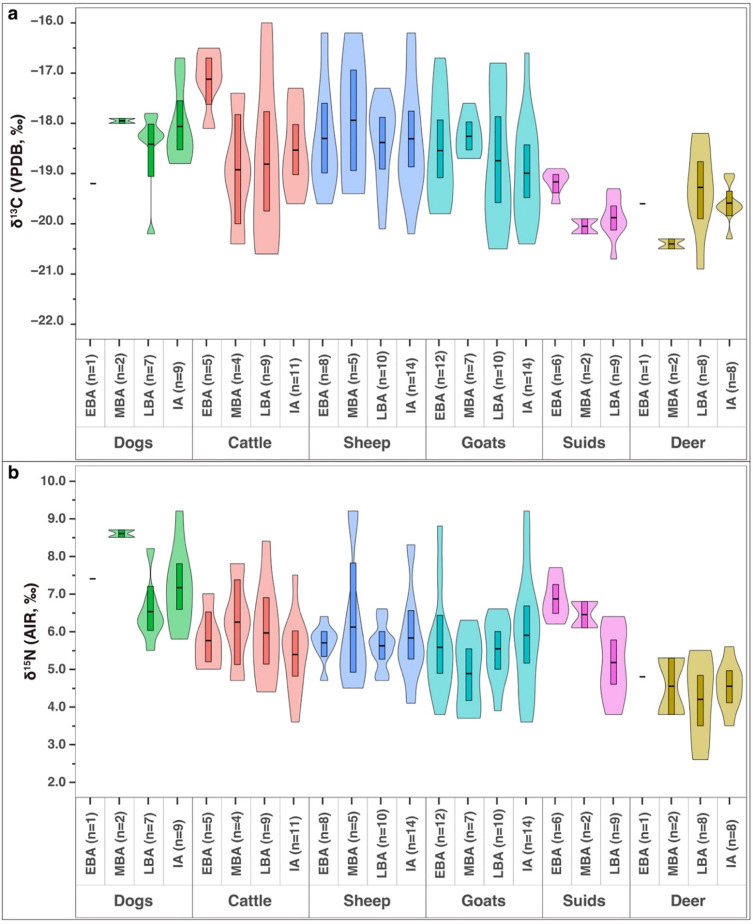
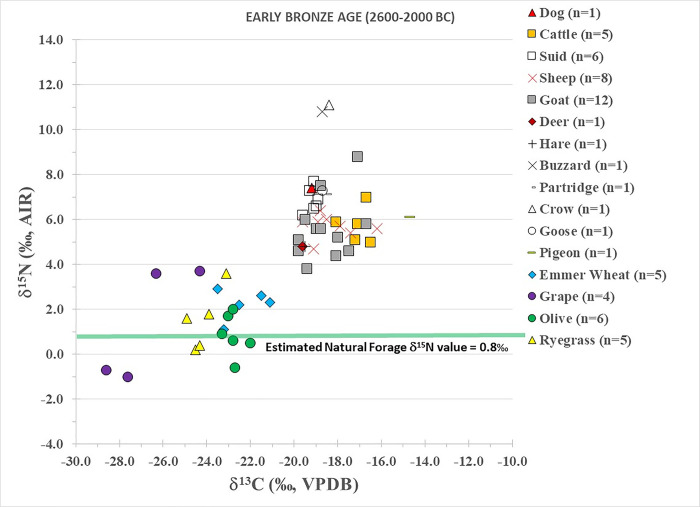
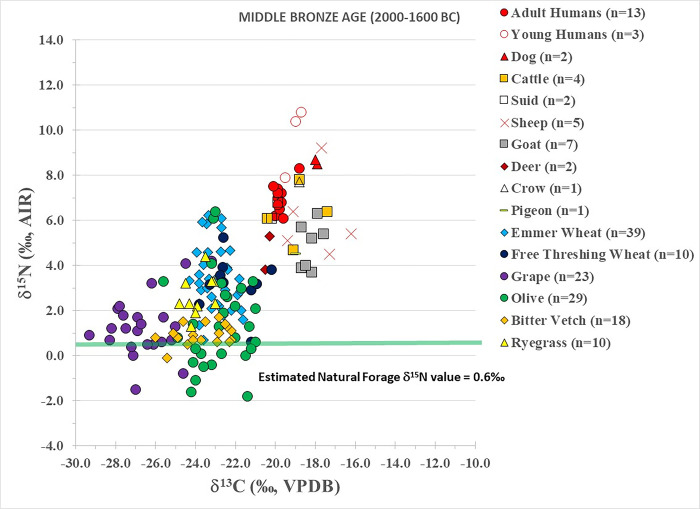
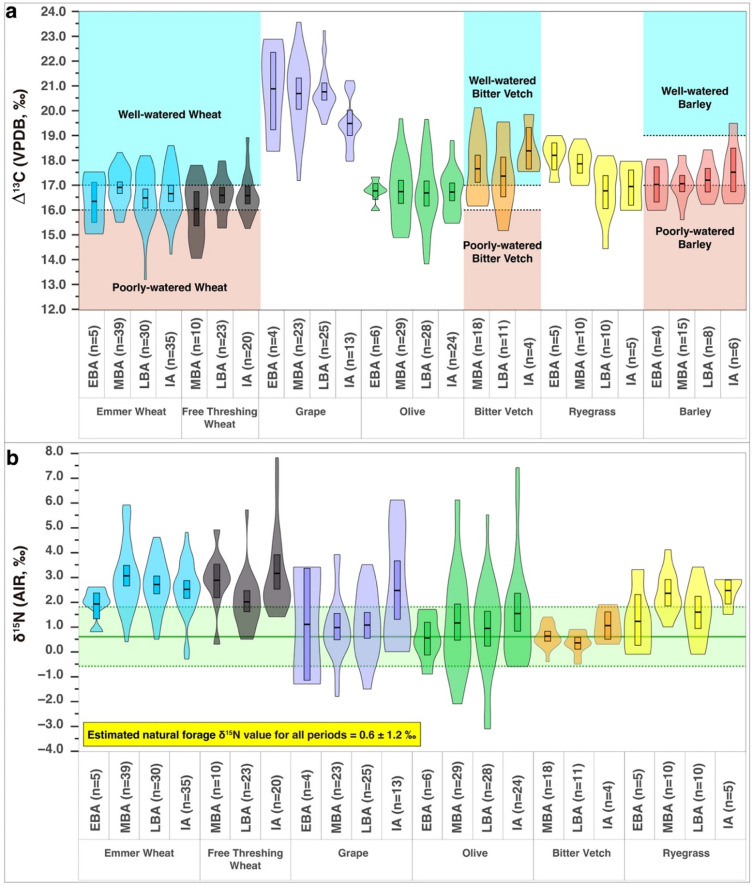
One of the largest isotopic datasets of the ancient Eastern Mediterranean region is evaluated, based on plants (n = 410), animals (n = 210) and humans (n = 16) from Tell Tweini (Syria). Diachronic analysis of plant and faunal specimens from four main periods of occupation: Early Bronze Age (2600-2000 BC), Middle Bronze Age (2000-1600 BC), Late Bronze Age (1600-1200 BC) and Iron Age (1200-333 BC) were investigated. Mean Δ13C results from seven plant species reveal emmer and free threshing wheat, olives, bitter vetch, rye grass and barley were adequately or well-watered during all periods of occupation. The grape Δ13C results suggest excellent growing conditions and particular care for its cultivation. The δ15N results indicate that especially the emmer and free threshing wheats received some manure inputs throughout the occupation sequence, while these were likely further increased during the Iron Age, encompassing also the olive groves and grape vineyards. Generally, domestic animals (cattle, sheep, goats) had C3 terrestrial diets and were kept together in similar environments. However, some animals consumed significant amounts of marine or C4 plants, possibly from disturbed habitats due to land use pressure or salt tolerant grasses and shrubs from wetland environments, which were recorded in the direct vicinity of the site. Middle Bronze Age humans consumed a C3 terrestrial diet with no measurable input from C4, freshwater or marine protein sources. Interestingly, the human diet was relatively low in animal protein and appears comparable to what is considered today a typical Mediterranean diet consisting of bread (wheat/barley), olives, grapes, pulses, dairy products and small amounts of meat. The combined isotopic analysis of plants, animals and humans from Tell Tweini represents unbroken links in the food chain which create unparalleled opportunities to enhance our current understanding of environmental conditions, climate change and lifeways in past populations from the Eastern Mediterranean.
对来自叙利亚 Tell Tweini 的植物(n = 410)、动物(n = 210)和人类(n = 16)样本进行了评估,这是东地中海地区最大的同位素数据集之一。对四个主要居住时期的植物和动物样本进行了历时性分析:早期青铜时代(公元前 2600-2000 年)、中期青铜时代(公元前 2000-1600 年)、晚期青铜时代(公元前 1600-1200 年)和铁器时代(公元前 1200-333 年)。来自七种植物的平均 Δ13C 结果表明,在整个居住时期,皮麦和自由脱粒小麦、橄榄、苦野豌豆、黑麦草和大麦都得到了充分或良好的灌溉。葡萄的 Δ13C 结果表明其生长条件极好,且对其种植特别关注。δ15N 结果表明,尤其是皮麦和自由脱粒小麦在整个居住序列中都得到了一些粪肥投入,而在铁器时代,这些投入可能进一步增加,同时橄榄园和葡萄园也是如此。一般来说,家养动物(牛、绵羊、山羊)的饮食为 C3 陆地食物,且在相似的环境中饲养。然而,一些动物消耗了大量的海洋或 C4 植物,可能是由于土地利用压力导致栖息地受到干扰,或者是由于湿地环境中的耐盐草和灌木,这些在遗址的直接附近都有记录。中期青铜时代人类的饮食为 C3 陆地食物,没有来自 C4、淡水或海洋蛋白质来源的可测量摄入。有趣的是,人类的饮食中动物蛋白含量相对较低,与今天被认为是典型的地中海饮食相似,包括面包(小麦/大麦)、橄榄、葡萄、豆类、奶制品和少量肉类。来自 Tell Tweini 的植物、动物和人类的综合同位素分析代表了食物链中未被打破的联系,这为我们增强对过去东地中海地区人口的环境条件、气候变化和生活方式的理解提供了无与伦比的机会。