Cao Zhimian, Yang Wei, Zhao Yangyang, Guo Xianghui, Yin Zhiqiang, Du Chuanjun, Zhao Huade, Dai Minhan
State Key Laboratory of Marine Environmental Science and College of Ocean and Earth Sciences, Xiamen University, Xiamen 361102, China.
Natl Sci Rev. 2020 Apr;7(4):786-797. doi: 10.1093/nsr/nwz105. Epub 2019 Aug 2.
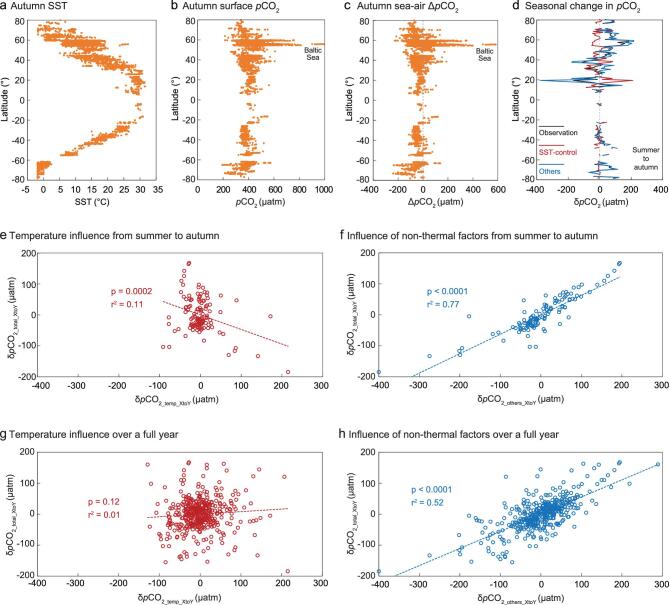
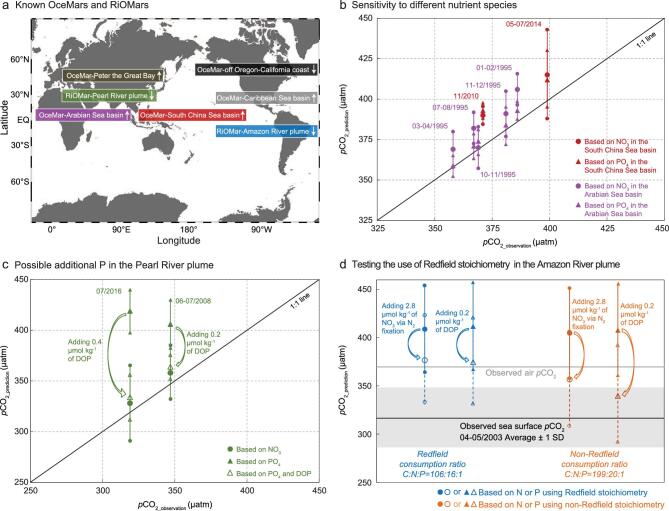
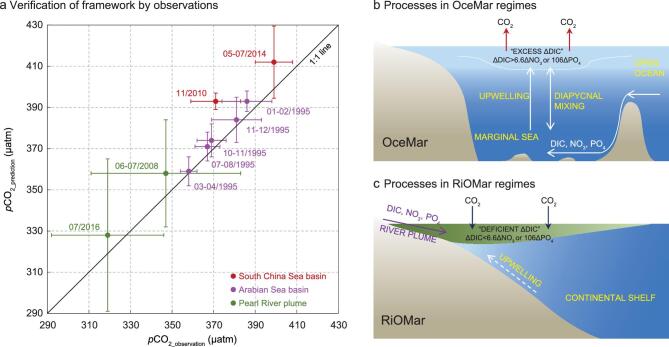
Global coastal oceans as a whole represent an important carbon sink but, due to high spatial-temporal variability, a mechanistic conceptualization of the coastal carbon cycle is still under development, hindering the modelling and inclusion of coastal carbon in Earth System Models. Although temperature is considered an important control of sea surface CO, we show that the latitudinal distribution of global coastal surface CO does not match that of temperature, and its inter-seasonal changes are substantially regulated by non-thermal factors such as water mass mixing and net primary production. These processes operate in both ocean-dominated and river-dominated margins, with carbon and nutrients sourced from the open ocean and land, respectively. These can be conceptualized by a semi-analytical framework that assesses the consumption of dissolved inorganic carbon relative to nutrients, to determine how a coastal system is a CO source or sink. The framework also finds utility in accounting for additional nutrients in organic forms and testing hypotheses such as using Redfield stoichiometry, and is therefore an essential step toward comprehensively understanding and modelling the role of the coastal ocean in the global carbon cycle.
全球沿海海洋总体上是一个重要的碳汇,但由于高度的时空变异性,沿海碳循环的机制概念仍在发展中,这阻碍了在地球系统模型中对沿海碳的建模和纳入。尽管温度被认为是海表二氧化碳的一个重要控制因素,但我们表明,全球沿海表层二氧化碳的纬度分布与温度分布不匹配,其季节间变化主要受诸如水体混合和净初级生产等非热因素的调节。这些过程在以海洋为主和以河流为主的边缘海域都有发生,碳和营养物质分别来自公海和陆地。这些可以通过一个半分析框架来概念化,该框架评估溶解无机碳相对于营养物质的消耗,以确定沿海系统是二氧化碳源还是汇。该框架在考虑有机形式的额外营养物质以及检验诸如使用雷德菲尔德化学计量法等假设方面也很有用,因此是朝着全面理解和模拟沿海海洋在全球碳循环中的作用迈出的重要一步。