Chaudhari Sejal D, Sharma Kapil K, Marchetto John J, Hydren Jay R, Burton Brett M, Moreno Alonso P
OrthodontiCell Inc., Leonhardt Launchpads Utah, Inc., Salt Lake City, UT 84115, United States of America.
John J. Marchetto DMD, Weston, FL 33326, United States of America.
Bone Rep. 2021 Oct 9;15:101141. doi: 10.1016/j.bonr.2021.101141. eCollection 2021 Dec.
Bone remodeling is a lifelong process that ranges from orthodontic tooth movement/alignment to bone damage/healing, to overall bone health. Osteoprotegerin (OPG) and transforming growth factor β1 (TGF-β1) are secreted by osteoblasts and participate in bone remodeling. OPG promotes bone remineralization and stabilization prominent in post-mechanical repositioning of the teeth in the dental alveolus. TGF-β1 participates in regulatory processes to promote osteoblast and osteoclast equilibrium. In the context of orthodontic tooth movement, post-treatment fixation requires additional, exogenous, stabilization support. Recent research showcases supplementary solutions, in conjunction to standard tooth fixation techniques, such as OPG injections into gum and periodontal tissues to accelerate tooth anchorage; however, injections are prone to post-procedure complications and discomfort. This study utilizes noninvasive bioelectric stimulation (BES) to modulate OPG and TGF-β1 as a novel solution to regulate bone remineralization specifically in the context of post-orthodontic tooth movement.
The aim of this study was to investigate a spectrum of BES parameters that would modulate OPG and TGF-β1 expression in osteoblasts.
Osteoblasts were cultured and stimulated using frequencies from 25 Hz to 3 MHz. RT-qPCR was used to quantify changes in OPG and TGFb-1 mRNA expression.
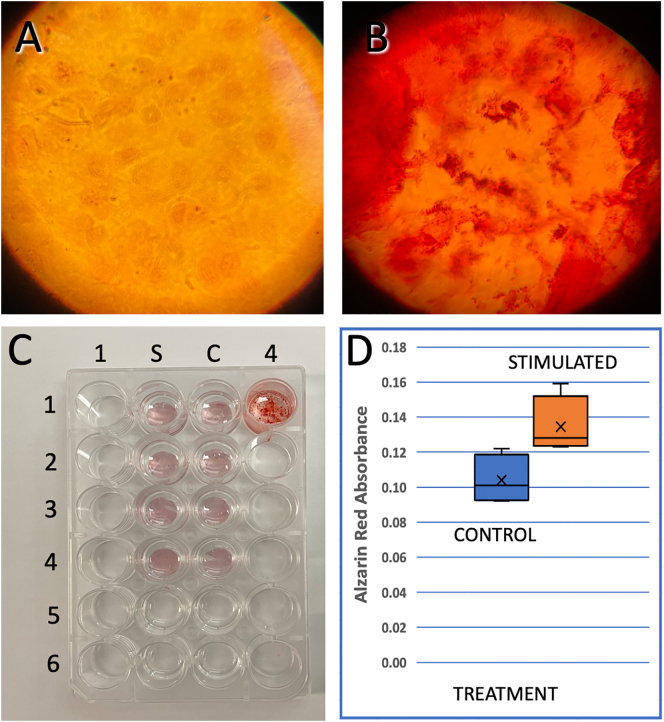
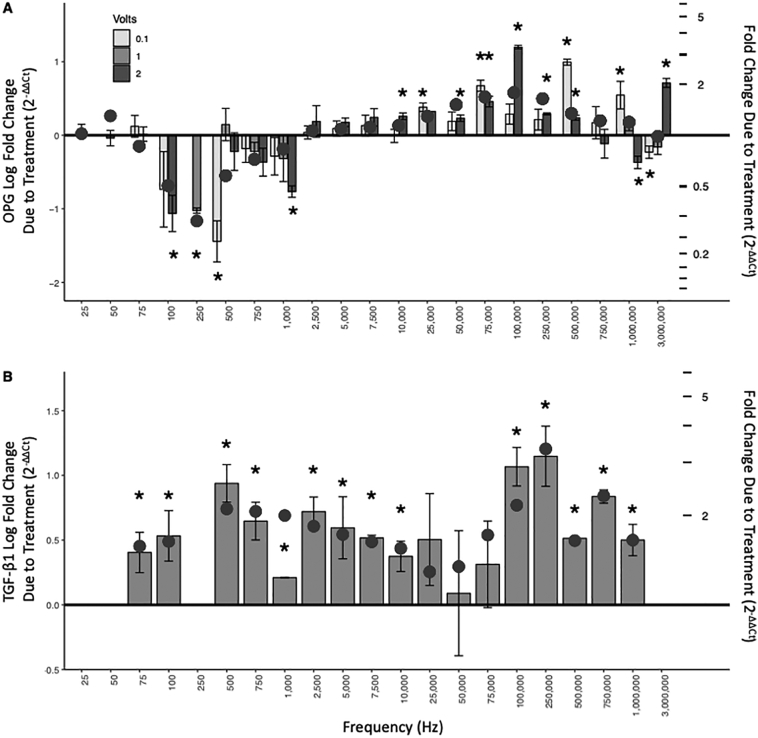
OPG mRNA expression was significantly increased at frequencies above 10,000 Hz with a maximum expression increase of 332 ± 8% at 100 kHz. Conversely, OPG mRNA expression was downregulated at frequencies lower than 1000 Hz. TGF-β1 mRNA expression increased throughout all stimulation frequencies with a peak of 332 ± 72% at 250 kHz. Alizarin Red tests for calcium, indicated that mineralization of stimulated osteoblasts in vitro increased 28% after 6 weeks in culture.
Results support the working hypothesis that OPG and TGF-β1 mRNA expression can be modulated through BES. Noninvasive BES approaches have the potential to accelerate bone remineralization by providing a novel tool to supplement the anchorage process, reduce complications, and promote patient compliance and reduce post-treatment relapse. Noninvasive BES may be applicable to other clinical applications as a novel therapeutic tool to modulate bone remodeling.
骨重塑是一个终身过程,涵盖从正畸牙齿移动/排列到骨损伤/愈合,再到整体骨骼健康。骨保护素(OPG)和转化生长因子β1(TGF-β1)由成骨细胞分泌并参与骨重塑。OPG促进骨再矿化和稳定,这在牙槽骨中牙齿机械复位后尤为突出。TGF-β1参与调节过程以促进成骨细胞和破骨细胞的平衡。在正畸牙齿移动的情况下,治疗后的固定需要额外的、外源性的稳定支持。最近的研究展示了一些补充解决方案,结合标准的牙齿固定技术,如向牙龈和牙周组织注射OPG以加速牙齿锚固;然而,注射容易引发术后并发症和不适。本研究利用非侵入性生物电刺激(BES)来调节OPG和TGF-β1,作为一种专门在正畸牙齿移动后调节骨再矿化的新解决方案。
本研究的目的是研究一系列能够调节成骨细胞中OPG和TGF-β1表达的BES参数。
培养成骨细胞并使用25Hz至3MHz的频率进行刺激。采用逆转录定量聚合酶链反应(RT-qPCR)来量化OPG和TGFb-1 mRNA表达的变化。
在高于10000Hz的频率下,OPG mRNA表达显著增加,在100kHz时表达增加最多,达到332±8%。相反,在低于1000Hz的频率下,OPG mRNA表达下调。TGF-β1 mRNA表达在所有刺激频率下均增加,在250kHz时达到峰值332±72%。茜素红钙检测表明,培养6周后,体外受刺激的成骨细胞矿化增加了28%。
结果支持了工作假设,即OPG和TGF-β1 mRNA表达可通过BES进行调节。非侵入性BES方法有可能通过提供一种新工具来补充锚固过程、减少并发症、促进患者依从性并减少治疗后复发,从而加速骨再矿化。非侵入性BES作为一种调节骨重塑的新型治疗工具,可能适用于其他临床应用。