Watwe Varuna S, Kulkarni Sunil D, Kulkarni Preeti S
Post-graduate and Research Centre, Department of Chemistry, MES Abasaheb Garware College, Pune 411004, India.
Post-graduate and Research Centre, Department of Chemistry, S. P. Mandali's Sir Parashurambhau College, Pune 411030, India.
ACS Omega. 2021 Oct 5;6(41):27288-27296. doi: 10.1021/acsomega.1c04090. eCollection 2021 Oct 19.
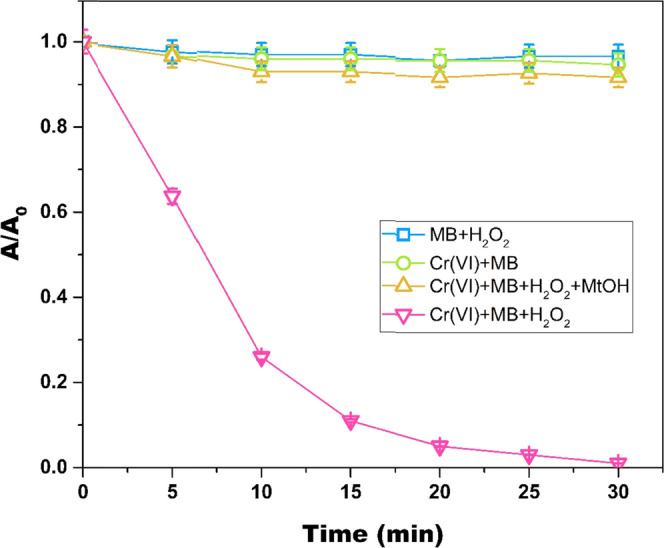
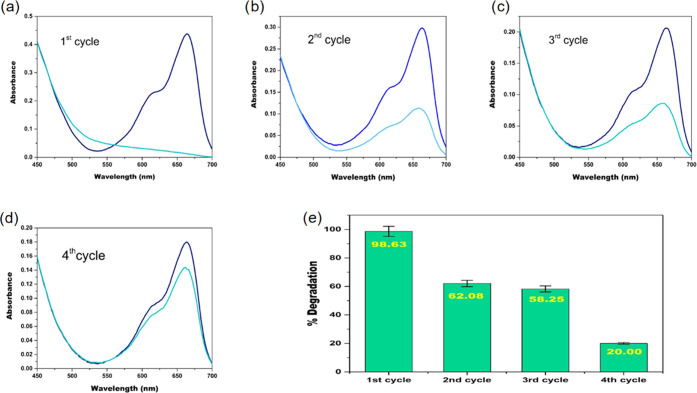
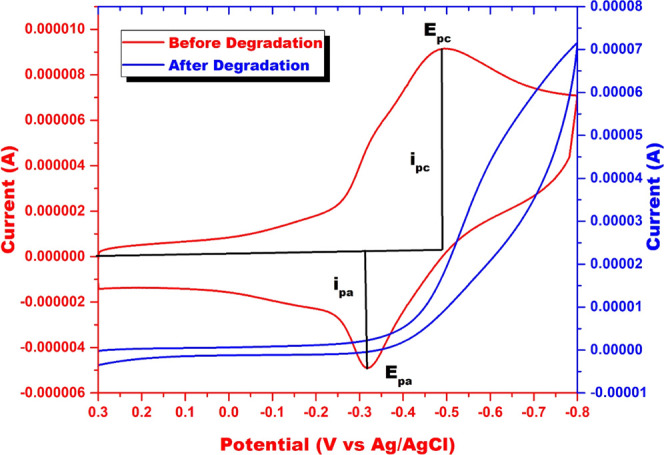
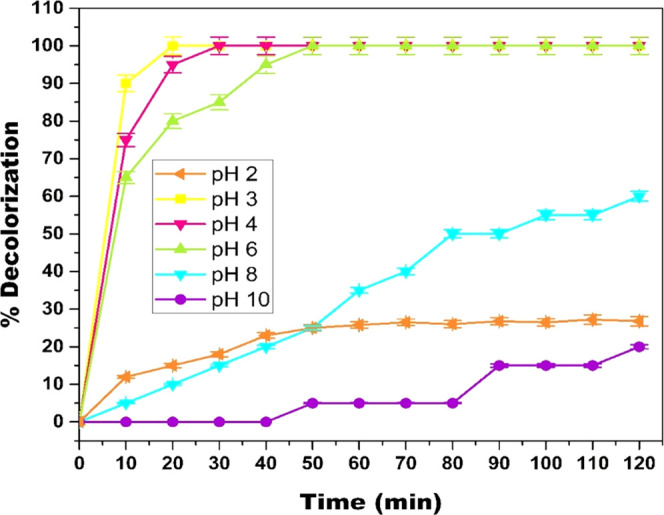
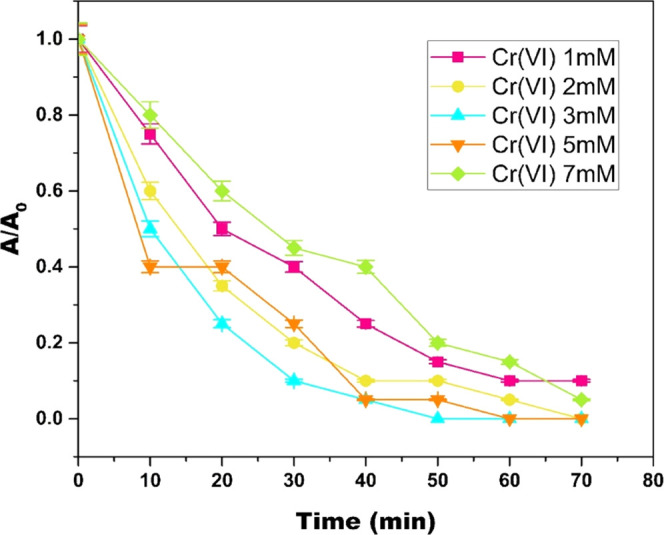
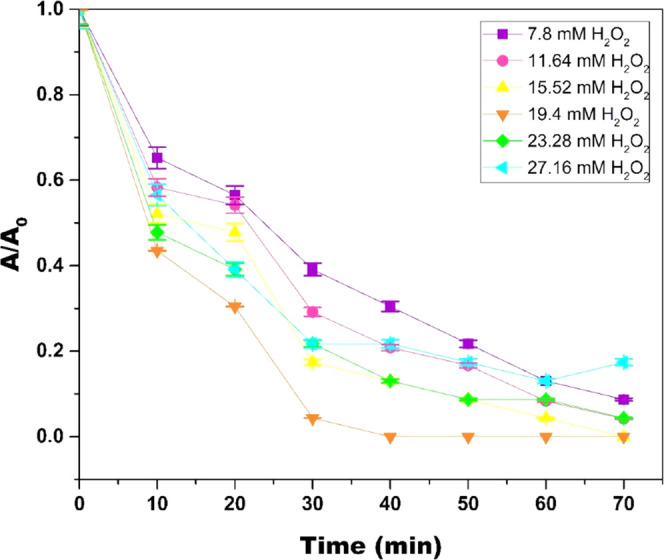
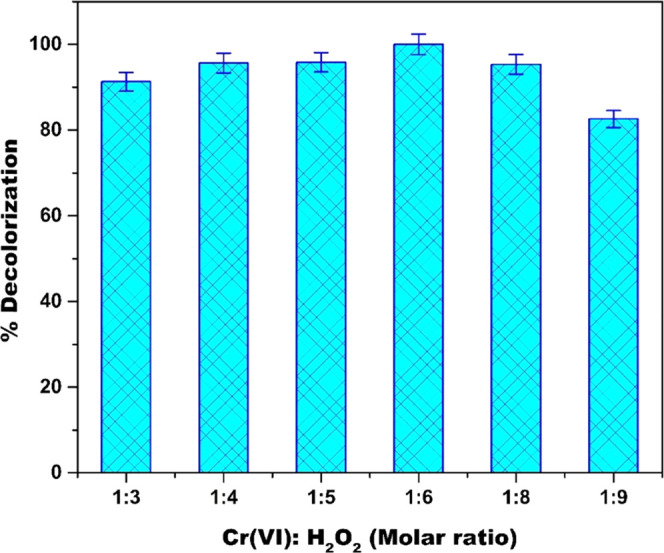
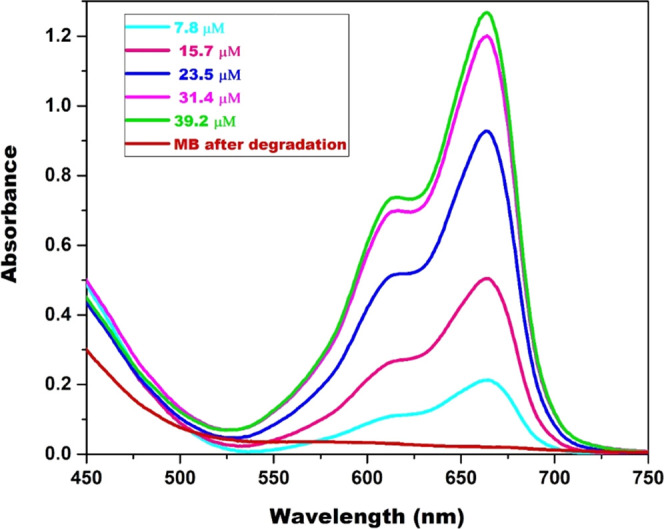
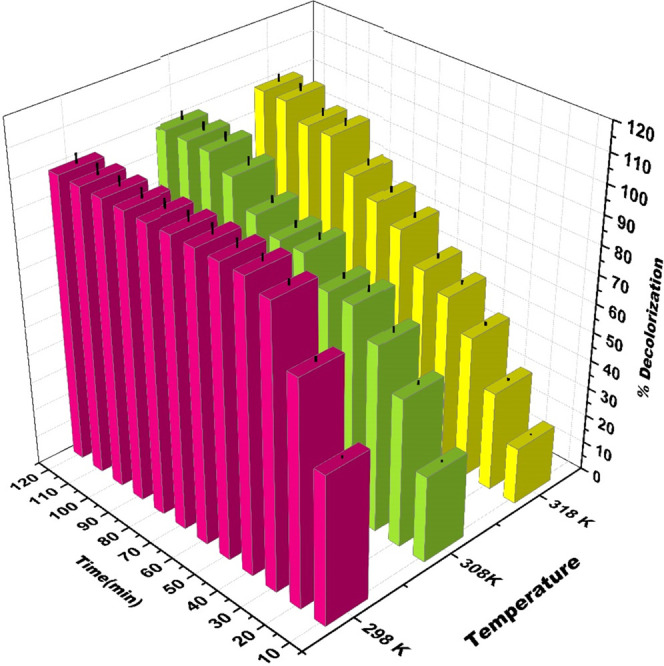
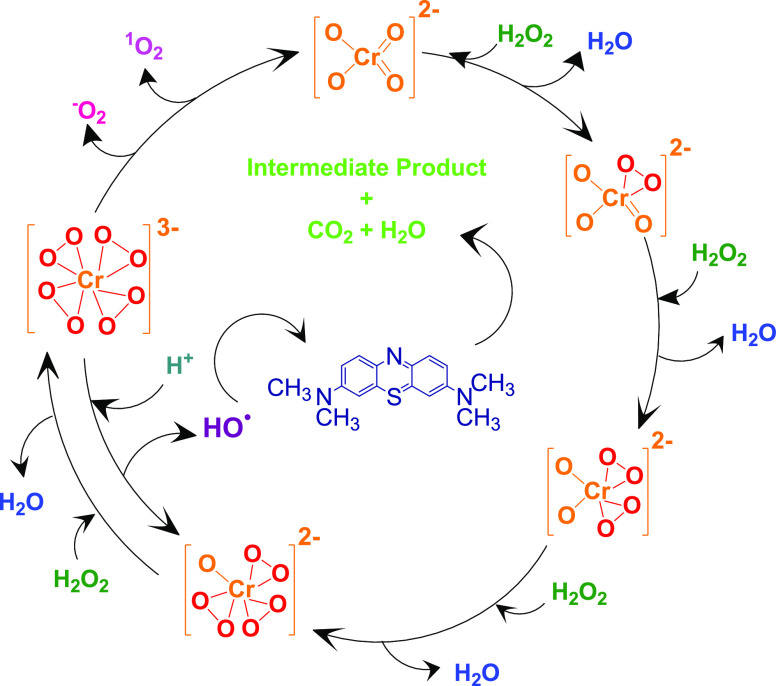
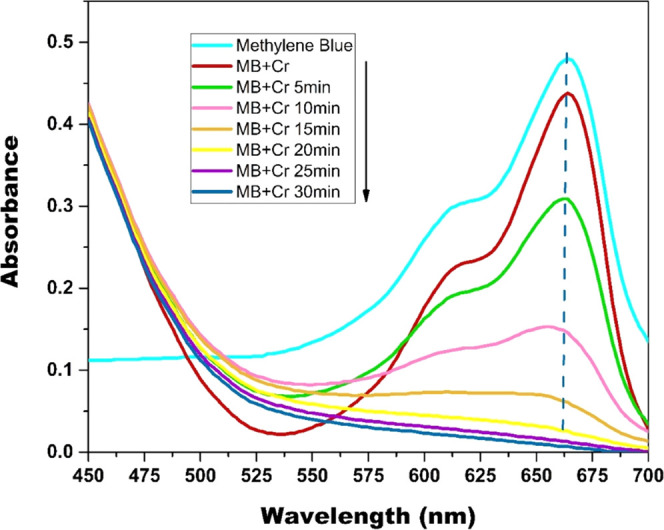
Fe(II)-mediated Fenton process is commonly employed for oxidative degradation of recalcitrant pollutants in wastewater. However, the method suffers from limitations like narrow working pH range and iron sludge formation. The present work deals with the degradation of Methylene Blue (MB) dye using Fenton-like oxidation by replacing Fe(II) with Cr(VI), which eliminates the limitations of classical Fenton oxidation. The Fenton-like oxidation of MB is brought about by HO radicals generated by the disproportionation of chromium-coordinated peroxo complexes. It was observed that the working pH range for the Cr(VI)-mediated Fenton oxidation was 3-10, and no sludge formation takes place up to four cycles as the oxidation remains in the pure solution phase. The complete mineralization of dye was confirmed by observing the decay of MB peaks by a spectrophotometer and cyclic voltammetry. The reaction parameters like pH of the solution, temperature, degradation time, concentrations of HO, Cr(VI), and MB were studied for optimal performance of the Cr(VI) as the catalyst. Kinetic studies revealed that the Cr(VI)-mediated Fenton reaction follows pseudo-first-order reaction kinetics and depends on the concentration of HO radicals. The proposed Cr(VI)-mediated Fenton oxidation in the present work is best suited for the degradation of organic dyes by adding HO as a precursor in chromate-contaminated wastewaters.
亚铁离子(Fe(II))介导的芬顿过程通常用于氧化降解废水中难降解的污染物。然而,该方法存在工作pH范围窄和形成铁污泥等局限性。目前的工作是通过用六价铬(Cr(VI))替代Fe(II),利用类芬顿氧化法降解亚甲基蓝(MB)染料,从而消除了传统芬顿氧化的局限性。MB的类芬顿氧化是由铬配位过氧络合物歧化产生的羟基自由基(HO·)引起的。观察到Cr(VI)介导的芬顿氧化的工作pH范围为3至10,并且由于氧化过程保持在纯溶液相中,在四个循环内均未形成污泥。通过分光光度计和循环伏安法观察MB峰的衰减,证实了染料的完全矿化。研究了溶液pH、温度、降解时间、HO·、Cr(VI)和MB的浓度等反应参数,以优化Cr(VI)作为催化剂的性能。动力学研究表明,Cr(VI)介导的芬顿反应遵循准一级反应动力学,并且取决于HO·自由基的浓度。目前工作中提出的Cr(VI)介导的芬顿氧化最适合通过在铬污染的废水中添加HO·作为前体来降解有机染料。