Verma Ashish, Chitalia Vipul C, Waikar Sushrut S, Kolachalama Vijaya B
Renal Division, Brigham and Women's Hospital, Boston, MA.
Section of Nephrology, Boston University School of Medicine and Boston Medical Center, Boston, MA.
Kidney Med. 2021 Jun 27;3(5):762-767. doi: 10.1016/j.xkme.2021.04.012. eCollection 2021 Sep-Oct.
RATIONALE & OBJECTIVES: Artificial intelligence driven by machine learning algorithms is being increasingly employed for early detection, disease diagnosis, and clinical management. We explored the use of machine learning-driven advancements in kidney research compared with other organ-specific fields.
Cross-sectional bibliometric analysis.
SETTING & PARTICIPANTS: ISI Web of Science database was queried using specific Medical Subject Headings (MeSH) terms about the organ system, journal International Standard Serial Number, and research methodology. In parallel, we screened the National Institutes of Health (NIH) RePORTER website to explore funded grants that proposed the use of machine learning as a methodology.
Number of publications using machine learning as a research method.
Articles were characterized by research methodology among 5 organ systems (brain, heart, kidney, liver, and lung). Grants funded by NIH for machine learning were characterized by study sections.
Percentages of articles using machine learning and other research methodologies were compared among 5 organ systems.
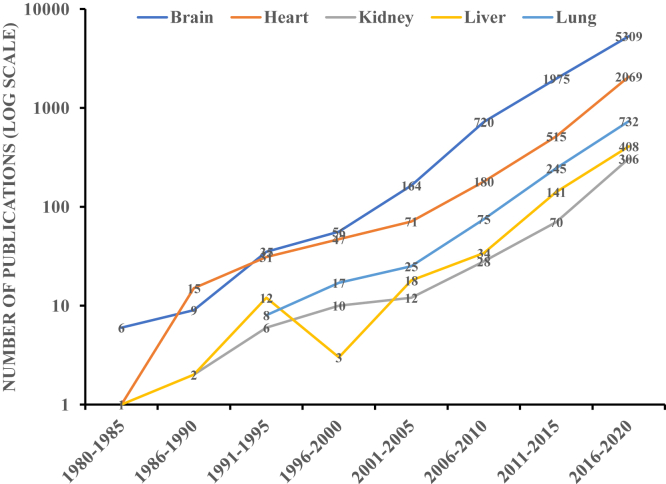
Machine learning-based articles that are focused on the kidney accounted for 3.2% of the total relevant articles from the 5 organ systems. Specifically, brain research published over 19-fold higher number of articles than kidney research. As compared with machine learning, conventional statistical approaches such as the Cox proportional hazard model were used 9-fold higher in articles related to kidney research. In general, a lower utilization of machine learning-based approaches was observed in organ-specific specialty journals than the broad interdisciplinary journals. The digestive disease, kidney, and urology study sections funded 122 applications proposing machine learning-based approaches compared to 265 applications from the neurology, neuropsychology, and neuropathology study sections.
Observational study.
Our analysis suggests lowest use of machine learning as a research tool among kidney researchers compared with other organ-specific researchers, underscoring a need to better inform the kidney research community about this emerging data analytic tool.
由机器学习算法驱动的人工智能正越来越多地用于早期检测、疾病诊断和临床管理。我们探讨了与其他器官特异性领域相比,机器学习驱动的进展在肾脏研究中的应用。
横断面文献计量分析。
使用关于器官系统的特定医学主题词(MeSH)、期刊国际标准连续出版物编号和研究方法,对ISI科学网数据库进行查询。同时,我们筛选了美国国立卫生研究院(NIH)报告者网站,以探索提议使用机器学习作为一种方法的资助项目。
使用机器学习作为研究方法的出版物数量。
文章按5个器官系统(脑、心脏、肾脏、肝脏和肺)的研究方法进行分类。NIH资助的机器学习相关项目按研究科室进行分类。
比较了5个器官系统中使用机器学习和其他研究方法的文章百分比。
专注于肾脏的基于机器学习的文章占5个器官系统相关文章总数的3.2%。具体而言,脑研究发表的文章数量比肾脏研究高出19倍以上。与机器学习相比,传统统计方法如Cox比例风险模型在与肾脏研究相关的文章中的使用频率高出9倍。一般来说,器官特异性专业期刊中基于机器学习方法的利用率低于广泛的跨学科期刊。消化疾病、肾脏和泌尿学研究科室资助了122个提议基于机器学习方法的申请,而神经学、神经心理学和神经病理学研究科室有265个此类申请。
观察性研究。
我们的分析表明,与其他器官特异性研究人员相比,肾脏研究人员将机器学习作为研究工具的使用最少,这突出表明需要让肾脏研究界更好地了解这种新兴的数据分析工具。