
迈向老年护理中的科学证据获取:高效提取变化的面部特征点。
Toward Capturing Scientific Evidence in Elderly Care: Efficient Extraction of Changing Facial Feature Points.
作者信息
Hirayama Kosuke, Chen Sinan, Saiki Sachio, Nakamura Masahide
机构信息
Graduate School of System Informatics, Kobe University, 1-1 Rokkodai-cho, Nada, Kobe 657-8501, Japan.
Department of Data & Innovation, Kochi University of Technology, 185 Miyanigutu, Tosayamada-cho, Kami-shi 782-8502, Japan.
出版信息
Sensors (Basel). 2021 Oct 10;21(20):6726. doi: 10.3390/s21206726.
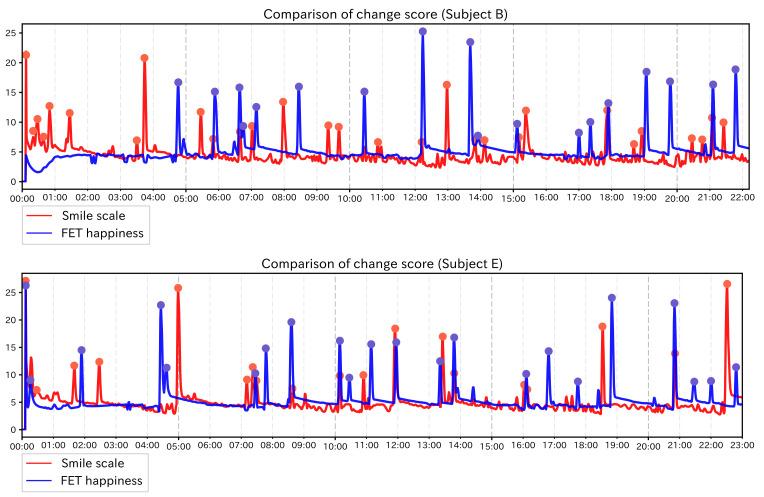
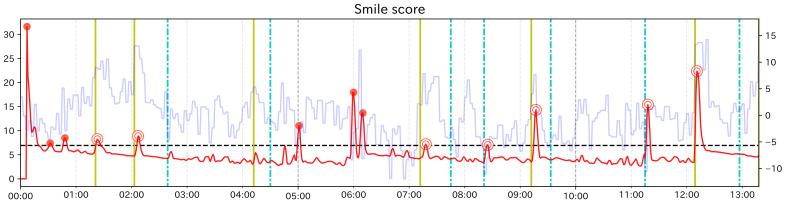
To capture scientific evidence in elderly care, a user-defined facial expression sensing service was proposed in our previous study. Since the time-series data of feature values have been growing at a high rate as the measurement time increases, it may be difficult to find points of interest, especially for detecting changes from the elderly facial expression, such as many elderly people can only be shown in a micro facial expression due to facial wrinkles and aging. The purpose of this paper is to implement a method to efficiently find points of interest (PoI) from the facial feature time-series data of the elderly. In the proposed method, the concept of changing point detection into the analysis of feature values is incorporated by us, to automatically detect big fluctuations or changes in the trend in feature values and detect the moment when the subject's facial expression changed significantly. Our key idea is to introduce the novel concept of composite feature value to achieve higher accuracy and apply change-point detection to it as well as to single feature values. Furthermore, the PoI finding results from the facial feature time-series data of young volunteers and the elderly are analyzed and evaluated. By the experiments, it is found that the proposed method is able to capture the moment of large facial movements even for people with micro facial expressions and obtain information that can be used as a clue to investigate their response to care.
为了获取老年护理中的科学证据,我们在之前的研究中提出了一种用户定义的面部表情传感服务。由于随着测量时间的增加,特征值的时间序列数据增长速度很快,可能难以找到感兴趣的点,特别是对于检测老年人面部表情的变化,例如许多老年人由于面部皱纹和衰老,只能以微表情呈现。本文的目的是实现一种从老年人面部特征时间序列数据中高效找到感兴趣点(PoI)的方法。在所提出的方法中,我们将变化点检测的概念纳入特征值分析中,以自动检测特征值的大幅波动或趋势变化,并检测受试者面部表情显著变化的时刻。我们的关键思想是引入复合特征值的新概念以实现更高的准确性,并将变化点检测应用于复合特征值以及单个特征值。此外,对年轻志愿者和老年人面部特征时间序列数据的PoI查找结果进行了分析和评估。通过实验发现,所提出的方法即使对于具有微表情的人也能够捕捉到面部大动作的时刻,并获得可作为调查他们对护理反应线索的信息。




 Zotero 插件