Lee Hyo Jin, Bae Eunhye, Lee Hong Yeul, Lee Sang-Min, Lee Jinwoo
Division of Pulmonary and Critical Care Medicine, Department of Internal Medicine, Seoul National University Hospital, Seoul, Korea.
Department of Critical Care Medicine, Seoul National University Hospital, Seoul, Korea.
Acute Crit Care. 2021 Nov;36(4):332-341. doi: 10.4266/acc.2021.00556. Epub 2021 Nov 26.
Patients in the intensive care unit (ICU) have increased risks of delirium, which is associated with worse outcomes. As pharmacologic treatments for delirium are ineffective, prevention is important. Nonpharmacologic preventive strategies include exposure to natural light and restoring circadian rhythm. We investigated the effect of exposure to natural light through windows on delirium in the ICU.
This retrospective cohort study assessed all patients admitted to the medical ICU of a university-affiliated hospital between January and June 2020 for eligibility. The ICU included 12 isolation rooms, six with and six without windows. Patients with ICU stays of >48 hours were included and were divided into groups based on their admission to a single room with (window group) or without windows (windowless group). The primary outcome was the cumulative incidence of delirium. The secondary outcomes were the numbers of delirium- and mechanical ventilation-free days, ICU and hospital length of stay, and in-ICU and 28-day mortalities.
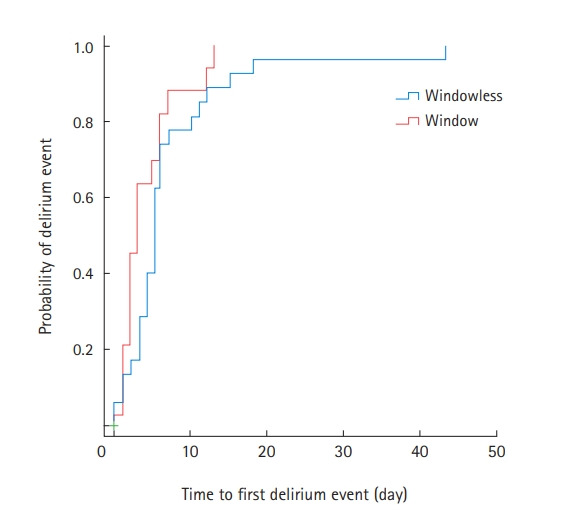
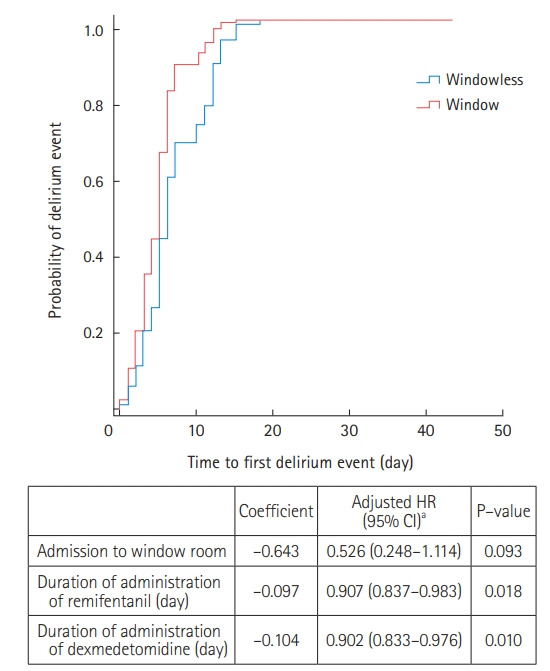
Of the 150 included patients (window group: 83 [55.3%]; windowless group: 67 [44.7%]), the cumulative incidence of delirium was significantly lower in the window group than in the windowless group (21.7% vs. 43.3%; relative risk, 1.996; 95% confidence interval [CI], 1.220-3.265). Other secondary outcomes did not differ between groups. Admission to a room with a window was independently associated with a decreased risk of delirium (adjusted odds ratio, 0.318; 95% CI, 0.125-0.805).
Exposure to natural light through windows was associated with a lower incidence of delirium in the ICU.
重症监护病房(ICU)的患者发生谵妄的风险增加,这与更差的预后相关。由于谵妄的药物治疗无效,预防很重要。非药物预防策略包括暴露于自然光和恢复昼夜节律。我们研究了通过窗户暴露于自然光对ICU患者谵妄的影响。
这项回顾性队列研究评估了2020年1月至6月期间入住一所大学附属医院内科ICU的所有患者是否符合条件。该ICU有12间隔离病房,其中6间有窗户,6间没有窗户。纳入入住ICU超过48小时的患者,并根据他们入住有窗户(开窗组)或无窗户(无窗组)的单人房间进行分组。主要结局是谵妄的累积发生率。次要结局是无谵妄和无机械通气天数、ICU住院时间和住院时间、ICU内及28天死亡率。
在150例纳入患者中(开窗组:83例[55.3%];无窗组:67例[44.7%]),开窗组谵妄的累积发生率显著低于无窗组(21.7%对43.3%;相对风险,1.996;95%置信区间[CI],1.220 - 3.265)。其他次要结局在两组之间没有差异。入住有窗户的房间与谵妄风险降低独立相关(调整后的优势比,0.318;95%CI,0.125 - 0.805)。
通过窗户暴露于自然光与ICU中谵妄的发生率较低相关。