
单链 DNA 结合蛋白影响 APOBEC3A 的底物偏好。
Single-stranded DNA binding proteins influence APOBEC3A substrate preference.
机构信息
School of Molecular Biosciences and Center for Reproductive Biology, Washington State University, Pullman, WA, USA.
出版信息
Sci Rep. 2021 Oct 25;11(1):21008. doi: 10.1038/s41598-021-00435-y.
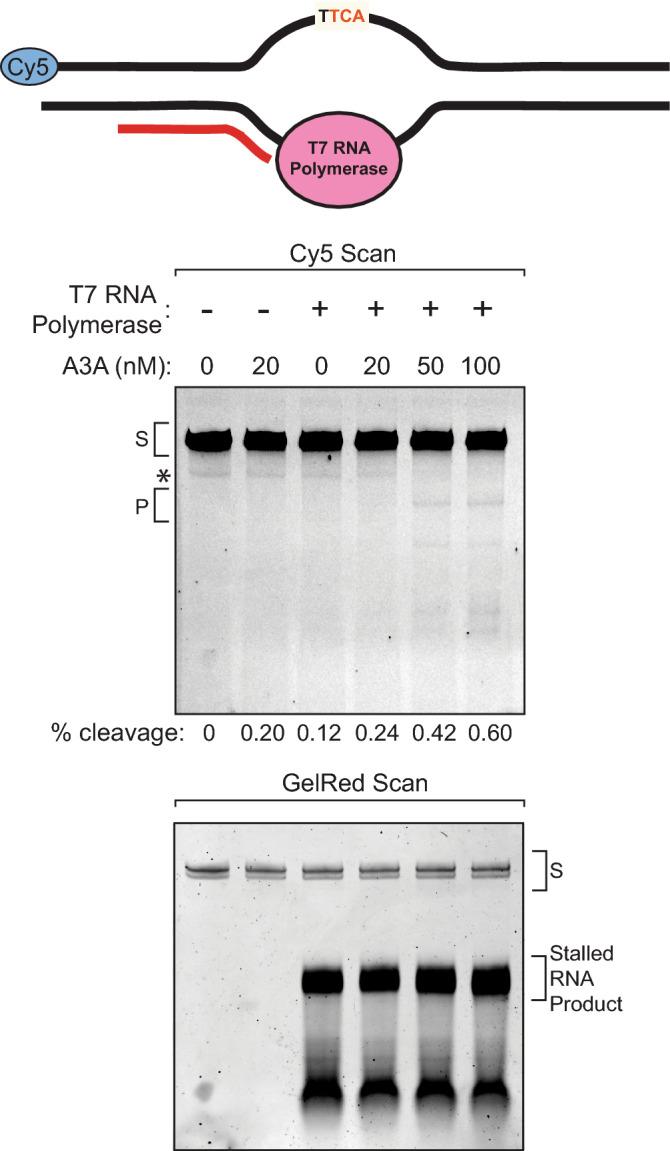
The cytidine deaminase, APOBEC3A (A3A), is a prominent source of mutations in multiple cancer types. These APOBEC-signature mutations are non-uniformly distributed across cancer genomes, associating with single-stranded (ss) DNA formed during DNA replication and hairpin-forming sequences. The biochemical and cellular factors that influence these specificities are unclear. We measured A3A's cytidine deaminase activity in vitro on substrates that model potential sources of ssDNA in the cell and found that A3A is more active on hairpins containing 4 nt ssDNA loops compared to hairpins with larger loops, bubble structures, replication fork mimics, ssDNA gaps, or linear DNA. Despite pre-bent ssDNAs being expected to fit better in the A3A active site, we determined A3A favors a 4 nt hairpin substrate only 2- to fivefold over linear ssDNA substrates. Addition of whole cell lysates or purified RPA to cytidine deaminase assays more severely reduced A3A activity on linear ssDNA (45 nt) compared to hairpin substrates. These results indicate that the large enrichment of A3A-driven mutations in hairpin-forming sequences in tumor genomes is likely driven in part by other proteins that preferentially bind longer ssDNA regions, which limit A3A's access. Furthermore, A3A activity is reduced at ssDNA associated with a stalled T7 RNA polymerase, suggesting that potential protein occlusion by RNA polymerase also limits A3A activity. These results help explain the small transcriptional strand bias for APOBEC mutation signatures in cancer genomes and the general targeting of hairpin-forming sequences in the lagging strand template during DNA replication.
胞苷脱氨酶 APOBEC3A(A3A)是多种癌症类型中突变的主要来源。这些 APOBEC 特征突变在癌症基因组中不均匀分布,与 DNA 复制过程中形成的单链(ss)DNA 和发夹形成序列相关。影响这些特异性的生化和细胞因素尚不清楚。我们在体外测量了 A3A 在模拟细胞中潜在 ssDNA 来源的底物上的胞苷脱氨酶活性,发现与具有较大环、泡状结构、复制叉模拟物、ssDNA 缺口或线性 DNA 的发夹相比,A3A 在含有 4 个核苷酸 ssDNA 环的发夹上更活跃。尽管预弯曲的 ssDNA 预计更适合 A3A 的活性位点,但我们确定 A3A 仅对 4 个核苷酸发夹底物的偏好比线性 ssDNA 底物高 2 到 5 倍。在胞苷脱氨酶测定中添加全细胞裂解物或纯化的 RPA 会更严重地降低 A3A 对线性 ssDNA(45 个核苷酸)的活性,而不是发夹底物。这些结果表明,肿瘤基因组中发夹形成序列中 A3A 驱动突变的大量富集可能部分是由其他优先结合更长 ssDNA 区域的蛋白质驱动的,这限制了 A3A 的进入。此外,A3A 的活性在与停滞 T7 RNA 聚合酶相关的 ssDNA 上降低,表明 RNA 聚合酶引起的潜在蛋白质阻塞也限制了 A3A 的活性。这些结果有助于解释癌症基因组中 APOBEC 突变特征的小转录链偏倚以及 DNA 复制过程中滞后链模板中发夹形成序列的普遍靶向。


 Zotero 插件