Department of Dermatology, Children's Hospital of Soochow University, Suzhou, Jiangsu Province 215025, China.
Biomed Res Int. 2021 Oct 16;2021:7629176. doi: 10.1155/2021/7629176. eCollection 2021.
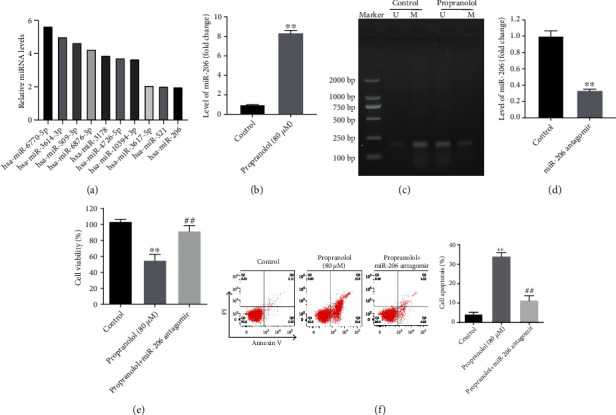
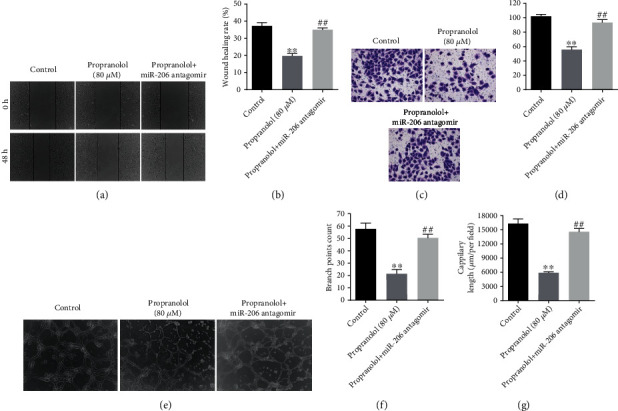
Propranolol has been used in the first-line therapy of infantile hemangioma (IH) for a number of years; however, the mechanisms through which propranolol regulates IH are not yet fully understood. In the present study, microRNA (miRNA/miR) sequencing analysis was performed to identify differentially expressed miRNAs in human umbilical vascular endothelial cells (HUVECs) treated with propranolol. Cell viability and apoptosis were detected using CCK-8 assay and flow cytometry, respectively. Cell migration was assessed using wound healing, Transwell, and tube formation assays. Methylation-specific PCR was then used to investigate the promoter methylation status. The levels of oxidative stress indicators, including superoxide dismutase, glutathione, and malondialdehyde were also detected. Finally, cell cycle analysis was performed using flow cytometry and western blotting. It was observed that propranolol induced the upregulation of miR-206 in HUVECs, which was caused by demethylation of the miR-206 promoter. Moreover, propranolol significantly inhibited the proliferation of HUVECs by inducing apoptosis, while these phenomena were reversed by miR-206 antagomir. VEGFA was found to be a target gene of miR-206. In addition, propranolol notably inhibited the migration and induced G1 arrest of the HUVECs, whereas these results were eliminated by miR-206 antagomir. Collectively, the findings of the present study demonstrated that propranolol may inhibit the proliferation and migration in HUVECs via modulating the miR-206/VEGFA axis. These findings suggest a novel mechanism through which propranolol suppresses the progression of IH.
普萘洛尔(心得安)已在婴幼儿血管瘤(IH)的一线治疗中应用多年,但普萘洛尔调节 IH 的机制尚不完全清楚。本研究通过 microRNA(miRNA/miR)测序分析,鉴定了普萘洛尔处理人脐静脉内皮细胞(HUVEC)中差异表达的 miRNAs。采用 CCK-8 法和流式细胞术分别检测细胞活力和细胞凋亡。采用划痕愈合实验、Transwell 实验和管形成实验评估细胞迁移。然后采用甲基化特异性 PCR 检测启动子甲基化状态。还检测了氧化应激指标的水平,包括超氧化物歧化酶、谷胱甘肽和丙二醛。最后,通过流式细胞术和 Western blot 检测细胞周期。结果发现,普萘洛尔诱导 HUVEC 中 miR-206 的上调,这是由于 miR-206 启动子的去甲基化。此外,普萘洛尔通过诱导细胞凋亡显著抑制 HUVEC 的增殖,而这些现象被 miR-206 拮抗剂逆转。VEGFA 被发现是 miR-206 的靶基因。此外,普萘洛尔显著抑制 HUVEC 的迁移并诱导其 G1 期阻滞,而这些结果被 miR-206 拮抗剂消除。综上所述,本研究结果表明,普萘洛尔可能通过调节 miR-206/VEGFA 轴抑制 HUVEC 的增殖和迁移。这些发现提示了普萘洛尔抑制 IH 进展的新机制。